Speak with an expert today (424) 363-3347(For attorneys only)

“Pink Cocaine” Isn’t Cocaine & is Dangerous

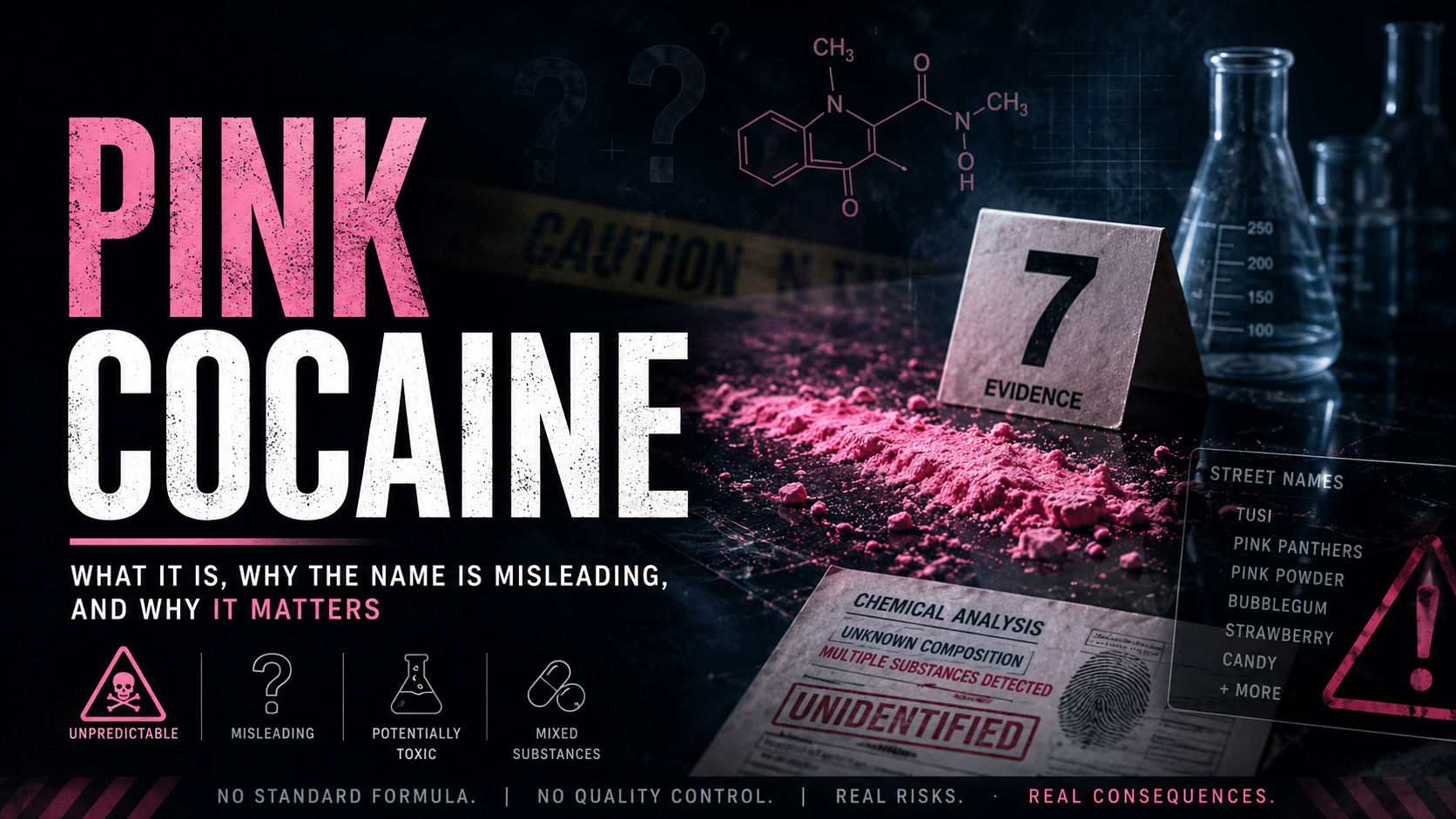
Pink Cocaine Isn’t Cocaine — The Dark Reality of “Tusi”
Forensic Toxicology · Public Health

Pink Cocaine
Isn’t Cocaine

A candy-colored powder is sweeping nightlife from Bogotá to New York. Almost nothing about it is what the name promises.

By The Desk Long read · 7 min Updated 2026

A pink, sweet-smelling powder has been turning up in nightclubs from Bogotá to Berlin to New York, often under the name “pink cocaine.” Celebrity headlines and seizure reports have made it sound like a glamorous new designer drug. The reality is far less tidy — and considerably more dangerous.

Despite the name, pink cocaine usually contains no cocaine at all. And despite its other common name, “tusi,” it almost never contains the psychedelic it was named after. Here is what the peer-reviewed and forensic literature published over the past few years actually shows.

01 — OriginA name designed to mislead

“Tusi” (also spelled tuci, tussi, tucibí, or tusibí) is a phonetic translation of “2C” — shorthand for a family of psychedelic phenethylamines first synthesized by chemist Alexander Shulgin in the 1970s and 1980s. The best known, 2C-B, produces euphoria, mild stimulation, and perceptual changes often compared to a blend of LSD and MDMA. In Colombia around 2012, genuine 2C-B became fashionable among an affluent clientele — but real supply was limited and expensive.

That gap in the market is where pink cocaine was born. Sellers began combining cheaper, more available drugs with bright pink food coloring and a sweet, fruity scent, then marketing the result under the 2C-B name. The hue masked the bitter taste and made the product instantly recognizable. From there it spread across South America and into Europe, North America, and Australia.

The branding is the danger. The powder is usually neither cocaine nor 2C-B — and each batch is a gamble.

02 — CompositionSo what is actually in it?

Drug-checking programs across multiple countries have converged on the same answer: pink cocaine is typically a mixture built around ketamine, a dissociative anesthetic, combined with MDMA (ecstasy). Genuine 2C-B is rarely present, and actual cocaine appears in only a minority of samples.

Erowid DrugsData.org · 68 samples labeled “pink cocaine,” “tusi,” or “2C-B” (2016–2024)
94%
contained ketamine
81%
contained MDMA
In a closer look at recent samples, ketamine made up roughly 40–90% of each one.

// substances detected across seized & tested batches

KetamineMDMACocaineMethamphetamineMDAAmphetaminesSynthetic cathinonesCaffeineOxycodoneAlprazolamLidocaineEutylone2C-B (rare)

Crucially, there is no stable recipe. The specific drugs and their proportions vary from batch to batch, and laboratory monitoring in Spain shows ketamine concentrations climbing over time — meaning the dissociative effects, and the associated risks, are getting stronger. As a 2024 editorial in the Journal of Medicinal Chemistry put it, the primary danger of pink cocaine lies in the unknown.

03 — ReachHow widespread is it?

For years, hard data were scarce because most surveys never asked about “tusi” or “pink cocaine” by name. The first U.S. study to measure it directly surveyed 1,465 adults entering electronic dance music nightclubs in New York City in 2024.

NYC nightclub-attending population · past-year use, 2024
2.7%
used tusi in the past year
~5.6%
among Hispanic respondents
Use tracked closely with MDMA, ketamine, and 2C-series use.

That study also revealed how badly self-report alone captures the picture. Saliva testing frequently came back positive for cocaine, ketamine, MDMA, methamphetamine, or synthetic cathinones — including drugs participants hadn’t reported. More than 40% of people who reported tusi use did not report any ketamine use, even though ketamine is the drug’s most consistent ingredient. Many users simply do not know what they are taking. Supply-side signals point the same way: a 10-pound seizure in New York City in January 2023, and 140 pounds intercepted off the California coast that June.

04 — HarmThe health risks

Because pink cocaine is a polysubstance mixture, its harms come less from any single ingredient than from the unpredictable interaction of several. Combining stimulants with a dissociative can produce an intense high — but also dizziness, confusion, hallucinations, vomiting, loss of reflexes, dangerously high body temperature, breathing problems, and cardiac failure. The candy-like presentation may falsely signal safety.

A medical examiner’s ledger

A Miami-Dade case series documented eight fatalities involving colored “tusi” powders. Of fourteen powders analyzed, ketamine was present in every one; none contained 2C-B.

The fentanyl gap

In some cases, decedents had high fentanyl levels in their blood that were not found in the powder at the scene — a warning that tusi users may be exposed to fentanyl from elsewhere, with fatal results.

Acute kidney injury

Spanish clinicians have reported young men developing rhabdomyolysis and kidney failure after tusi use — in at least one case severe enough to require dialysis.

Ketamine’s own toll

With concentrations rising, frequent users face ketamine’s documented risks: dependence and bladder and urinary-tract damage — harms many never anticipate, because they don’t realize ketamine is the main ingredient.

A particularly insidious problem: someone expecting a mild 2C-B psychedelic, or a familiar cocaine stimulant, may instead be hit with a heavy dissociative dose plus a stimulant cocktail. The mismatch between expectation and reality is itself a source of danger.

05 — ResponseWhy it’s so hard to track

Pink cocaine breaks the usual mold. Most new psychoactive substances are novel compounds. Tusi is novel in a different way: it’s a combination of existing drugs sold under a misleading brand. That confounds surveillance systems built to track individual substances — overdose statistics record the specific drugs detected, not the “tusi” product, so the trend hides in plain sight. Researchers point to several fixes:

  • A.Standardized survey language that explicitly describes tusi and distinguishes it from both 2C-B and cocaine, paired with biological testing.
  • B.Expanded drug-checking services that quantify how much of each substance is present — following programs like Colombia’s Échele Cabeza and Spain’s Energy Control.
  • C.Better precursor and supply monitoring plus international data sharing.
  • D.Public education with one blunt, repeatable message: pink cocaine is not cocaine, and it is not 2C-B.
The Bottom Line

The people most at risk are often those most confident they know what they’re buying. With pink cocaine, the only consistent ingredient is uncertainty.

This is a general-interest summary of published research and is not medical advice. If you or someone you know is struggling with substance use, a qualified healthcare provider or local support service can help.

Sources
  1. Abukahok N, Fitzgerald ND, Palamar JJ. “An Update on the Epidemiology of Tusi (‘Pink Cocaine’).” Current Addiction Reports. 2025;12:90.
  2. Palamar JJ, Abukahok N, Acosta P, et al. “Tusi use among the New York City nightclub-attending population.” Addiction. 2025;120(8):1646–1654.
  3. Moore DM, Giachetti AD, Zaney ME, et al. “Tusi but not 2C: A Miami-Dade medical examiner case series.” Journal of Forensic Sciences. 2025;70(3):1208–1216.
  4. “What Is Pink Cocaine? The Dark Reality behind a Colorful Name.” Editorial, Journal of Medicinal Chemistry. 2024;67:20733–20736.
  5. Palamar JJ. “Tusi: a new ketamine concoction complicating the drug landscape.” American Journal of Drug and Alcohol Abuse. 2023;49(5):546–550.
  6. Peña-Esparragoza JK, Fernández Á, de Lorenzo Álvarez A, et al. “‘Pink cocaine’ (tusi): a new cause of acute kidney injury?” Abstract, Nephrology Dialysis Transplantation. 2025.
Spread the love


The National Black Lawyers

top 40 lawyers

civil trial law

Lawyers of Distinction

Loading...

Recent Blog Articles

“Pink Cocaine” Isn’t Cocaine & is Dangerous

Pink Cocaine Isn’t Cocaine — The Dark Reality of “Tusi” Forensic Toxicology · Public Health Pink CocaineIsn’t Cocaine A candy-colored powder is sweeping nightlife from Bogotá to New York. Almost nothing about it is what the name promises. By The Desk Long read · 7 min Updated 2026 A pink,…

Spread the love

Read More

Ninth Circuit Rulings Cause Open-Carry Law Confusion

Open Carry in California: Why the Headlines Outran the Law The Okorocha Firm Notes on California Law Second Amendment · Status Update Open Carry in California: Why the Headlines Outran the Law A Ninth Circuit panel struck down the urban open-carry ban in January. The full court has since voted…

Spread the love

Read More

California’s Age-Appropriate Design Code Act Decision

Half a Loaf for California’s Kids-Online Law The Okorocha Firm Notes on California Law Technology · Children Online Half a Loaf for California’s Kids-Online Law On its second look at the Age-Appropriate Design Code, the Ninth Circuit put the age-estimation rule back in play while keeping the data-use and “dark…

Spread the love

Read More

Speak with an expert today!

Contact the offices of Okorie Okorocha for professional and reliable advice which you can trust.

Call (424) 283-0029 Contact Us