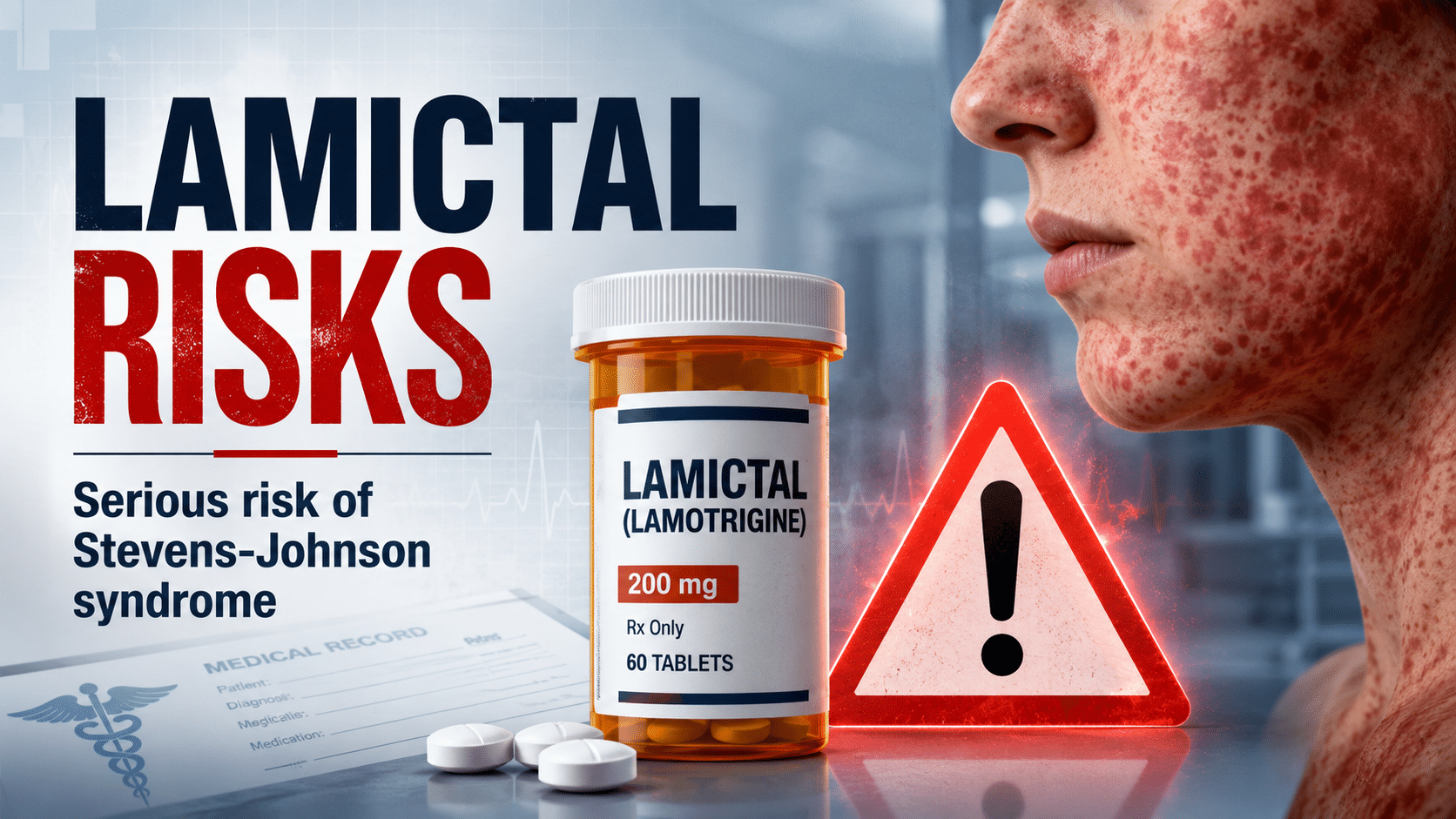
Lamictal & Serious Stevens-Johnson Syndrome Risk

Forensic Pharmacology
A Rash That Reads Like Evidence
Lamotrigine carries a boxed warning for Stevens-Johnson syndrome. The science of how that injury happens, and when, maps almost line for line onto the questions a courtroom will eventually ask.
Lamotrigine, sold as Lamictal, is one of the more widely prescribed anticonvulsants and mood stabilizers in the country. It is also a drug whose own federal label opens with a black box. The very first thing the prescribing information tells a clinician is that this medicine can cause life-threatening skin reactions, including Stevens-Johnson syndrome and toxic epidermal necrolysis, and that some of those reactions have ended in death. For a forensic practice that lives at the intersection of medicine and litigation, few drugs lay their own risk profile out as plainly, or as usefully, as this one.
What follows is not legal advice and is not a treatment guide. It is an account of what the label actually says, why the pharmacology behind it matters, and where each clinical fact tends to become a contested issue once an injury has already occurred.
I · The Warning ItselfWhat the box on the label says
The boxed warning is the strongest signal the Food and Drug Administration can place on a prescription drug. On lamotrigine, it states that serious rashes, including Stevens-Johnson syndrome and toxic epidermal necrolysis, have been caused by the medication, and that the rate of serious rash is higher in children than in adults.
The warning then identifies three factors understood to raise that risk:
- Giving lamotrigine together with valproate, the active ingredient in Depakote and Depakene.
- Starting at a dose higher than the recommended initial dose.
- Escalating the dose faster than the recommended schedule allows.
There is a fourth statement in that box that does as much work as any of the three risk factors. The label says benign rashes also occur with lamotrigine, but that it is not possible to predict reliably which rashes will turn serious. Because of that uncertainty, the instruction is to discontinue the drug at the first sign of any rash, unless the rash is clearly unrelated to the medication.
A boxed warning is not background reading. It is the standard of care reduced to a paragraph. When a case involves a lamotrigine injury, the first three questions a forensic reviewer asks track the box exactly: Was valproate on board? Was the starting dose correct? Was the titration within schedule?
The answers are usually sitting in the pharmacy record and the prescriber’s own notes, which means they can be established before any expert ever opines on causation.
II · The InjuryWhat Stevens-Johnson syndrome actually is
Stevens-Johnson syndrome and its more severe form, toxic epidermal necrolysis, are not ordinary drug rashes. They are immune-mediated reactions in which the skin and mucous membranes blister and detach. The two conditions sit on a single spectrum, separated mainly by how much of the body surface sloughs away. Patients can lose skin the way a serious burn victim does, and the eyes, mouth, and other mucosal surfaces are frequently involved.
The label groups these reactions with the other catastrophic skin and immune events lamotrigine can trigger, including angioedema and the multiorgan hypersensitivity reaction known as DRESS, short for drug reaction with eosinophilia and systemic symptoms. DRESS can involve the liver, kidneys, heart, and blood, and the label notes it has been fatal. A clinician is told that early signs of hypersensitivity, such as fever and swollen lymph nodes, can be present even when no rash has appeared yet.
The skin is the visible part of the reaction. The dangerous part is what the immune system is doing underneath it.
III · The NumbersHow often, and in whom
The label puts figures to the risk, and the figures are specific enough to anchor an analysis. Serious rashes requiring hospitalization and discontinuation occur in roughly the following ranges:
Those percentages can look reassuringly small until they are placed next to the size of the prescribing population. A risk on the order of a few tenths of one percent, spread across the millions of people who take this drug, produces a steady stream of serious and sometimes fatal injuries every year. The label itself records a single rash-related death in a prospectively followed group of 1,983 pediatric epilepsy patients taking lamotrigine as add-on therapy, and notes additional cases of toxic epidermal necrolysis, with and without lasting harm or death, in worldwide postmarketing reports.
IV · The InteractionWhy valproate changes everything
Of the three risk factors in the box, the valproate interaction is the one most rooted in measurable pharmacology, and the one most often misunderstood. Lamotrigine is cleared from the body almost entirely by glucuronidation, a metabolic step in which the liver attaches a sugar molecule to the drug so it can be excreted. Valproate inhibits that step.
The consequence is quantitative and large. The label reports that adding valproate increases lamotrigine concentrations by slightly more than twofold. A patient on a routine lamotrigine dose can therefore carry roughly double the drug exposure simply because valproate is also present. This is why the dosing tables call for a markedly lower lamotrigine starting dose, and a slower climb, whenever valproate is on board.
The clinical trial data make the stakes concrete. Among pediatric patients, serious rash occurred in 1.2 percent of those taking valproate concurrently, compared with 0.6 percent of those who were not. In adults, of 584 patients given lamotrigine alongside valproate, six were hospitalized for rash, against four hospitalizations among 2,398 patients who received lamotrigine without it.
The valproate interaction is the rare clinical fact that is both well documented and easy to verify after the fact. Two prescriptions, two fill dates, two dosing schedules. Either the lamotrigine dose was reduced to account for valproate, or it was not.
When it was not, the deviation is not a matter of opinion. It is a number sitting beside a published instruction, and the gap between them is the case.
V · The TitrationThe starter kits exist for a reason
Lamotrigine is one of the few drugs sold with color-coded starter and titration kits built around the first five weeks of treatment. The manufacturer designed those kits specifically to keep patients on the recommended slow escalation, because a careful climb is understood to reduce the risk of rash. The dosing tables differ depending on whether the patient is taking valproate, taking an enzyme-inducing drug, or taking neither, and the differences are not subtle.
The label is direct about the discipline this requires. To avoid an increased risk of rash, it instructs, the recommended initial dose and the subsequent escalations should not be exceeded. It also cautions against restarting lamotrigine in a patient who previously stopped it because of rash, unless the benefits clearly outweigh the risk, and it explains that a patient who has been off the drug long enough must be restarted from the beginning of the titration schedule rather than resumed at the old dose.
VI · The WindowWhen the danger is highest
Timing is one of the most forensically important features of this injury, and one of the most frequently misread. The label states that nearly all cases of life-threatening rash have occurred within the first two to eight weeks of treatment.
Onset of serious rash, by week of treatment
The shaded band marks the two to eight week window in which nearly all life-threatening rashes appear. The label cautions, however, that isolated cases have surfaced after about six months, and that duration of therapy cannot be relied upon to predict when the first rash will arrive.
That last point matters in both directions. The early window tells a reviewer where to look most closely. The exception tells a defense theory that a late-appearing rash is not, by itself, proof that lamotrigine was blameless. The drug carries the warning at week one and at month six alike.
VII · The Duty to StopFirst sign of rash
The label’s central instruction is also its bluntest: ordinarily discontinue lamotrigine at the first sign of rash, unless the rash is clearly not drug related. The reasoning is the uncertainty already described. Because no one can reliably tell a benign rash from the early phase of a catastrophic one, the safe course is to treat every rash as a potential warning until proven otherwise.
There is a sobering qualification attached to that instruction, and it cuts against any assumption that stopping the drug in time guarantees a good outcome. The label states plainly that discontinuation may not prevent a rash from becoming life-threatening, permanently disabling, or disfiguring. In other words, prompt withdrawal is necessary but not always sufficient.
This is where the medical record and the standard of care meet most directly. When a patient reported a rash, what happened next? Was the drug stopped, or was the patient told to continue and monitor?
The label also notes a detail with practical reach: lamotrigine can cause false-positive results on some rapid urine drug screens, particularly for phencyclidine. In a forensic toxicology practice, that single line resolves a surprising number of disputes that have nothing to do with skin at all.
VIII · The SynthesisWhere the science becomes the case
Read as a whole, the lamotrigine label is almost a roadmap for the analysis that follows a serious injury. The boxed warning supplies the standard of care. The pharmacology of glucuronidation explains why the valproate interaction is dangerous rather than merely noteworthy. The dosing tables define what a careful titration looks like. The timing data tell a reviewer where in the treatment course to concentrate. And the instruction to stop at the first sign of rash defines the duty that a treating clinician either met or did not.
None of this decides a case. Causation, comparative fault, the adequacy of the warning to the particular prescriber, and the cause of a specific patient’s reaction all require expert analysis grounded in the actual records. But the structure of the inquiry is unusually legible here, because the manufacturer’s own document states the risks, quantifies them, and prescribes the precautions in language a jury can follow.
When the label tells you exactly what should have been done, the case is often about the distance between that instruction and what happened.
That distance is measurable. It lives in fill dates, dosing schedules, and the note a clinician wrote, or failed to write, the day a patient first mentioned a rash. The science explains why the distance matters. The record shows how far it ran.