Ninth Circuit Open-Carry Decisions: What They Mean
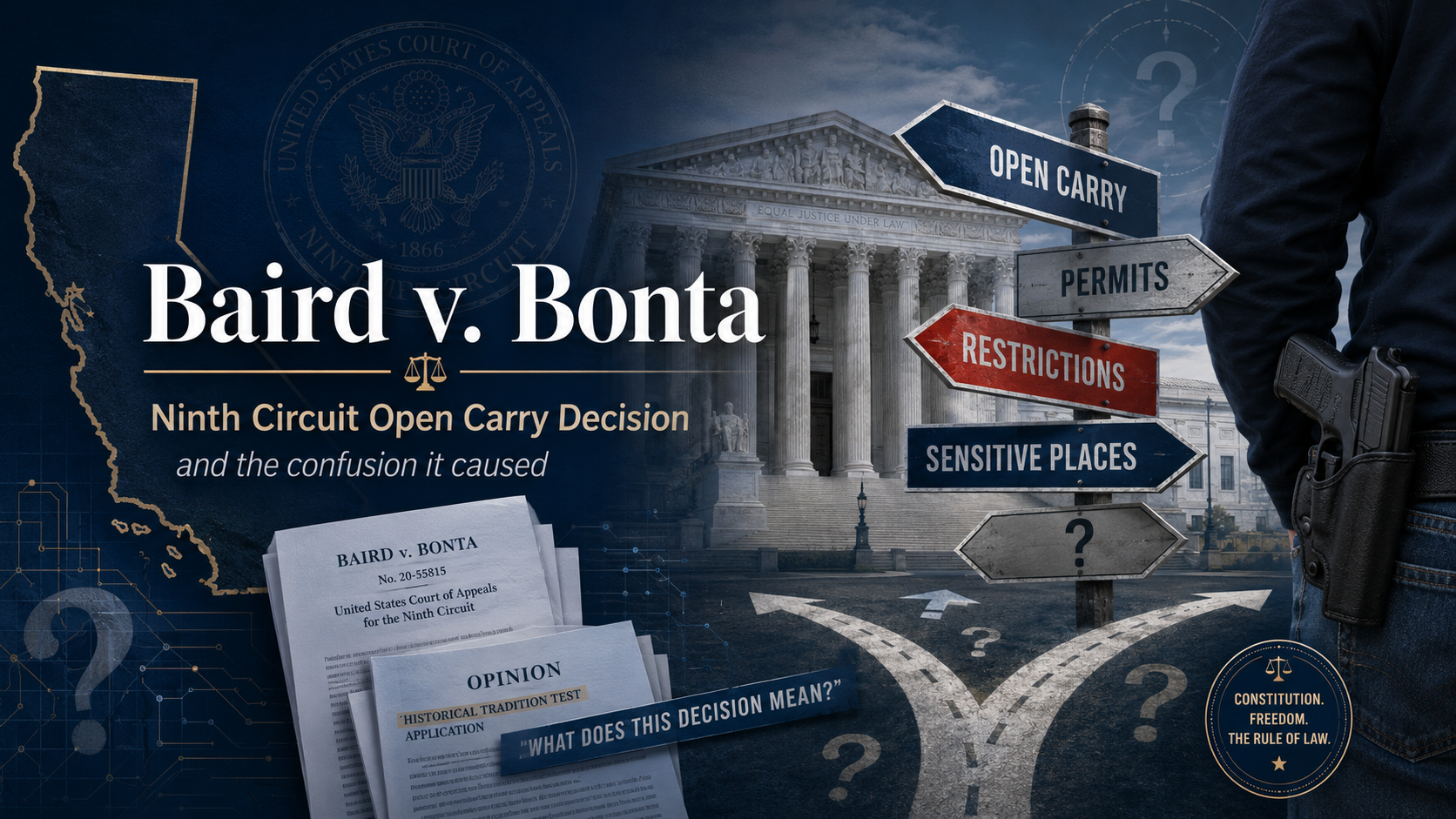
Article overview: A Ninth Circuit panel struck down the urban open-carry ban in January. The full court has since voted to rehear the case and vacated that opinion. The ban remains in force for now.
Few recent rulings have generated more confusion than the Ninth Circuit’s decision in Baird v. Bonta. In January 2026, a divided panel held that California’s ban on openly carrying firearms in its most populous counties is unconstitutional. Headlines announced that California had become an open-carry state. The reality is more complicated, and as of this writing the panel decision is not the law. Anyone who relies on the January ruling to carry a firearm openly in Los Angeles, San Diego, or the Bay Area is making a serious mistake.
Start with the statutory scheme the case challenged. California recognizes two methods of public carry, concealed and open. As a practical matter, the state bans open carry outright in counties with populations of two hundred thousand or more, which is where roughly ninety-five percent of Californians live. In the less populous counties, a shall-issue licensing scheme theoretically allows open carry, but any such license is valid only within the issuing county, and the record in the case suggested that few if any of those licenses have actually been issued.
What the panel held in January
The plaintiff, a resident of a rural county, challenged the open-carry restrictions under the Second and Fourteenth Amendments. A divided three-judge panel sided with him on the urban ban. Applying the Supreme Court’s framework from New York State Rifle and Pistol Association v. Bruen, the majority concluded that a flat prohibition on open carry across the counties where most Californians live cannot be squared with the historical tradition the Second Amendment protects. The panel rejected the argument that allowing concealed carry is enough to justify banning open carry, reasoning that the state cannot eliminate one recognized mode of carry by pointing to the other. A concurrence accused the state of using the rural licensing scheme as a workaround, while a partial dissent argued that states have historically been free to favor one mode of carry over another.
The panel’s reasoning created a direct conflict with the Second Circuit, which had upheld a comparable New York open-carry ban on the theory that concealed carry remained available. That kind of split between circuits is exactly the sort of disagreement that can eventually draw the Supreme Court. One narrowing detail also matters: the plaintiff did not preserve an as-applied challenge to the rural licensing scheme, and his facial challenge to that scheme failed on the record, so the panel’s relief was limited to the urban ban.
The crucial update: the panel opinion has been vacated
Here is the development that most coverage has missed. California’s Attorney General petitioned for rehearing before the full court, and the Ninth Circuit has voted to rehear the case en banc. Under the court’s rules, that vote vacates the three-judge panel’s opinion. In plain terms, the January decision no longer carries legal force. The urban open-carry ban remains in effect, and the entire question will be argued again before a larger en banc panel. The Ninth Circuit has a well-documented history of reversing gun-rights panel decisions on en banc review, so the ultimate outcome is far from settled.
The framework driving the dispute deserves a closer look. In Bruen, the Supreme Court rejected the old interest-balancing approach to Second Amendment claims and replaced it with a test rooted in text, history, and tradition. A modern gun regulation survives only if the government can point to a well-established historical analog for it. The Baird panel and the Second Circuit reached opposite conclusions about whether banning open carry, while permitting concealed carry, fits that tradition, which is why the split is so consequential. The level of generality a court uses when searching for historical analogs often decides the case.
The procedural mechanics also matter for anyone tracking the case. En banc rehearing in the Ninth Circuit is decided by a vote of the active judges, and a grant automatically vacates the panel opinion and sets the matter for reargument before a larger panel. There is no quick timetable. Briefing, argument, and a decision can take many months, and during that entire period the law reverts to what it was before the panel ruled. That is why the urban open-carry ban controls today and will keep controlling unless and until the en banc court says otherwise.
The stakes reach well beyond California. Because the panel created a clear conflict with the Second Circuit over whether a state may channel public carry into the concealed mode, the issue is a natural candidate for Supreme Court review if the en banc court does not resolve it cleanly. Gun-rights advocates and state governments alike are watching, since the answer will shape carry regimes across the country. For California residents specifically, though, the only safe reading today is the conservative one: treat open carry in the populous counties as prohibited.
For now, the bottom line is simple and important. Open carry is not lawful in California’s urban counties today, regardless of what the January headlines suggested. The constitutional debate is real, the circuit split is real, and the case is worth watching closely, both for what the en banc court does and for whether the dispute eventually reaches the Supreme Court. But until the en banc court rules, the status quo controls, and acting on a vacated opinion is a fast route to a criminal charge.
What it means
- The January 2026 panel opinion striking the urban open-carry ban has been vacated; rehearing en banc was granted.
- That means the urban open-carry ban is in force right now. Open carry is not lawful in California’s populous counties today.
- The panel had relied on Bruen and created a circuit split with the Second Circuit, which could attract Supreme Court review.
- The Ninth Circuit often reverses gun-rights panel wins en banc, so the final outcome remains open.
For additional constitutional and firearms decisions, browse the Law Updates archive.
Current primary authorities for Baird v. Bonta
- Ninth Circuit panel opinion in Baird v. Bonta
- Ninth Circuit order granting rehearing en banc and vacating the panel opinion
- Ninth Circuit en banc case-status page
- California Penal Code section 26150
Primary authorities on Baird v. Bonta and California open carry
- Ninth Circuit panel opinion in Baird v. Bonta
- Ninth Circuit order granting rehearing en banc and vacating the panel opinion
- California Penal Code section 25850
- California Penal Code section 26350
Related reading: For related context, read California’s Age-Appropriate Design Code Act Decision, Kosecki 2023 Blood-Fermentation Study: Limits and Evidence, Drug Recognition Expert (DRE) Program Analysis.