California Dual Employment: Working for a Competitor
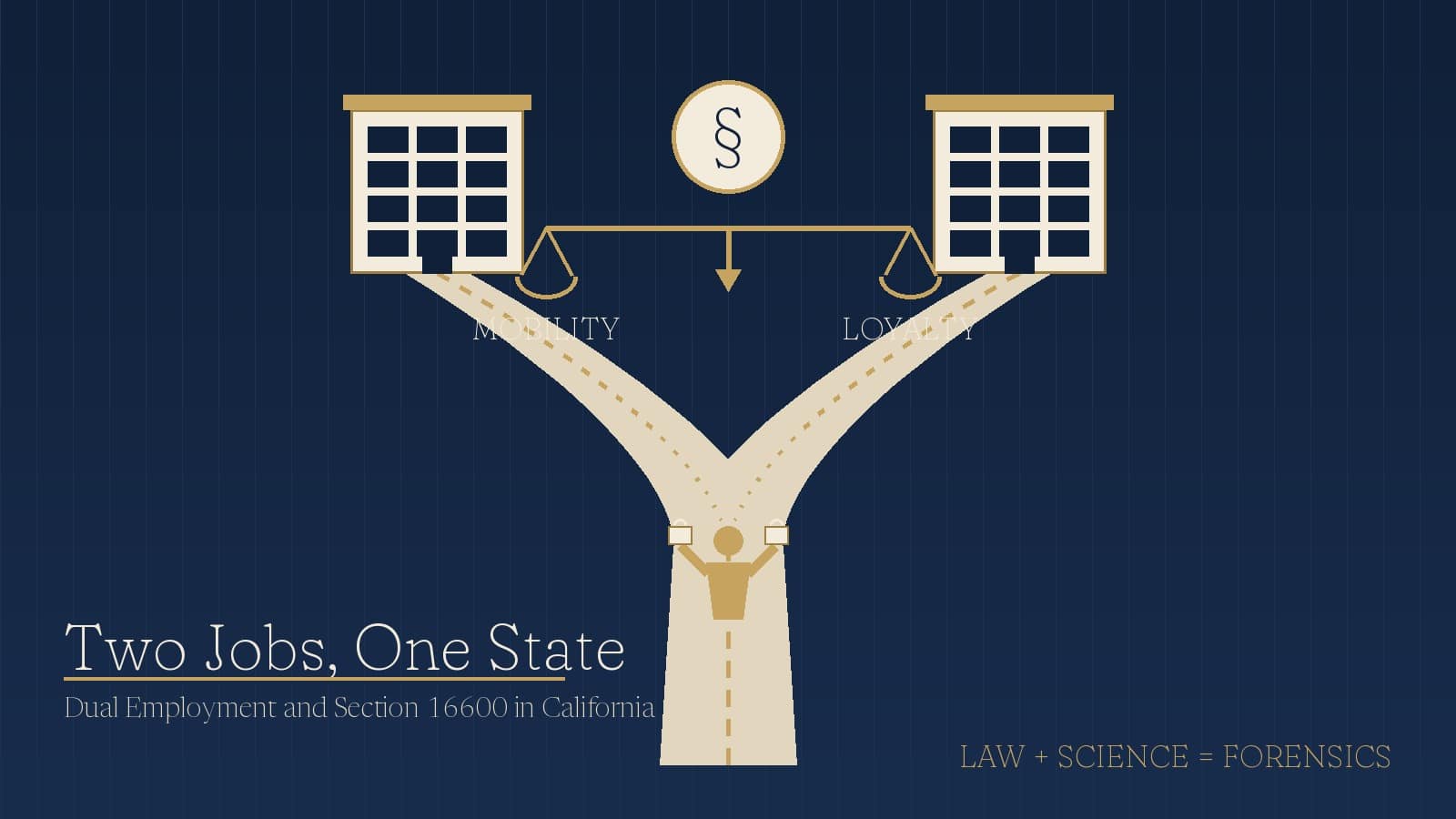
Short answer: California generally voids employee noncompete agreements, but that does not necessarily prevent an at-will employer from terminating a worker who simultaneously works for a competitor. The result depends on duties of loyalty, trade-secret conduct, contract terms and other statutory protections.
Reviewed and updated July 24, 2026.
Ask most California workers about noncompetes and they will tell you, correctly, that the agreements are dead on arrival here. Business and Professions Code section 16600 declares that every contract restraining anyone from engaging in a lawful profession, trade, or business is, to that extent, void. Courts read the statute broadly: no matter how narrowly a noncompete is tailored, it fails unless it fits one of a handful of statutory exceptions, none of which applies to an ordinary employment relationship. Samuelian v. Life Generations Healthcare, LLC, 104 Cal. App. 5th 331 (2024).
From that premise, many employees draw a tempting conclusion: if my employer cannot restrain me from competing, then holding a second job with a competitor must be protected too, and firing me for it must be unlawful. That conclusion is wrong, and the gap between the two ideas is where a great deal of California employment litigation lives.
What Section 16600 Actually Protects
Section 16600 is a rule about contracts, not about conduct. It voids agreements that restrain future work. The statutory exceptions are narrow: sellers of a business or ownership interest (section 16601), partners upon dissolution or dissociation (section 16602), and LLC members upon dissolution or termination of their interest (section 16602.5). None reaches the everyday employee.
The protection is muscular where it applies. An employer cannot require a worker to sign an unlawful noncompete as a condition of employment, even if the agreement carries severability or choice-of-law language. D’Sa v. Playhut, Inc., 85 Cal. App. 4th 927 (2000). California also refuses to recognize the “inevitable disclosure” doctrine, which some states use to enjoin a departing employee on the theory that the new job will inevitably involve using the old employer’s trade secrets. FLIR Systems, Inc. v. Parrish, 174 Cal. App. 4th 1270 (2009). After employment ends, the former employee may compete freely, absent trade secret misappropriation or other independently unlawful conduct. Application Group v. Hunter Group, 61 Cal. App. 4th 881 (1998).
So an employer who sues to enforce a noncompete, or who seeks an injunction to keep a former employee away from a competitor, will lose. What section 16600 does not do is regulate why an employer may end an at-will relationship in the first place.
At-Will Employment Still Means What It Says
Under Labor Code section 2922, employment with no specified term is terminable at will by either party. An at-will employee may be let go at any time, with or without cause, for any lawful reason or no reason at all. Singh v. Southland Stone, U.S.A., Inc., 186 Cal. App. 4th 338 (2010). The employer need not act in good faith or show good cause. Guz v. Bechtel National, Inc., 24 Cal. 4th 317 (2000).
The right is not unlimited. A termination that violates fundamental public policy supports a wrongful discharge claim. Lagatree v. Luce, Forward, Hamilton & Scripps, 74 Cal. App. 4th 1105 (1999). But the bar is high. The policy must be delineated in a constitutional or statutory provision, must benefit the public rather than the individual alone, must have been well established at the time of discharge, and must be substantial and fundamental. Haney v. Aramark Uniform Services, Inc., 121 Cal. App. 4th 623 (2004). It must be carefully tethered to specific constitutional or statutory text; a policy merely derived from a statute is not enough. Sequoia Ins. Co. v. Superior Court, 13 Cal. App. 4th 1472 (1993).
Nor does the implied covenant of good faith and fair dealing rescue the analysis. The covenant applies to employment contracts, but it cannot impose substantive limits beyond the parties’ actual agreement, and it can never override the at-will term the law implies into every contract that does not specify otherwise. Guz, 24 Cal. 4th 317; California Dental Assn. v. Delta Dental of California, 115 Cal. App. 5th 142 (2025).
The Duty of Loyalty: Where Dual Employment Gets Dangerous
The Samuelian court drew the operative line. California law permits an employee to seek other employment and even to make some preparations to compete before resigning. What it does not permit is transferring loyalty to a competitor during the employment relationship. During employment, an employer is entitled to its employees’ undivided loyalty.
Section 16600 protects the right to pursue any lawful calling. It does not immunize employees who undermine their employer by competing with it while still on the payroll.
The court put it memorably: the statute is not an invitation to employees to bite the hand that feeds them. Section 16600 governs restraints on future work; it does not affect the limits on an employee’s conduct or duties while employed. So an employee who diverts customers, assists a competitor, or uses confidential information while still employed has stepped outside the statute’s protection entirely.
By contrast, where neither the employee nor the new employer has committed any unlawful act accompanying a job change, the employee’s interest in mobility and betterment is paramount to the former employer’s competitive interests. Application Group, 61 Cal. App. 4th 881. The distinction between preparing to compete and actively competing carries most of the weight.
The Apparent Paradox, Resolved
Put the pieces together and the seeming contradiction dissolves. A noncompete clause in an employment agreement is void, and any attempt to enforce it by injunction or damages fails under section 16600. But the same employer, exercising its at-will rights, may terminate an employee for working for a competitor, and that termination generally does not violate public policy. Firing someone is not enforcing a contractual restraint; it is ending a relationship the law lets either side end.
Where the second job involves active competition, the employer’s position is stronger still, because the employee has breached the duty of loyalty. Where the second job is in the same industry but does not compete, or amounts only to preparation for future competition, the analysis is more nuanced, but the at-will termination right generally remains. Singh, 186 Cal. App. 4th 338. The wrongful discharge cases demand a specific, fundamental, textually anchored public policy, and no established policy authorizes an employee to assist the employer’s competitors while still employed.
The Four Questions That Decide These Cases
- Does the dual employment amount to active competition with the current employer, or merely preparation to compete after leaving?
- Has the employee breached the duty of loyalty by assisting competitors or diverting business during current employment?
- Is the employer enforcing a contractual restraint (prohibited) or exercising its at-will termination right (generally permitted)?
- Does any statutory protection beyond section 16600 shield the employee’s specific conduct?
What This Means in Practice
For employees: holding two jobs is not itself unlawful, and no California employer can make you sign away your right to work for a competitor after you leave. But moonlighting for a direct competitor while employed is a resignation letter you have not signed yet. If the second role involves the same customers, the same market, or your current employer’s confidential information, expect the termination to hold up, and it is worth having the facts reviewed before assuming the firing was unlawful, and expect any loyalty-breach conduct to generate exposure of its own.
For employers: the temptation to reach for the noncompete is understandable and almost always a mistake in California. The lawful tools are the at-will termination right, trade secret law, and the duty of loyalty during employment. Trying to restrain a former employee’s future work invites liability rather than preventing it.
Absent unusual circumstances involving other statutory protections or express contract terms limiting the at-will relationship, California employers may lawfully terminate employees for working for competitors, even though they can never enforce a contractual restriction preventing that competitive employment after the relationship ends. Mobility after employment; loyalty during it. That is the whole rule.
This article is for general informational purposes only and does not constitute legal advice. Reading it does not create an attorney-client relationship. Every case turns on its specific facts; consult counsel about your particular situation.
Related reading: For related context, read The Okorocha Mid-Year Street Drug Report of 2026, Kratom and 7-OH in 2026: Evidence, Risks and Regulation, Medetomidine in the Fentanyl Supply: Risks and Testing. Browse the Forensic Toxicology topic hub.