CBD After Repeated Dosing: Why Detectability Does Not Establish a Washout Deadline
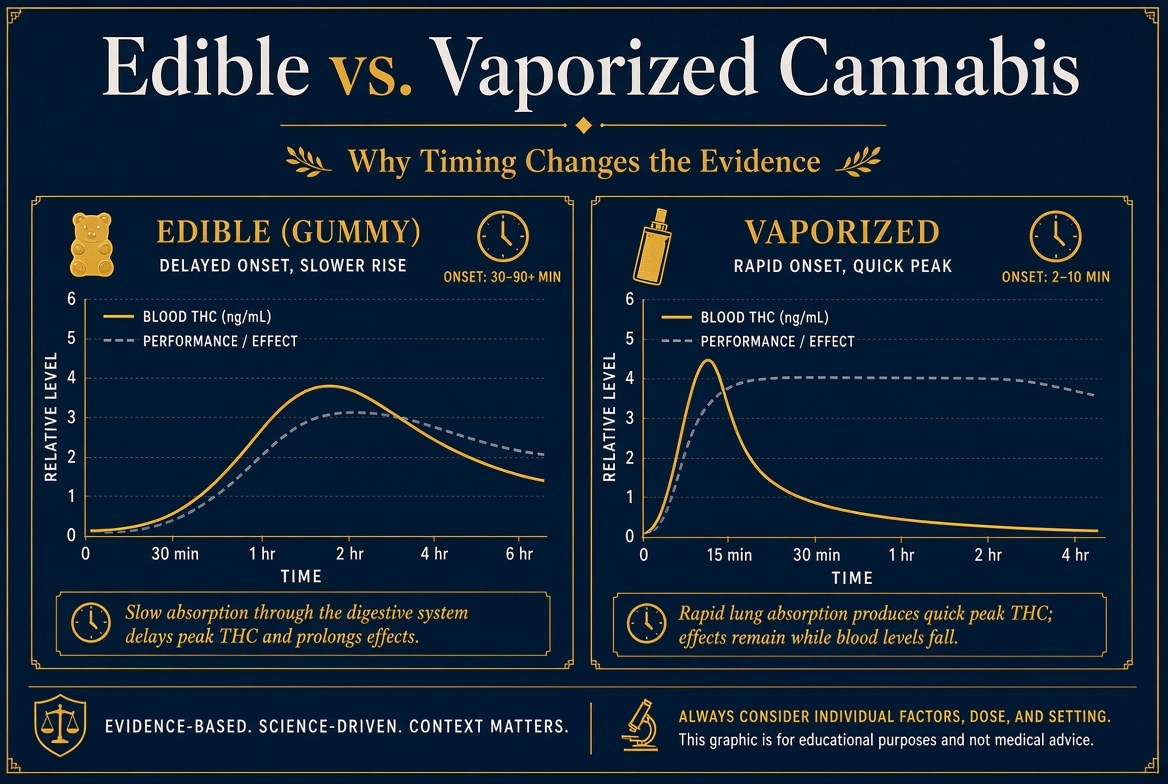
A cannabinoid detected after dosing stops is evidence of analytical persistence. It does not, by itself, establish an exact elimination half-life, the time of the last dose or a universal date when another person’s sample will test negative.
A controlled study by Wolinsky and colleagues helps explain the distinction. Published in the Journal of Analytical Toxicology, the study followed 60 healthy adults given oral cannabidiol (CBD), either alone or with low doses of delta-9-tetrahydrocannabinol (THC).
Separate the initial profile from later spot measurements
Ten participants were assigned to each of six groups. Every dose contained 100 mg CBD in medium-chain triglyceride oil, combined with 0, 0.5, 1, 2, 2.8 or 3.7 mg THC. The protocol included an initial laboratory session, twice-daily dosing during a 14-day exposure period and a seven-day period without study drug.
During the first session, investigators collected serial specimens at scheduled times. They calculated observed peak concentrations, times to peak and area under the concentration-time curve across the six-hour sampling window. These acute estimates were not complete exposure estimates extrapolated to infinity.
Later outpatient assessments occurred at variable intervals relative to home dosing. The researchers therefore based those peak and AUC calculations on the initial session. Later visit concentrations should not be presented as though each visit supplied an equivalent complete pharmacokinetic profile.
Parent drug and metabolites behaved differently
The investigators analyzed CBD and its metabolites separately in whole blood and urine. Repeated dosing produced findings consistent with accumulation of the CBD metabolite 7-COOH-CBD. That is not the same claim as demonstrating equal accumulation of parent CBD or every other measured compound.
After the seven-day washout, the paper reported that CBD and 7-COOH-CBD remained detectable in most participants’ whole-blood samples. Detectability depends on the measured compound, specimen and analytical sensitivity. Whole-blood results cannot simply be relabeled as plasma or urine concentrations.
One follow-up point cannot define a terminal half-life
The washout assessment was a follow-up visit rather than a dense series of terminal samples. Detecting an analyte at that visit demonstrates persistence to that observation under the study conditions. It does not establish precisely when its concentration crossed a threshold between visits or when every participant would become negative.
Likewise, dividing a follow-up concentration by the initial observed peak can describe relative concentrations, but it does not supply an individual’s elimination-rate constant. Timing relative to dosing and the behavior of each metabolite remain essential.
Limits on applying the findings
This study tested one oil formulation and a defined dosing period, with ten participants per group. Outpatient adherence was monitored, but missed doses occurred. The findings do not establish identical behavior for longer exposure periods, different products or an unknown person’s dosing history.
The pharmacokinetic conclusion is specific: repeated dosing and later detectability must be interpreted using the actual analyte, specimen and sampling schedule. A measured concentration alone is not a dosing reconstruction, an impairment finding or a guaranteed washout timetable.
Source: Wolinsky D and colleagues. The acute and chronic pharmacokinetics and pharmacodynamics of oral cannabidiol with and without low doses of delta-9-tetrahydrocannabinol. Journal of Analytical Toxicology. 2026;50(1):bkaf075. PubMed record.



