Breath-to-Blood Conversion: Scientific Limits and Records
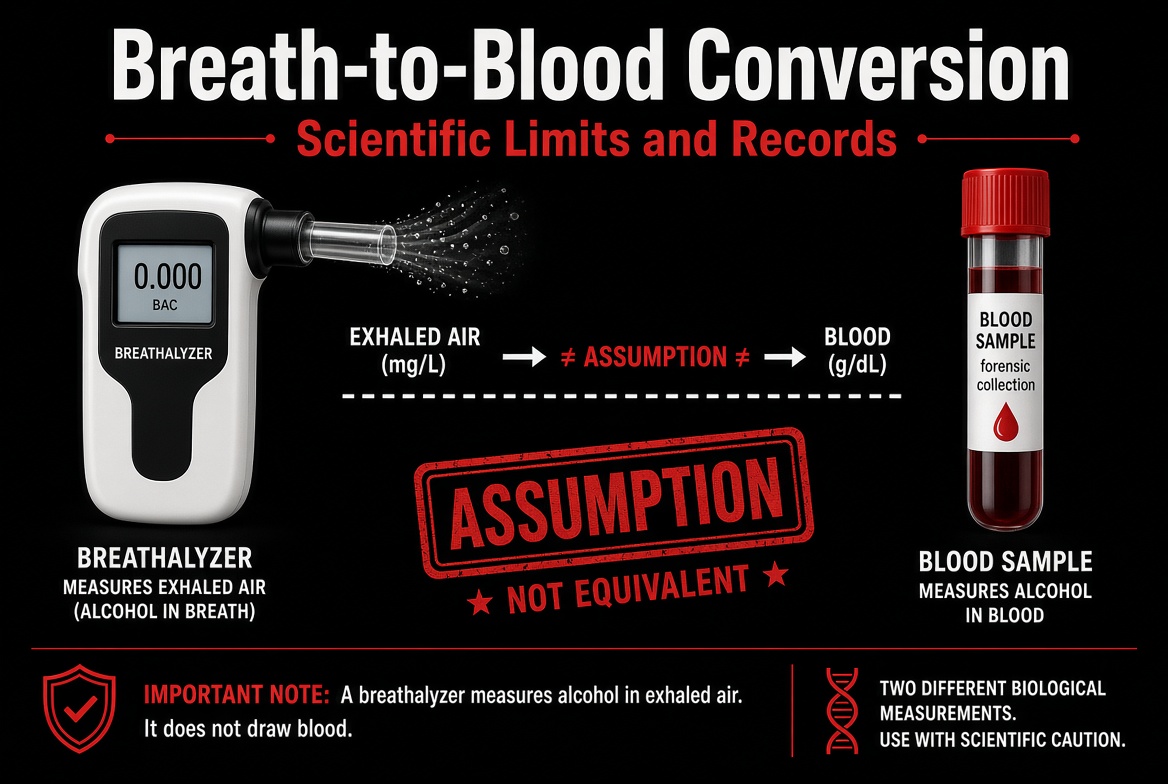
A breath-alcohol instrument measures alcohol in a breath sample. It does not draw or analyze blood. When a breath result is discussed as though it were a blood-alcohol concentration, a conversion assumption connects two different biological measurements.
That distinction is not merely semantic. It affects how a result should be described, what sources of uncertainty should be investigated, and which records are necessary before anyone can evaluate the reliability of a specific test.
This article explains the scientific issue without assuming that every breath result is wrong or that an approved instrument is automatically correct in every case.
Breath concentration and blood concentration are not the same measurement
Alcohol moves between blood and air in the lungs. A breath instrument estimates the amount of alcohol in a defined volume of exhaled breath. A blood test measures alcohol in a collected blood specimen using a laboratory method.
The two measurements are related, but they are not interchangeable samples. The relationship can be affected by physiology, breathing pattern, breath temperature, timing, specimen quality, instrument design, and the phase of alcohol absorption or elimination.
Forensic review therefore begins with a basic question: is the reported number a direct measurement in the tested specimen, or is it being interpreted through an assumed relationship to a different specimen?
What Mason and Dubowski argued in the foundational literature
In 1974, M. F. Mason and K. M. Dubowski reviewed alcohol testing in traffic-law enforcement and discussed discrepancies between near-simultaneous venous-blood and breath measurements. They argued that the causes of those discrepancies could not be adequately controlled in routine law-enforcement practice. Their recommendation was to avoid calculating a blood-alcohol concentration from a breath result and instead define the breath-testing offense in breath-specific units.
They developed that position further in a 1976 review of breath-alcohol analysis. The paper addressed instrumentation, physiological variables, breath sampling, and uncertainty in translating a breath measurement into a blood value. Again, their recommendation was to treat breath alcohol as its own measured quantity rather than as a proxy blood result.
These papers are historically important, but they must be described accurately. They are reviews and opinions from 1974 and 1976. They do not establish that every modern evidential breath test is unreliable. They do establish that the scientific distinction between breath and blood has been recognized for decades.
What modern device approval does and does not establish
The National Highway Traffic Safety Administration maintains model specifications and Conforming Products Lists for evidential breath-testing devices, screening devices, and calibration units. NHTSA testing addresses whether a submitted device model meets specified performance criteria.
Model-level conformity is important. It is not the same as proving that a particular instrument was functioning correctly on a particular date, that the operator followed the required procedure, or that the tested breath samples were acceptable.
NHTSA also explains that state-approved evidential breath devices may be used in court and that calibration, maintenance, and quality-assurance records are important to a successful testing program. The applicable state rules, instrument instructions, agency procedures, and case records still must be reviewed.
Federal workplace testing provides a useful example of procedural safeguards, although those federal procedures do not automatically govern a state DUI case. The U.S. Department of Transportation instructs breath-alcohol technicians to use approved devices, observe a waiting period before confirmation testing, conduct an air blank, show and print the result, and maintain inspection, maintenance, and calibration documentation.
Why a single conversion factor can require scrutiny
A fixed conversion factor is a legal or administrative convention applied to a biological relationship that varies. The scientific question is not whether breath and blood alcohol are associated. They are. The question is whether a fixed relationship accurately represents the tested person and the tested moment well enough for the conclusion being offered.
A sound review separates at least four issues:
1. The measured quantity. What did the instrument directly measure and in what units?
2. The conversion or statutory rule. Was a blood-equivalent value calculated, implied, or simply displayed using standardized terminology?
3. The analytical process. Was the specific instrument properly checked, maintained, and operated?
4. The biological context. Could absorption phase, breath pattern, temperature, medical condition, or another documented factor affect interpretation?
Conflating those issues can make a test appear more direct and certain than it actually is.
Records needed for a meaningful scientific review
A numerical result alone is not enough to reconstruct the testing process. Depending on the instrument and jurisdiction, a review may require:
Test record: the complete breath-test printout and raw test sequence.
Instrument identity: the make, model, serial number, software version, and applicable approval or Conforming Products List record.
Instrument history: maintenance, repair, inspection, out-of-service, calibration, and accuracy-check records before and after the subject test.
Reference materials: simulator-solution or dry-gas lot information, certificates, target values, and expiration dates.
Quality controls: air-blank, control, duplicate-sample, diagnostic, sample-flow, slope, and interference results or messages.
Operator and procedure: training, certification, observation-period documentation, contemporaneous notes, and available collection video or audio.
Contextual records: nearby subject tests, control tests, and error logs needed to identify a pattern.
For a fuller production checklist, see Breath-Test Records Needed for Scientific Review.
Questions that should be answered before drawing a conclusion
A defensible review should answer questions such as:
Measurement and units: Was the result reported in breath units, blood units, or blood-equivalent terminology, and what statutory conversion rule applied?
Sample acceptance: Did the instrument obtain acceptable samples under its own criteria, and were paired results sufficiently consistent under the governing procedure?
Controls: Did the air blank and controls fall within required limits?
Maintenance: Was the instrument within its maintenance and accuracy-check schedule, and were repairs, error codes, or failed checks close in time to the test?
Biology and timing: Was the person still absorbing alcohol when tested?
Comparison evidence: Is there a blood result, and if so, were collection time and analytical method considered before comparison?
The purpose is not to hunt for a predetermined answer. It is to determine which conclusions the available data can support and which remain uncertain.
Related scientific guides
Blood testing versus breath testing
Forensic toxicology behind DUI chemical tests
Alcohol testing: where it can go wrong
Sources
1. Mason MF, Dubowski KM. Alcohol, Traffic, and Chemical Testing in the United States: A Resume and Some Remaining Problems. Clinical Chemistry. 1974;20(2):126-140. Publisher record and DOI.
2. Mason MF, Dubowski KM. Breath-Alcohol Analysis: Uses, Methods, and Some Forensic Problems – Review and Opinion. Journal of Forensic Sciences. 1976;21(1):9-41. PubMed record. DOI.
3. National Highway Traffic Safety Administration. Alcohol Measurement Devices and Conforming Products Lists.
4. National Highway Traffic Safety Administration. Model Specifications for Evidential Breath Testers.
5. U.S. Department of Transportation, Office of Drug and Alcohol Policy and Compliance. Back to Basics for Breath Alcohol Technicians and Screening Test Technicians.
Limitations and disclaimer
This educational article does not determine the reliability or admissibility of any individual test. Device design, jurisdiction-specific law, agency procedure, instrument history, biological facts, and the complete case record must be evaluated together. It is not legal advice, medical advice, or a substitute for case-specific expert analysis. See the full Content Disclaimer.