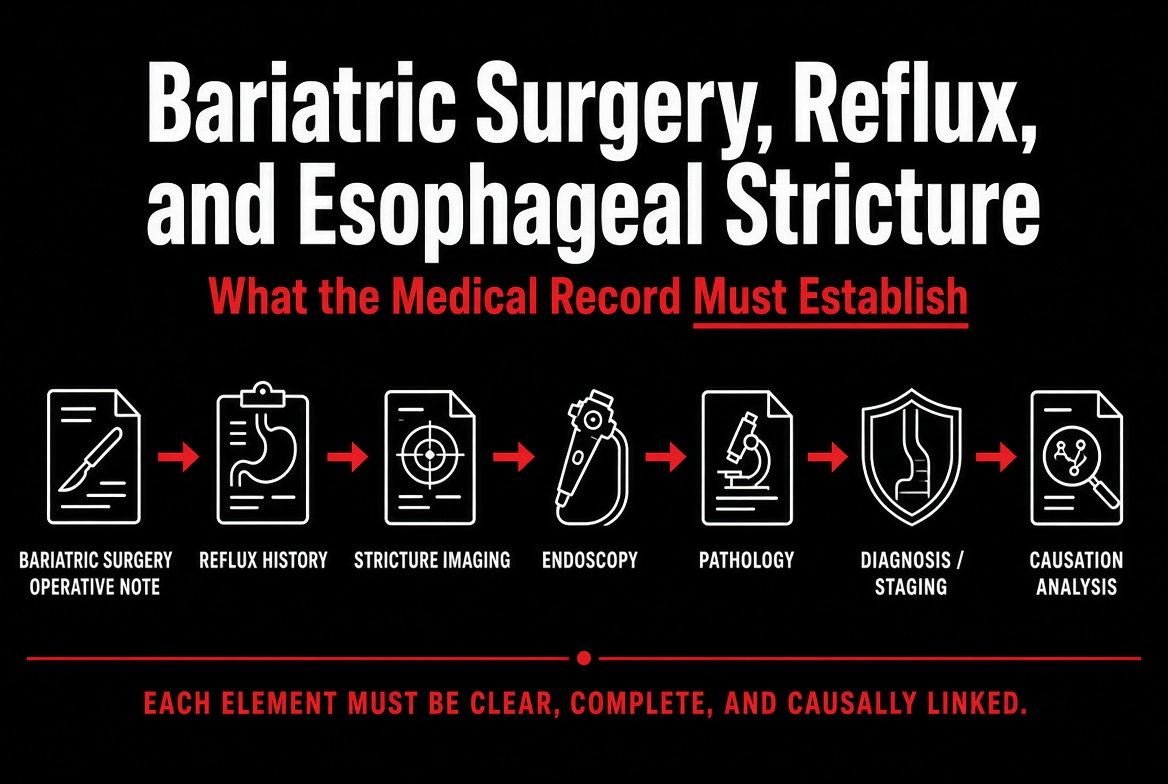
Bariatric Surgery, Reflux, and Esophageal Stricture: What the Medical Record Must Establish
This content has not been verified by a trained forensic toxicologist or medical specialist. It is general informational and marketing material, not medical advice, legal advice, expert opinion, or a statement of scientific fact. Read the full Content Disclaimer.
Symptoms after bariatric surgery can raise serious medical and legal questions. Reflux, nausea, vomiting, difficulty swallowing, pain, reduced intake, and weight loss may occur in several different conditions. A later diagnosis does not, by itself, establish what caused the condition, when it became detectable, or whether a different evaluation would have changed the outcome.
Start with the operation and the timeline
The first task is to identify the precise bariatric procedure, operative anatomy, date, and immediate postoperative course. Evidence about sleeve gastrectomy should not be applied automatically to Roux-en-Y gastric bypass or another operation.
The literature also separates early and later complications. Wozniewska and colleagues describe hemorrhage, staple-line leak, and abscess as early concerns, while stenosis, nutritional deficiencies, migration, and development or exacerbation of gastroesophageal reflux may appear later. The American Gastroenterological Association’s expert review addresses complications within 90 days and emphasizes multidisciplinary management, while acknowledging that treatment algorithms are not fully standardized and high-quality prospective evidence is limited.
A defensible review should create a dated chronology of symptoms, calls, office visits, emergency encounters, imaging, endoscopy, pathology, medication changes, referrals, admissions, and follow-up recommendations.
Symptoms identify questions, not diagnoses
Difficulty swallowing can occur with a stricture, but narrowing can have inflammatory, fibrotic, postoperative, motility-related, or malignant explanations. Nausea, vomiting, early satiety, appetite loss, abdominal discomfort, and weight loss are also nonspecific.
The combination, severity, persistence, and progression of symptoms can affect the need for further evaluation. Difficulty swallowing, unintentional weight loss, gastrointestinal bleeding or anemia, and frequent or persistent vomiting may justify escalation depending on the full clinical context. These findings still do not identify a cause by themselves. Benign disease, postoperative anatomy, medication effects, functional disorders, and malignancy can overlap in presentation.
The medical record must show what differential diagnoses were considered and what objective testing was performed. Depending on the actual presentation, relevant records may include upper endoscopy, biopsy, contrast imaging, computed tomography, manometry, reflux testing, laboratory studies, nutritional assessment, and operative consultation. Upper endoscopy can permit direct visualization and tissue sampling, while contrast studies and other tests answer different questions. A website article cannot determine which test was medically required in a particular encounter.
Sleeve stenosis and reflux require procedure-specific review
Masood and colleagues review post-sleeve complications including leak, stenosis, fistula, gastrointestinal bleeding, and reflux disease, together with endoscopic diagnostic and management options. Their review supports obtaining the complete endoscopy record, procedure images, fluoroscopy, stent or dilation documentation, and subsequent response.
It does not establish that every postoperative symptom represents stenosis or that one endoscopic technique was required in every patient. Anatomy, hemodynamic stability, timing, downstream obstruction, prior procedures, available expertise, and alternative surgical or radiologic approaches all matter.
Hiatal hernia may also affect reflux physiology. Sawada and colleagues studied a selected group of proton-pump-inhibitor-refractory patients with non-erosive reflux disease and reported differences in reflux episodes and mucosal-integrity measures between patients with and without a defined hiatal hernia. That study can identify issues for investigation, but it cannot prove that a hiatal hernia caused another patient’s symptoms or later disease.
Endoscopic findings may conflict across cohorts
Coupaye and colleagues offered endoscopy at least three years after sleeve gastrectomy to patients from one institution. Of 375 patients who underwent surgery, 162 received the later endoscopy. The examined group showed increases in symptomatic reflux, hiatal hernia, and esophagitis compared with preoperative findings. No Barrett’s esophagus was detected, while 27 percent of patients with gastric biopsies developed antral reactive gastropathy.
The study should be read with its selection and follow-up limits. Only 43 percent underwent the later examination, 91 percent of the examined group were women, and the results came from one institution. The findings neither prove that sleeve gastrectomy causes Barrett’s esophagus nor establish that the risk is zero.
Population risk is not individual causation
Lagergren and colleagues reported a strong population association between recurrent reflux symptoms and esophageal adenocarcinoma in a Swedish case-control study. Greater frequency, severity, and duration of symptoms were associated with larger risk estimates. This evidence supports taking longstanding reflux seriously, but it does not determine why one person developed cancer, when the cancer began, or whether a particular surgery or alleged delay caused it.
Esparham and colleagues used a national inpatient database to compare gastrointestinal cancer hospitalizations in patients with and without a recorded history of bariatric metabolic surgery. The study reported different associations across cancer categories. Administrative hospitalization data, however, do not directly measure cancer incidence and cannot resolve histology, surveillance intensity, latency, procedure-specific anatomy, obesity history, smoking, reflux, Barrett’s esophagus, family history, or other individual factors.
In a legal review, association is only one part of the analysis. The record must separately address diagnosis, standard of care, breach, general causation, specific causation, preventability, and damages.
Diagnosis, staging, and causation are separate questions
Symptoms may prompt an investigation, but a cancer diagnosis generally depends on tissue evaluation. Staging is a separate process used to describe the extent of disease and guide treatment and prognosis. The test that establishes a diagnosis may not answer when the disease began or when it first could have been detected.
A later advanced stage does not, by itself, prove that an earlier examination would have found the disease or changed treatment or outcome. That analysis requires the complete symptom and testing chronology, pathology, tumor type and biology, stage-specific treatment evidence, and qualified expert review of progression and preventability.
The same separation applies outside cancer. An endoscopic finding of inflammation, narrowing, or altered anatomy must be interpreted with the operative history, biopsy results, imaging, physiology, treatment response, and reasonable alternative explanations.
Records to obtain
- Preoperative bariatric evaluation, consent, endoscopy, imaging, reflux history, and risk assessment.
- The complete operative report, procedure type, anatomy, intraoperative findings, and complications.
- Postoperative calls, messages, symptom questionnaires, diet progression, weight trajectory, and missed or rescheduled visits.
- Emergency-department, hospital, primary-care, bariatric-surgery, gastroenterology, oncology, and nutrition records.
- Endoscopy reports, photographs, video when retained, biopsy-site documentation, and pathology slides and reports.
- Contrast studies, computed tomography, manometry, pH or impedance testing, and laboratory results.
- Medication history, including acid suppression and the documented response.
- Referral orders, authorization records, scheduling communications, and the reason for any delay.
- Cancer staging, molecular and histologic findings, treatment records, and expert review of latency and progression.
- The clinical guidelines, policies, and resources actually available at the relevant time and facility.
Questions for expert review
- What diagnosis was reasonably supported at each point in the timeline?
- Which symptoms were new, progressive, persistent, or accompanied by objective warning findings?
- Did the recorded anatomy and testing support stenosis, reflux injury, ulceration, motility disorder, gastropathy, Barrett’s esophagus, or malignancy?
- Were the evaluation and referral decisions reasonable under the circumstances known at the time?
- If an earlier test had been performed, what would it probably have shown?
- Would an earlier diagnosis probably have changed treatment, stage, prognosis, or damages?
- Which alternative causes and risk factors must be considered?
The strongest medical-legal analysis begins with the complete contemporaneous record and then uses research that matches the actual operation, condition, testing method, population, and time period.
Selected references
- Kumbhari V, Cummings DE, Kalloo AN, Schauer PR. AGA Clinical Practice Update on evaluation and management of early complications after bariatric/metabolic surgery: expert review. Clinical Gastroenterology and Hepatology. 2021;19(8):1531-1537. https://doi.org/10.1016/j.cgh.2021.03.020
- Masood M, Low DE, Deal SB, Kozarek RA. Endoscopic management of post-sleeve gastrectomy complications. Journal of Clinical Medicine. 2024;13(7):2011. https://doi.org/10.3390/jcm13072011
- Wozniewska P, Diemieszczyk I, Hady HR. Complications associated with laparoscopic sleeve gastrectomy – a review. Gastroenterology Review. 2021;16(1):5-9. https://doi.org/10.5114/pg.2021.104733
- Coupaye M, Gorbatchef C, Dior M, et al. Endoscopic follow-up between 3 and 7 years after sleeve gastrectomy reveals antral reactive gastropathy but no Barrett’s esophagus. Obesity Surgery. 2023;33(10):3112-3119. https://doi.org/10.1007/s11695-023-06785-y
- Sawada A, Gyawali CP, Sifrim D, et al. Effect of hiatus hernia on reflux patterns and mucosal integrity in patients with non-erosive reflux disease. Neurogastroenterology and Motility. 2022;34(11):e14412. https://doi.org/10.1111/nmo.14412
- Yang F, Hu Y, Shi Z, et al. The occurrence and development mechanisms of esophageal stricture: state of the art review. Journal of Translational Medicine. 2024;22:123. https://doi.org/10.1186/s12967-024-04932-2
- Lagergren J, Bergstrom R, Lindgren A, Nyren O. Symptomatic gastroesophageal reflux as a risk factor for esophageal adenocarcinoma. New England Journal of Medicine. 1999;340(11):825-831. https://doi.org/10.1056/NEJM199903183401101
- Esparham A, Shoar S, Mehri A, Khorgami Z, Modukuru VR. Bariatric surgery and risk of hospitalization for gastrointestinal cancers in the USA. Obesity Surgery. 2023;33(12):3797-3805. https://doi.org/10.1007/s11695-023-06883-x
- Katz PO, Dunbar KB, Schnoll-Sussman FH, et al. ACG Clinical Guideline for the Diagnosis and Management of Gastroesophageal Reflux Disease. American Journal of Gastroenterology. 2022;117(1):27-56. https://doi.org/10.14309/ajg.0000000000001538
- National Institute of Diabetes and Digestive and Kidney Diseases. Upper GI endoscopy. https://www.niddk.nih.gov/health-information/diagnostic-tests/upper-gi-endoscopy
- National Cancer Institute. Esophageal cancer diagnosis and prognosis. https://www.cancer.gov/types/esophageal/diagnosis-prognosis
- National Cancer Institute. Stomach cancer diagnosis. https://www.cancer.gov/types/stomach/diagnosis
General informational and marketing material only. It is not medical advice, legal advice, expert opinion, or a case-specific assessment.