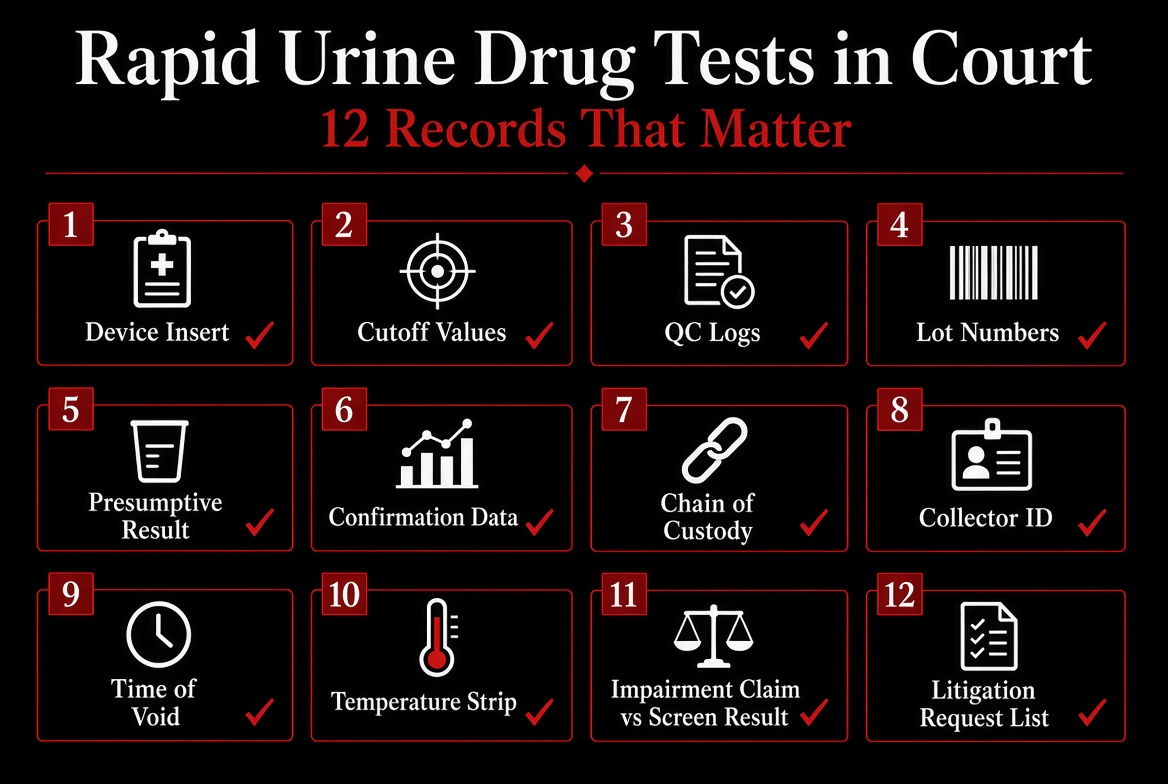
Rapid Urine Drug Tests in Court: 12 Records That Matter
THE OKOROCHA FIRM*
Scientific and toxicology content on this site was written by non-toxicologist marketing staff at Connectica, LLC. It has not been verified for accuracy by a trained forensic toxicologist. Read the full Content Disclaimer.
A rapid urine drug screen can influence an arrest, employment decision, probation allegation, licensing dispute, treatment decision, or civil case within minutes. The word positive, however, does not identify every substance that produced the response, establish when exposure occurred, or prove impairment. The quality of the conclusion depends on the exact device, drug channel, cutoff, specimen, operator, controls, and confirmation procedure.
The first legal question: screen or confirmation?
Most test cups and cards are immunoassays. They use antibodies to produce a class-based response at a specified cutoff. They are useful for rapid screening, but the scientific literature repeatedly describes positive and negative disagreements with more specific laboratory methods.
Gas chromatography-mass spectrometry and liquid chromatography-tandem mass spectrometry can identify selected compounds with much greater chemical specificity. A lawyer reviewing a disputed result should determine whether a separate confirmation was actually performed, which analytes it covered, and whether the reported cutoff matched the question being asked.
Why a single accuracy percentage is misleading
Published device comparisons show that performance is not a fixed property of the words “drug test.” Results vary by product, drug class, matrix, cutoff, reader, and specimen population.
- Gronholm and Lillsunde compared eight urine devices and two oral-fluid devices in an 800-person study. The reported performance ranges differed by drug class, and some oral-fluid channels did not meet the study’s sensitivity needs.
- Crouch and colleagues evaluated devices across laboratories and later in a field study involving DUI arrestees. Their work illustrates both device variation and the importance of what the confirmation laboratory is designed to detect.
- Kadehjian deliberately tested challenging near-cutoff specimens. Results differed by product, analyte, reader, and the rule used to define agreement.
- Attema-de Jonge and colleagues compared three point-of-care devices in an emergency department. One instrument-read system performed better overall in that setting, but sensitivity still varied by analyte.
Those historical studies do not rank current products. They establish a more durable point: a party cannot defend a particular result by citing a generic manufacturer claim or an overall percentage from a different device and population.
Twelve records to request
- The original result. Obtain the first report, every amended report, the test date and time, and the name of the person who read or approved it.
- The exact device. Request the manufacturer, product name, model, drug panel, lot number, expiration date, and a photograph of the result if one exists.
- The instructions in effect that day. Package inserts change. Obtain the version supplied with the tested lot, including reading time, invalid-result rules, storage conditions, and cross-reactivity tables.
- The cutoff for each channel. A cutoff is a decision point, not a boundary between “drug present” and “drug absent.” Near-cutoff specimens are especially vulnerable to classification differences.
- Specimen collection records. Obtain collection time, container and seal records, temperature, observed or unobserved collection status, transfers, storage, and chain of custody.
- Specimen-validity data. Request creatinine, specific gravity, pH, oxidant or adulterant testing, and documentation of unusual color, volume, or condition when available.
- Operator competency. Obtain training, competency checks, proficiency testing, and records showing whether the result was read visually or by an instrument.
- Quality-control records. Request positive and negative controls, calibration or electronic checks, maintenance, error logs, invalid runs, and corrective actions for the relevant period.
- The complete medication and product history. Prescription drugs, nonprescription products, supplements, and administered medications can matter, but only in relation to the exact assay and plausible concentrations.
- The confirmation order and scope. Determine whether confirmation was automatic or separately ordered, which compounds and metabolites were included, and whether the method could distinguish relevant isomers.
- The raw confirmation data. Request chromatograms, mass spectra or ion-transition data, calibration curves, internal-standard responses, integrations, calculations, batch controls, and review records.
- The laboratory’s current and historical procedures. Obtain the standard operating procedures, validation or verification studies, uncertainty information where applicable, reporting rules, and accreditation records in effect on the test date.
A positive screen does not prove impairment
Urine is an excretion matrix. Even a properly confirmed urine result generally addresses prior exposure, not the concentration circulating in blood or acting at the brain at a particular earlier moment. Hydration, urine pH, metabolism, collection timing, and the interval since the previous void can affect what appears in urine.
A disputed case therefore requires separate questions: Was a target compound reliably identified? What source explanations remain? What time period can the result reasonably address? Is there independent evidence of functional impairment? The test report alone may not answer all four.
A negative rapid screen is not a universal exclusion
False-negative results also matter. A test may not include the relevant compound, may have limited cross-reactivity with a member of the reported drug class, or may use a cutoff above the specimen concentration. Hikiji and colleagues reported a device-specific false-negative amphetamine-channel phenomenon in a postmortem case and experimental follow-up. The paper does not prove the same mechanism in other cases, but it demonstrates why a negative screen should be reconciled with the specimen, device, medications, and instrumental testing.
Postmortem and alternative specimens need separate analysis
Research involving forensic autopsy specimens shows that screening results depend on matrix and context. Tominaga and colleagues reported false-positive and false-negative findings across devices and emphasized instrumental identification and quantification. Toubou and colleagues described a specially prepared blood-screening method using a device ordinarily intended for oral fluid. That optimized laboratory method should not be confused with direct, routine testing of untreated blood.
Questions for counsel and expert review
- What exact antibody-based assay produced the result?
- Was the result presumptive, confirmed, or reported without confirmation?
- Did the confirmation identify the same compound implied by the screen?
- Were the specimen and procedure validated for this device and purpose?
- Was the result close to the decision cutoff?
- Do medication, metabolite, isomer, matrix, or specimen-validity issues require further testing?
- What can the result support about exposure, and what can it not support about timing, dose, causation, or impairment?
Selected scientific references
- Johnson-Davis KL, Sadler AJ, Genzen JR. A retrospective analysis of urine drugs of abuse immunoassay true positive rates at a national reference laboratory. Journal of Analytical Toxicology. 2016;40(2):97-107. doi:10.1093/jat/bkv133.
- Saitman A, Park HD, Fitzgerald RL. False-positive interferences of common urine drug screen immunoassays: a review. Journal of Analytical Toxicology. 2014;38(7):387-396. doi:10.1093/jat/bku075.
- Gronholm M, Lillsunde P. A comparison between on-site immunoassay drug-testing devices and laboratory results. Forensic Science International. 2001;121(1-2):37-46. doi:10.1016/S0379-0738(01)00451-0.
- Crouch DJ, Hersch RK, Cook RF, Frank JF, Walsh JM. A multiple-site laboratory evaluation of three on-site urinalysis drug-testing devices. Journal of Analytical Toxicology. 1998;22(6):493-502. doi:10.1093/jat/22.6.493.
- Crouch DJ, Walsh JM, Cangianelli L, Quintela O. A field evaluation of five on-site drug-testing devices. Journal of Analytical Toxicology. 2002;26(7):493-499. doi:10.1093/jat/26.7.493.
- Kadehjian LJ. Performance of five non-instrumented urine drug-testing devices with challenging near-cutoff specimens. Journal of Analytical Toxicology. 2001;25(8):670-679. doi:10.1093/jat/25.8.670.
- Attema-de Jonge ME, Peeters SYG, Franssen EJF. Performance of three point-of-care urinalysis test devices for drugs of abuse and therapeutic drugs applied in the emergency department. Journal of Emergency Medicine. 2012;42(6):682-691. doi:10.1016/j.jemermed.2011.01.031.
- Hikiji W, Kudo K, Sato S, et al. False negative result for amphetamines on the Triage Drug of Abuse panel? International Journal of Legal Medicine. 2009;123(3):247-252. doi:10.1007/s00414-008-0304-9.
- Tominaga M, Michiue T, Maeda H. Evaluation of the on-site immunoassay drug-screening device Triage-TOX in routine forensic autopsy. Legal Medicine. 2015;17(6):499-502. doi:10.1016/j.legalmed.2015.10.007.
- Toubou H, Namera A, Arima Y, et al. Detection of abused drugs in human blood by using the on-site drug-screening device Oratect III. Legal Medicine. 2014;16(5):308-313. doi:10.1016/j.legalmed.2014.04.004.
Related resources
For the broader evidence request, read How to Review a Toxicology Laboratory Packet. For amphetamine-specific cross-reactivity and source questions, see False-Positive Amphetamine Urine Screens: What Lawyers Should Request. Scientific background on screening and confirmation is available at ForensicToxicology.net.
SCIENCE. STRATEGY. TRIAL EXPERIENCE.
When the case depends on the science, your lawyer should understand the science.
General informational and marketing material only. Nothing on this page is legal advice, expert opinion, or a statement of scientific fact. No attorney-client or expert-client relationship is created. Full Content Disclaimer.