How to Review a Toxicology Laboratory Packet
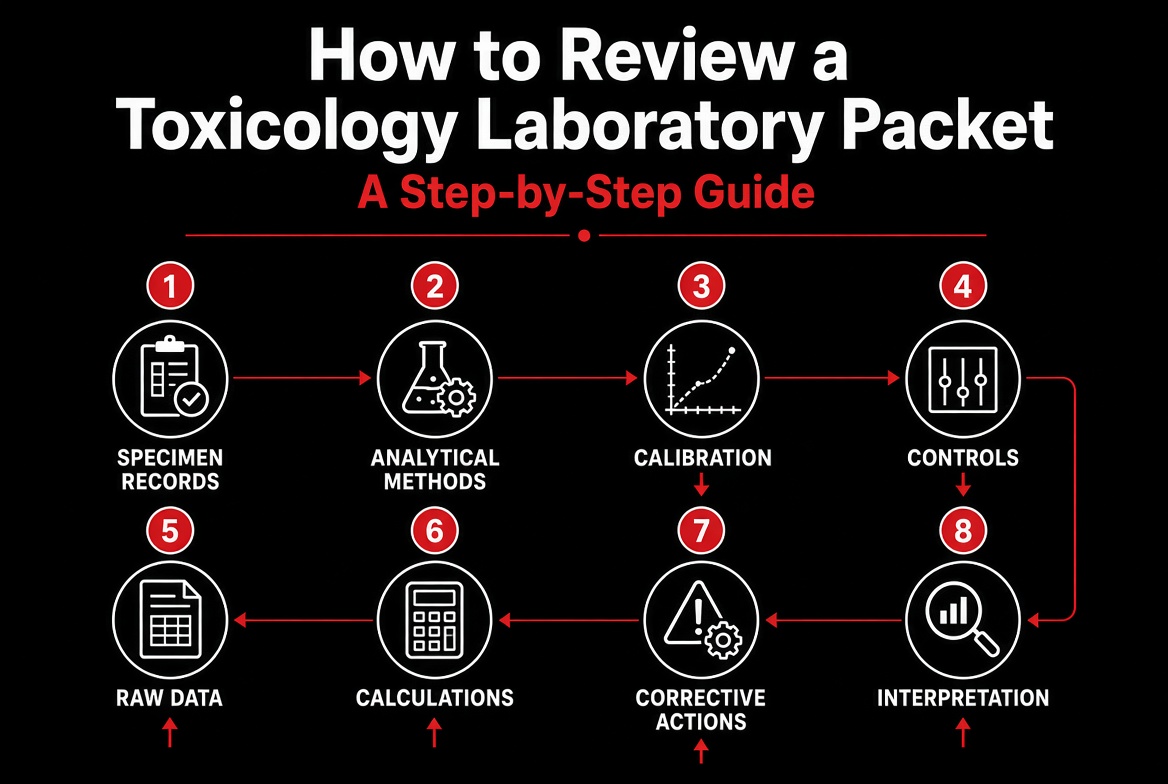
A toxicology laboratory packet should be reviewed as a connected system: specimen identity, analytical method, batch performance, result calculation, technical review, and interpretation. Reading only the final number can miss the records that show whether the number was generated and reported according to the laboratory’s own validated procedure.
The review sequence below is designed for attorneys, experts, and litigation teams working with alcohol, drug, medication, poison, or other toxicology evidence.
Start with the question the result is being used to answer
Before reviewing pages of instrument data, define the proposition in dispute. Common propositions include:
- A particular substance was present in the submitted specimen.
- The measured concentration is reliable.
- The person used a substance within a particular period.
- The person was impaired at the time of an event.
- A substance contributed to injury, death, or behavior.
- The specimen was adulterated, substituted, contaminated, or degraded.
Different propositions require different evidence. A packet that supports identification may still be insufficient for a timing or causation opinion.
Step 1: Build the specimen timeline
Create a chronology from the underlying records. Include the incident, observation, treatment, collection, sealing, transport, receipt, preparation, analysis, review, and reporting times. Identify every person or location in the evidence trail.
Check whether the specimen description stays consistent across the collection record, accession record, worksheets, instrument batch, and final report. Note the container, preservative, temperature, seal condition, and storage interval where documented. In postmortem cases, confirm the anatomical source instead of treating every blood specimen as equivalent.
Step 2: Identify the test sequence
Determine what the laboratory did first and what it did next. The sequence may include a broad screen, a targeted screen, confirmation, quantitation, dilution, repeat preparation, or referral to another laboratory. Identify which result was ultimately reported and why.
Ask whether the screen and confirmation target the same analyte. A class-based immunoassay response is not the same as compound-specific identification. A metabolite may establish prior exposure without establishing that the parent drug was circulating at a particular time.
Step 3: Match the method to the specimen and analyte
Review the standard operating procedure and validation summary applicable on the date of testing. Confirm that the method covers the reported analyte, specimen matrix, concentration range, and any dilution used in the case.
Key validation topics may include selectivity, interference, sensitivity, precision, bias, recovery, matrix effects, carryover, stability, calibration model, dilution integrity, and measurement range. The packet should show that the case result falls within the conditions the laboratory studied or should explain how an exception was handled.
Step 4: Read the batch before reading the case sample
The case specimen should be reviewed in the context of the analytical batch. Locate:
- Calibrators and the calibration model
- Positive and negative controls
- Method blanks and carryover blanks
- Internal-standard response
- Other samples immediately before and after the case specimen
- Dilutions, reinjections, repeat preparations, and reanalysis
Compare actual results with the laboratory’s acceptance criteria. If a control failed or a response was unusual, look for documented evaluation, corrective action, and authorization to proceed.
Step 5: Trace identification to the raw data
For chromatographic and mass-spectrometric methods, review the data used to identify the analyte. Depending on the procedure, relevant criteria may include retention time, ion transitions, ion ratios, spectral match, peak shape, signal-to-noise, and separation from potential interferences.
Do not evaluate a peak in isolation. Check the blank, calibrators, controls, internal standards, and neighboring samples. Determine whether the software integration was automatic or manually changed, and whether the audit trail documents the change.
Step 6: Reconstruct the quantitative result
Identify the calibration equation, weighting model, units, sample volume, extraction volume, dilution factor, and any conversion applied. Confirm that the reported value is within the validated reportable range. If the sample exceeded the range, determine whether it was diluted and whether dilution integrity was established.
Rounding and reporting conventions should be consistent with the procedure. Review whether measurement uncertainty is required, available, or relevant to the disputed threshold.
Step 7: Review quality events and corrective actions
Look for nonconformance reports, instrument errors, maintenance, failed suitability checks, repeat runs, analyst comments, and supervisor review. A documented problem does not automatically invalidate the result. The important questions are whether the problem could affect the case sample, whether it was investigated, and whether the response followed a defined procedure.
Also consider whether the record is complete. Missing pages, unexplained gaps in the instrument sequence, absent raw-data files, or a final report that cannot be traced to a reviewed batch may justify a focused supplemental request.
For evidential breath testing, the relevant packet extends beyond the result ticket. Use the breath-test source-record checklist to identify instrument, calibration, reference-material, operator, sequence, maintenance, and audit records that may be needed for scientific review.
Step 8: Separate analytical review from interpretation
Analytical review asks whether the reported test result is supported by the laboratory data. Interpretive review asks what that result means in the case. Both are important, but they use different evidence.
| Analytical question | Interpretive question |
|---|---|
| Was the analyte reliably identified? | What does its presence establish about exposure? |
| Was the concentration reliably measured? | What does that concentration mean in this specimen and timeline? |
| Did controls satisfy acceptance criteria? | Does the result support impairment, toxicity, or causation? |
| Was the method validated for the matrix? | What limitations and alternative explanations apply? |
Use standards as a review framework, not a substitute for evidence
The NIST Forensic Science Standards Library identifies current standards across forensic disciplines. A reviewer can use relevant standards, accreditation requirements, and the laboratory’s own procedures to frame questions about method validation, quality assurance, reporting, and testimony.
For federal workplace testing, SAMHSA’s drug-testing resources provide current program documents, custody and control materials, and laboratory information. Other settings may use different rules, so the first task is always to identify the governing program.
A concise laboratory packet review worksheet
- State the proposition the toxicology evidence is offered to prove.
- List every specimen, source, collection time, and reported analyte.
- Identify screening, confirmation, and quantitation methods.
- Match the case to the governing procedure and validation.
- Record calibration and control results against acceptance criteria.
- Trace each reported analyte to its raw identification data.
- Reconstruct each quantitative result and dilution.
- List repeats, manual changes, failures, and corrective actions.
- Separate analytical conclusions from timing, impairment, and causation opinions.
- Identify missing records and draft a focused supplemental request.
For scientific background on laboratory data, visit Toxicology Data Review. For litigation-oriented topic references, use the ForensicToxicology.net library.
Serious representation when medicine, drugs, alcohol, toxicology, or complex scientific evidence can determine the outcome. Contact The Okorocha Firm for legal representation, toxicology co-counsel, or expert-witness review.
This article provides general educational information and is not legal advice or a case-specific scientific opinion.