Amended Toxicology Reports: A Version Comparison Worksheet
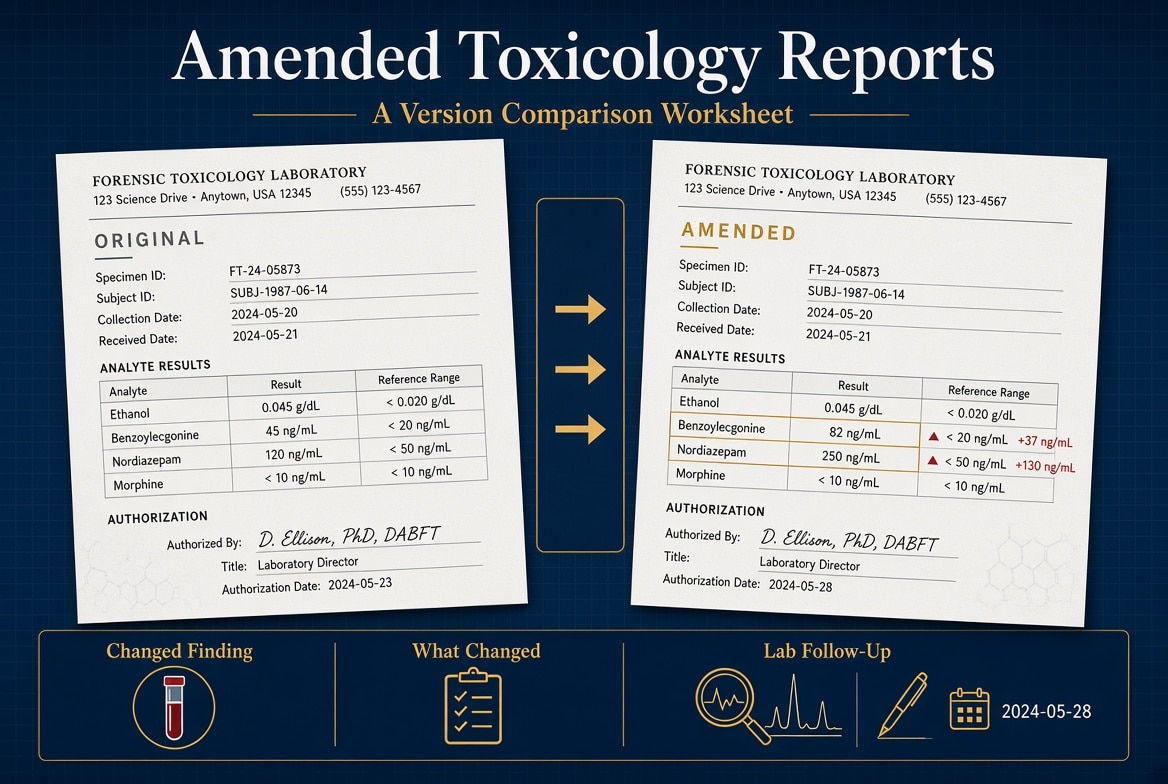
When a toxicology report changes, preserve both versions and identify exactly what changed before evaluating the effect on the case. This worksheet organizes that comparison. It is a document-review tool, not a rule that an amendment proves a laboratory error or makes an earlier opinion invalid.
Start with a version register
Keep each report as a separate file. Record the laboratory, accession number, specimen identifier, report date, version label, page count, and date received. Preserve the original filenames and accompanying correspondence. If the laboratory does not label versions, use neutral working labels such as Report A and Report B without changing the underlying documents.
For the broader production request, begin with the forensic toxicology case review checklist. Use this worksheet when the production contains a correction, addendum, supplemental result, or replacement report.
Compare fields rather than impressions
| Field | Record from each version | Follow-up question |
|---|---|---|
| Specimen identity | Accession, label, matrix, source, and collection time | Does the amendment concern the same submitted specimen? |
| Test coverage | Named analytes and method descriptions | Was a new test added, or was an existing finding revised? |
| Reported finding | Exact result, units, qualifiers, and thresholds | Which specific field changed? |
| Interpretation | Comments, limitations, and conclusions | Did the data change, the explanatory language change, or both? |
| Authorization | Signatures, release dates, and amendment explanation | Who can explain the reason and supporting record? |
Separate a correction from additional testing
Ask the laboratory to describe the change in its own terms. A revised identifier, an added analyte, a different numerical result, and a revised interpretive comment call for different follow-up. Do not infer the reason from the word amended alone. Request the stated reason, the relevant worksheet or audit entry, and identification of the report the laboratory currently considers operative.
Where new testing occurred, request the new analysis date and method and ask whether the work involved the original preparation, a new preparation from retained material, or a separately collected specimen. Organize those answers alongside the original test sequence. The laboratory packet review guide provides the wider record-review workflow.
Use a neutral hypothetical
Suppose Report A contains one result and Report B adds a second analyte while leaving the first unchanged. The comparison should state that an additional finding appeared. It should not label the original result false without supporting evidence. Conversely, if Report B changes a concentration, preserve the exact before-and-after entries and request the calculation or analytical record explaining the revision.
Track which opinion relied on which version
Create a second register for expert reports, correspondence, summaries, and demonstratives. For each item, record the laboratory report version it cites. Then ask the author whether the amendment affects the stated reasoning. This creates a traceable question for review without deciding the scientific answer in advance.
Questions to resolve before closing the comparison
- Are all pages and attachments available for both versions?
- Is every changed field identified in the worksheet?
- Has the laboratory supplied an explanation rather than an assumed explanation?
- Does each downstream summary identify the version it uses?
- Are unresolved issues listed with a responsible follow-up contact?
For a separate comparison of results from different specimens or methods, use the two-report comparison worksheet. Keep version control and scientific comparability as distinct review tasks.
Prepared with AI assistance as an educational document-review aid. This worksheet is not legal advice or a case-specific scientific opinion.



