California Forensic Toxicology Expert Testimony: Evidence Code, Sargon & Kelly
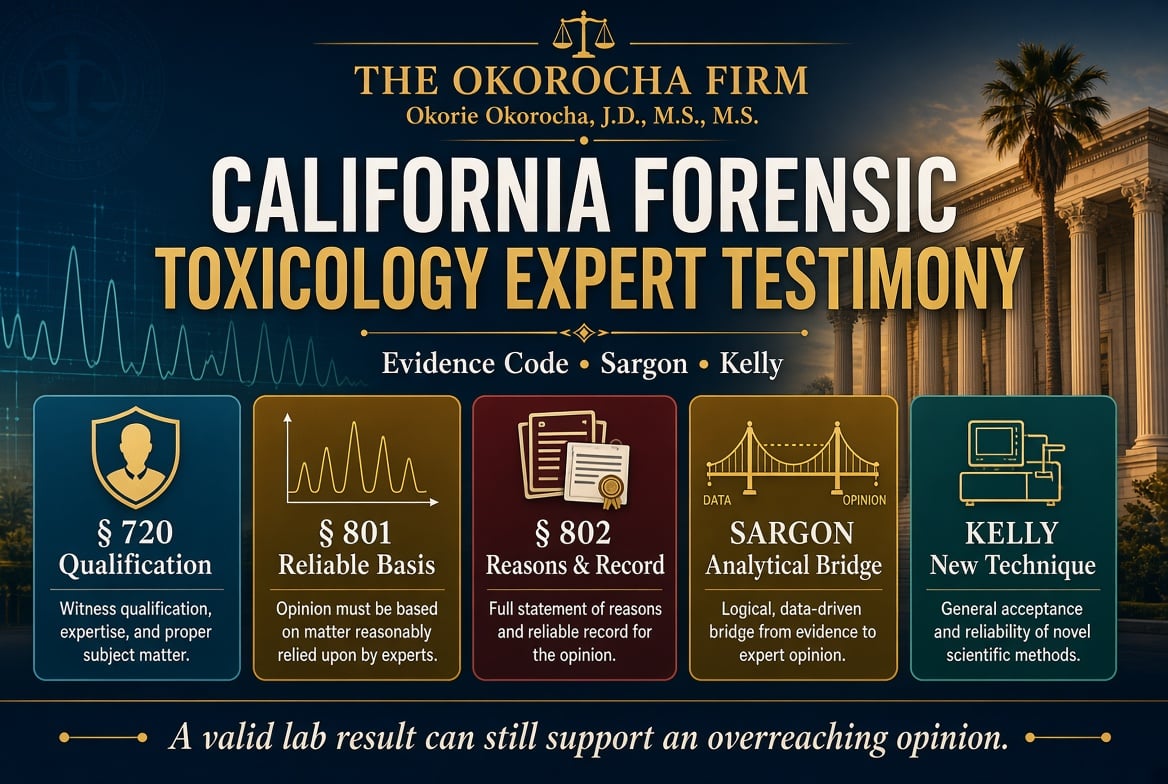
California forensic toxicology expert testimony is governed by a state-law framework that is different from federal Rule 702. In California state court, the core statutes are Evidence Code sections 720, 801, and 802. Trial courts also apply Sargon Enterprises, Inc. v. University of Southern California when evaluating whether an expert opinion rests on matter and reasoning that can reliably support the conclusion, and People v. Kelly when a party relies on a new scientific technique whose general acceptance is genuinely at issue.
This distinction matters in toxicology cases because a laboratory result can be analytically valid while the opinion built from that result still overreaches. Qualification, analytical method, specimen integrity, interpretation, and the ultimate legal opinion are separate issues and should be tested separately.
Quick answer: what must a California forensic toxicology expert show?
A California expert must first be qualified on the subject of the proposed testimony. The opinion must address a matter sufficiently beyond common experience to assist the trier of fact and must rest on information of a type experts reasonably rely upon in that field. The court may also examine the reasons and matter supporting the opinion. In a scientific case, that means counsel should look beyond the expert’s résumé and ask whether the underlying toxicology method, specimen, data, quality controls, assumptions, and inferential steps actually support the conclusion offered.
Evidence Code § 720: qualification is subject-specific
California Evidence Code § 720 addresses expert qualification. The relevant question is not whether a witness is impressive in the abstract. It is whether the witness has sufficient special knowledge, skill, experience, training, or education on the subject to which the testimony relates.
For forensic toxicology, that subject-specific inquiry can matter when testimony crosses boundaries. A witness may be qualified to explain laboratory testing but not necessarily to diagnose a medical condition, reconstruct driving behavior, opine on a pharmacogenetic mechanism, or convert a drug concentration into a precise degree of impairment. Conversely, a physician may understand clinical effects without having expertise in forensic laboratory validation, chromatographic data review, measurement uncertainty, or postmortem redistribution.
For a broader overview of the role itself, see Forensic Toxicology Expert Witness.
Evidence Code § 801: helpful subject matter and a reliable basis
Evidence Code § 801 limits expert opinion to subjects beyond common experience when expert assistance would help the factfinder, and to opinions based on matter of a type reasonably relied upon by experts in the field.
In a toxicology case, the second requirement is often where the real dispute lives. The opinion may depend on:
- the identity and integrity of the tested specimen;
- collection site, timing, preservatives, transport, and storage;
- the laboratory’s validated analytical scope;
- screening versus confirmatory methodology;
- calibration, controls, blanks, internal standards, and batch acceptance;
- limits of detection and quantitation;
- matrix effects, LC-MS/MS carryover and sequence effects, interferences, stability, and uncertainty;
- chromatographic peak integration, manual re-integration, and audit trails;
- pharmacokinetic assumptions;
- published literature and whether it actually applies to the specimen, population, route, dose, and time interval at issue.
The practical question is therefore not merely whether an expert cited literature or relied on a laboratory report. It is whether the cited matter reasonably supports the specific inferential step the expert is asking the court or jury to accept.
Evidence Code § 802: examine the reasons, not just the conclusion
Evidence Code § 802 permits examination of the reasons for an opinion and the matter on which it is based. In forensic toxicology litigation, this makes the underlying analytical record central.
A result such as “positive for methamphetamine,” “THC 4.2 ng/mL,” or “ethanol 0.09 g/dL” is only the beginning of the analysis. A meaningful challenge may require the full laboratory packet: chromatograms, spectra, calibration data, controls, sequence tables, integration history, instrument maintenance, validation records, chain of custody, specimen inventory, storage logs, and amended-report history.
See How to Review a Toxicology Laboratory Packet and the Forensic Toxicology Case Review Checklist. For the deeper technical reference material, see Toxicology Data Review and Method Validation in Forensic Toxicology. For case-specific review of the validation package, method version, QC, raw data, and audit records, see Validation Package Review in Forensic Toxicology.
Sargon: the court may test whether the reasoning actually supports the opinion
In Sargon Enterprises, Inc. v. University of Southern California (2012) 55 Cal.4th 747, the California Supreme Court confirmed a meaningful gatekeeping role for trial courts evaluating expert opinion. The court may examine the type of matter relied upon and the reasoning connecting that matter to the opinion. The point is not to decide which of two properly supported expert views is more persuasive; it is to exclude an opinion when the analytical bridge from data to conclusion is speculative or logically unsupported.
California Supreme Court case page for Sargon.
That framework maps naturally onto forensic toxicology. Examples of potential “analytical gap” problems include:
- treating a urine result as proof of impairment at a particular time;
- using a postmortem blood concentration as though it were a stable antemortem concentration without addressing redistribution;
- back-extrapolating a drug concentration using a population half-life without a defensible case-specific model;
- assuming a positive immunoassay identifies a specific drug without adequate confirmation;
- using plasma literature to interpret a whole-blood result without accounting for matrix differences;
- treating detection as proof of causation;
- using a therapeutic, toxic, or fatal concentration table as though the ranges were bright-line boundaries applicable to every individual and every matrix.
These are not merely “weight” arguments when the inferential method itself cannot support the proposition being offered. Whether exclusion is appropriate remains case-specific, but Sargon gives counsel a framework for identifying the precise unsupported step.
Kelly: when a new scientific technique is the issue
People v. Kelly (1976) 17 Cal.3d 24 remains the familiar California authority for the admissibility of evidence derived from a new scientific technique. The doctrine focuses on whether the technique has gained general acceptance in the relevant scientific community, whether the witness is properly qualified, and whether correct scientific procedures were used in the particular case.
Not every toxicology dispute is a Kelly dispute. Routine headspace gas chromatography for ethanol, established mass-spectrometric confirmation, or ordinary immunoassay screening may involve familiar techniques. The more productive challenge may instead concern validation, selectivity, matrix suitability, calibration, laboratory execution, or interpretation. Kelly becomes more important when the proponent relies on a genuinely novel analytical technique, a new application of an existing technique, or a scientific proposition presented as established when acceptance in the relevant field is uncertain.
California’s published-opinion resources are available through the Judicial Branch of California opinions portal.
California state court is not federal Rule 702
Federal courts apply Federal Rule of Evidence 702 and the federal reliability framework. California state courts apply California’s Evidence Code and California precedent. Counsel should therefore avoid importing federal terminology mechanically into a California state-court motion.
For federal cases, see Rule 702 and Forensic Toxicology Expert Testimony. The scientific records that matter may overlap, but the governing admissibility doctrine is different.
A litigation framework for challenging a toxicology opinion
1. Define the exact opinion
Separate identification, concentration, timing, impairment, causation, source attribution, and medical diagnosis. An expert may be well supported on one and unsupported on another.
2. Match the opinion to the expert’s actual qualifications
Use Evidence Code § 720 to identify whether the witness has relevant expertise for the precise proposition offered, not merely adjacent credentials.
3. Identify every factual and scientific premise
List the specimen assumptions, analytical assumptions, literature, pharmacokinetic assumptions, and case facts that form the chain of reasoning.
4. Test the laboratory foundation
Review whether the method was validated for the analyte and matrix, whether quality-control criteria were met, whether the instrument data support identification and quantitation, and whether the result survived proper technical and administrative review. If batch performance or laboratory competence is disputed, treat those as separate evidentiary questions: quality control addresses the analytical batch that produced the case result, while proficiency testing addresses performance on controlled challenge samples.
5. Test the interpretive bridge
Ask whether the cited scientific literature actually supports the proposed conclusion at the relevant concentration, matrix, time, route, and population. This is often the central Sargon issue.
6. Decide whether the issue is qualification, foundation, reliability, novelty, or weight
Different defects call for different objections and different records. A vague attack on “the science” is usually less effective than identifying the exact unsupported premise or methodological failure.
Frequently asked questions
Can a California court exclude a toxicology expert who is qualified but uses unreliable reasoning?
Yes. Qualification is only one part of admissibility. A court may examine the matter relied upon and the reasoning connecting that matter to the opinion. A strong résumé does not cure a speculative analytical leap.
Does a positive toxicology result prove impairment?
No. Detection and impairment are different propositions. The answer depends on the drug, specimen, timing, concentration, pharmacology, tolerance, observed behavior, and the scientific validity of any concentration-effect relationship being asserted.
Does a laboratory’s accreditation make every result admissible?
No. Accreditation is important evidence of a quality system, but a specific result still depends on the method, matrix, batch performance, specimen integrity, records, and interpretation in the case at hand.
Is a Kelly hearing required in every forensic toxicology case?
No. Kelly is directed to new scientific techniques and related acceptance questions. Many toxicology disputes concern established methods but disputed validation, execution, specimen handling, or interpretation.
What records are most useful before deposing a toxicology expert?
At minimum, obtain the complete report history, chain of custody, specimen inventory, analytical sequence, chromatograms or spectra, calibration and controls, method validation or verification records, relevant SOPs, uncertainty information, and any technical-review documentation. The exact request should be tailored to the opinion being challenged.
How should counsel approach a toxicology result near a cutoff?
When a reported concentration is close to a statutory limit, reporting threshold, or other consequential numerical boundary, counsel should determine whether the laboratory evaluated measurement uncertainty, what decision rule applies at the boundary, how the result was rounded, and whether the uncertainty estimate corresponds to the analyte, matrix, and method actually used. A close numerical distinction should not be treated as more exact than the measurement process can support. For the technical framework, see Measurement Uncertainty Near Forensic Toxicology Cutoffs.
When does specimen storage become a meaningful expert issue?
Specimen handling and storage can matter when an opinion assumes that the concentration measured days, months, or years after collection is equivalent to the concentration originally present. Counsel should identify the matrix, preservative, container, storage temperature, elapsed time, transport conditions, aliquoting history, and known freeze–thaw events, then determine whether the expert can point to analyte- and matrix-specific stability data that reasonably match those conditions.
This is especially important in delayed retesting, postmortem cases, disputed quantitative comparisons, and cases near a cutoff or other decision point. A validated analytical method does not by itself establish that every stored specimen remained chemically unchanged before analysis. For the underlying science, see Specimen Stability in Forensic Toxicology: Storage, Freeze–Thaw, and Degradation.
Technical resources for the science behind the legal challenge
When does specimen homogeneity become a litigation issue?
Homogeneity matters when the tested aliquot may not fairly represent the larger specimen. Potential examples include clotted or separated blood, decomposed postmortem specimens, gastric contents containing visible pill material, tissue homogenates, or a reanalysis performed from a different aliquot. Counsel should distinguish analytical precision from the separate sampling question: a highly precise instrument can still measure a nonrepresentative aliquot precisely. The technical foundation is discussed in Specimen Homogeneity and Aliquot Representativeness in Forensic Toxicology.
The law-firm site addresses admissibility, litigation strategy, and expert use. The technical reference library at ForensicToxicology.net provides deeper scientific treatment of analytical methods, method validation, measurement uncertainty, chain of custody, and postmortem redistribution.
About the author
Okorie Okorocha, J.D., M.S., M.S. is an attorney and forensic toxicology expert witness. This page is written to separate the legal admissibility question from the laboratory-science question so that each can be examined on its own record.
Last reviewed September 20, 2026. This article provides general legal and scientific information and is not legal advice for any particular case.



