A Longer Visual-Memory Test Detected THC Effects That Shorter Tests Could Miss
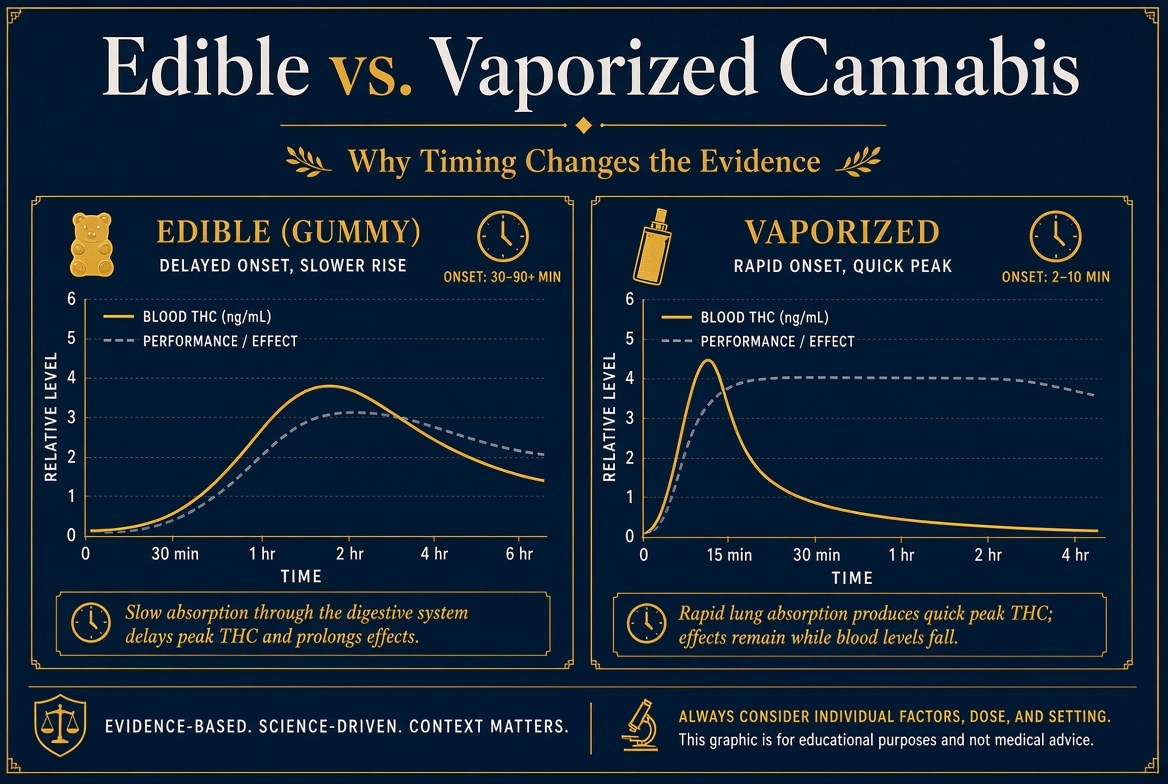
A controlled THC study found a visual working-memory deficit and showed how a short or small experiment could miss it. A null result from a different brief task is therefore not automatically evidence that THC leaves memory unchanged.
Two separate human experiments
Researchers conducted two randomized, double-blind crossover experiments, each contributing 23 participants to the reported working-memory analyses. Participants received placebo and oral THC; both experiments included a 15-mg condition, while one also included 7.5 mg.
The main task required participants to report briefly presented visual information across 90 trials. This assessed temporary visual working memory, not every form of memory or actual driving.
The dose comparisons were not identical
The 15-mg dose reduced working-memory performance in both experiments. In the experiment containing 7.5 mg, the lower-dose comparison with placebo did not reach conventional statistical significance, even though a dose-related trend was present.
That combination matters. The findings do not justify saying that every tested dose produced the same demonstrated deficit. They also do not justify treating the lower-dose null comparison as proof of no possible effect.
Sensitivity was part of the research question
The authors examined how sample size and task duration influence the likelihood of detecting an effect. A reliable task with more observations can identify an average change that a brief measure may miss.
Task trials improve measurement within a person; they do not create additional independent participants. The two experiments recruited separate groups, allowing the common 15-mg comparison to be combined without counting the same people twice.
Awareness and performance require separate analysis
THC also affected reported mind wandering and aspects of metacognitive accuracy in the respective experiments. Those outcomes offer possible insight into the experience of a deficit, but they do not prove one single mechanism explains every error.
The study used oral THC in selected healthy adults and did not establish a blood-concentration cutoff, crash-risk estimate or universal duration of impairment. The useful inference is narrower: the measurement method helps determine whether a cognitive effect becomes statistically visible.
For the separate forensic question, see our discussion of cannabinoid concentrations and evidence of impairment.
Primary research
Δ9-Tetrahydrocannabinol (THC) impairs visual working memory performance: a randomized crossover trial. Neuropsychopharmacology (2020). DOI: 10.1038/s41386-020-0690-3.



