A Human CBD Conversion Study Relied on Chromatographic Separation, Not Mass Signals Alone
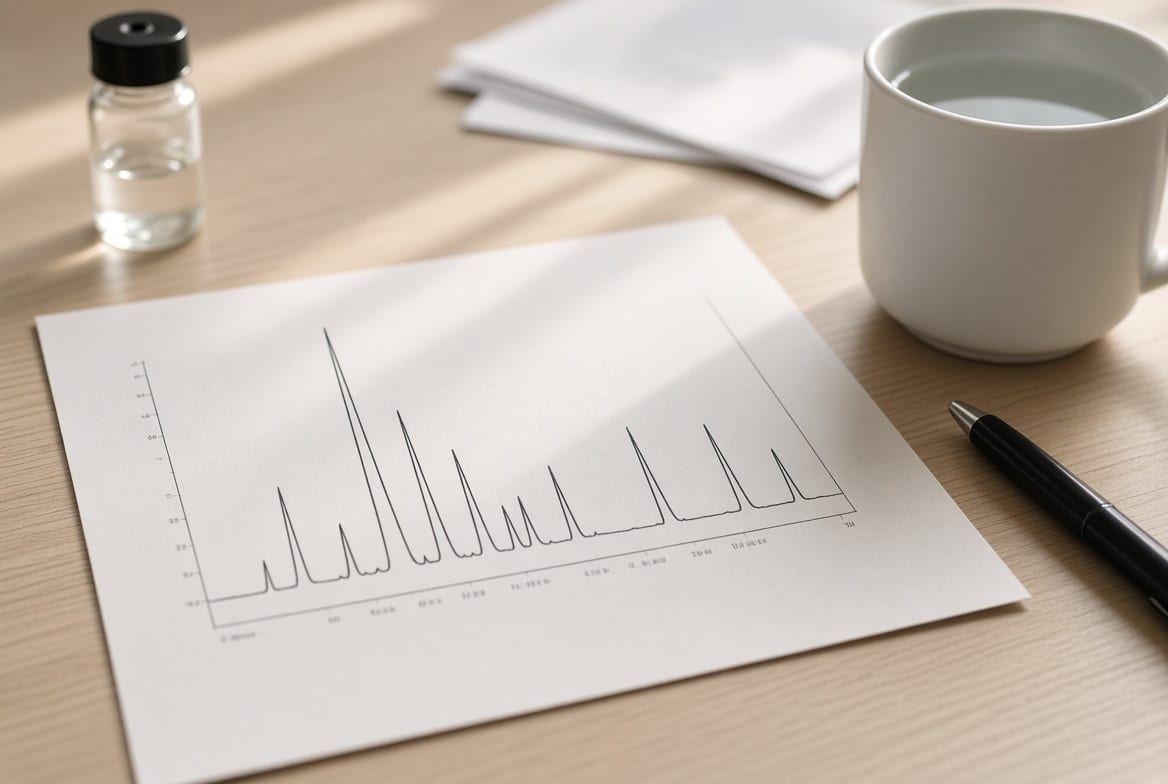
A human study found no detectable THC signal after the tested oral CBD formulation, but its analytical reasoning is as important as the headline. CBD and THC can share mass-spectrometry transitions, making chromatographic separation essential to interpreting an apparent conversion result.
The human experiment tested a defined formulation
The study examined samples associated with 300 mg oral CBD in a corn-oil formulation under fasting and fed conditions. Its report describes 120 healthy participants across those conditions, with withdrawals detailed separately.
The analytical specimen was plasma in the methods and assay validation. That is distinct from a stomach-fluid experiment, an animal tissue experiment or a product-label survey. It also should not be casually relabeled whole blood because of inconsistent wording in the discussion.
Similar signals do not establish the same chemical
The authors explained that CBD and the THC isomers can share the monitored mass-spectrometry transition. They used different chromatographic retention behavior to distinguish CBD from potential THC signals.
A detector response without adequate separation can therefore be misleading. The experiment evaluated possible THC interference and monitored the relevant chromatographic regions, rather than assuming that a shared ion transition uniquely identified THC.
The negative finding is narrower than absolute zero
The researchers reported no detectable delta-8 or delta-9 THC in the analyzed human samples after the tested CBD preparation. That result does not demonstrate that every conceivable trace concentration was absent under every dosing condition.
The paper’s fully quantified CBD assay and its semiquantitative assessment of THC should also be distinguished. The stated CBD quantification limit should not be presented as a separately validated universal THC detection threshold.
What the evidence supports
These human findings do not support assuming that an unexplained THC result must have arisen from CBD conversion inside the person. They also cannot determine the composition of a different commercial CBD product, rule out contamination or establish chronic safety.
A sound evaluation asks which formulation was administered, what specimen was analyzed, how the compounds were separated and what the method could detect. Laboratory chemistry, human pharmacokinetics and the contents of a retail product remain separate evidentiary questions.
For the separate forensic question, see our discussion of cannabinoid concentrations and evidence of impairment.
Primary research
Oral Cannabidiol Does Not Convert to Δ8-THC or Δ9-THC in Humans: A Pharmacokinetic Study in Healthy Subjects. Cannabis and Cannabinoid Research (2020). DOI: 10.1089/can.2019.0024.



