A Cannabis Trial’s Smoking-Procedure Change Was Not a Randomized Safety Comparison
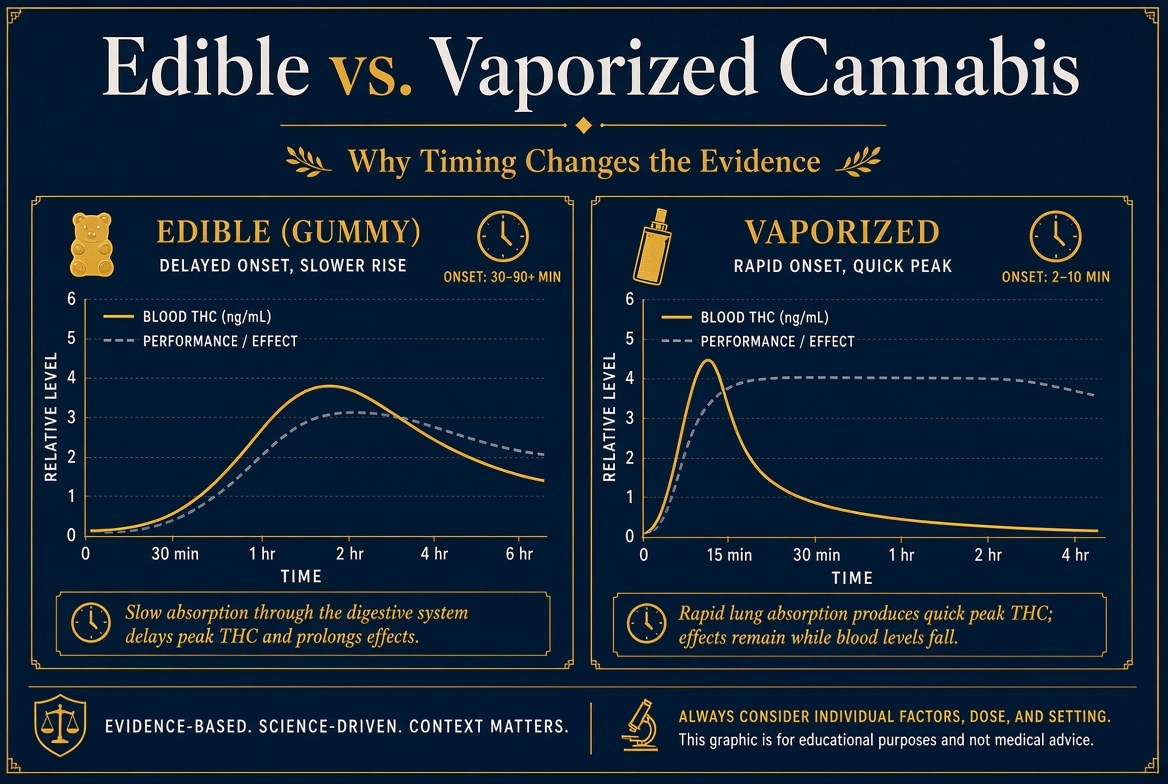
A cannabis driving trial reported fewer adverse events after switching from paced smoking to smoking to a desired effect. That observation does not establish the size of a causal safety benefit. The trial randomized cannabis-potency conditions; the smoking procedure changed during the study because the initial procedure was poorly tolerated.
What was randomized—and what changed
Brands and colleagues conducted a placebo-controlled crossover trial involving adults who regularly used cannabis. Participants received cigarettes with placebo or different THC potencies in randomized sequences. Fifty-four people were randomized, 49 received at least one study condition, and 35 completed the per-protocol analysis.
The initial procedure used timed instructions for inhaling, holding and exhaling smoke. After tolerability problems and consultation with the study’s safety board, the researchers adopted an ad libitum procedure: participants smoked to their usual desired effect. The paper describes 53 paced-smoking sessions and 99 ad libitum sessions.
That mid-study adaptation differs from assigning people or sessions randomly between two smoking procedures. Randomization of potency does not automatically remove confounding from every later comparison within the trial.
Count events, sessions and people separately
The paper reported 24 adverse events among 18 of the 49 dosed participants. Nineteen events were mild and five moderate; none were classified as severe or serious. Fifteen events occurred under the fixed procedure and nine under ad libitum smoking.
Those are event counts. They are not counts of fifteen affected people versus nine affected people, and the two procedures did not have equal numbers of sessions. Simply comparing fifteen with nine does not provide a participant-level risk reduction. Even an event-per-session calculation would remain an observational comparison within an adapted protocol.
The change was a practical response to tolerability concerns. It does not establish that self-directed smoking eliminates adverse effects, particularly because events also occurred under that procedure.
A null blood comparison did not prove equivalence
The researchers found no significant main effect of smoking procedure on whole-blood THC concentrations in their model, with p = 0.55. The corresponding comparisons for 11-hydroxy-THC and THC-COOH were also not statistically significant.
Failure to detect a difference is not the same as demonstrating that two procedures deliver equivalent exposure within a prespecified acceptable margin. A null concentration comparison also cannot establish equal tolerability or identical driving performance. These are separate outcomes requiring their own evidence.
The driving findings still require a balanced reading
The primary outcome, mean speed, did not show a significant potency effect. Several secondary outcomes did: all active conditions increased lane-position variability relative to placebo, while medium and high potencies increased reaction time. The paper reported whole-blood THC associations with lane control and reaction time, but did not validate a universal concentration threshold for classifying individual drivers.
Important limitations included the smaller-than-planned sample, unadjusted pairwise comparisons and the use of two smoking procedures. Simulator drives began at 30 and 90 minutes, so the experiment could not establish when driving performance returned to baseline beyond that period.
For evidence review, identify which intervention was randomized, which comparisons followed a protocol adaptation, and whether the denominator is people, sessions or events. Related research on driving confidence and simulator recovery concerns a separate trial and should not be combined with these participants as though it were the same experiment.
Primary research
Bruna Brands and colleagues. Scientific Reports (2026), 16:12961. Potency-related effects of smoked cannabis on simulated driving performance: a randomized, controlled crossover trial.



