Rule 702 and Forensic Toxicology Expert Testimony
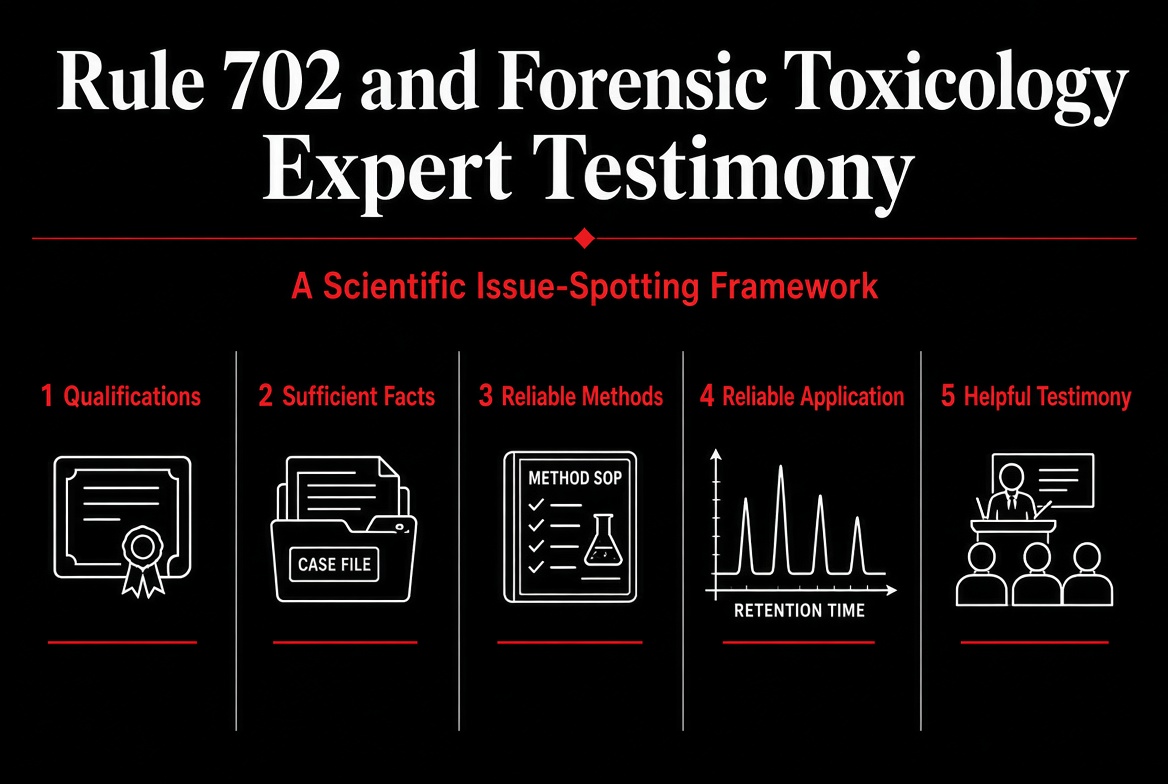
Federal Rule of Evidence 702 requires the proponent of expert testimony to show that the expert is qualified, the testimony will help the factfinder, the opinion rests on sufficient facts or data, reliable principles and methods were used, and those principles and methods were reliably applied to the facts. In a forensic toxicology dispute, that framework should be connected to the actual specimen, analytical data, laboratory procedures, interpretive reasoning, and limitations of the opinion.
Rule 702 is not satisfied by a credential list alone. Qualifications matter, but the court’s reliability inquiry also concerns what the expert did in the case and how the expert moved from laboratory evidence to the offered conclusion.
The current Rule 702 framework
The authoritative current rule and official materials are available from the United States Courts’ Federal Rules of Evidence page. The rule places the admissibility showing on the proponent by a preponderance of the evidence. The court evaluates whether:
- The expert’s specialized knowledge will help the trier of fact understand evidence or decide a fact in issue.
- The testimony is based on sufficient facts or data.
- The testimony is the product of reliable principles and methods.
- The expert’s opinion reflects a reliable application of those principles and methods to the case facts.
The precise legal analysis depends on the court, claims, defenses, deadlines, and record. This article provides a scientific issue-spotting framework, not a prediction about admissibility.
1. Qualifications should match the opinion
A toxicologist may be qualified in one area and not another. Relevant experience could involve analytical chemistry, laboratory quality systems, pharmacology, postmortem toxicology, alcohol calculations, workplace testing, clinical interpretation, or impairment analysis. The offered opinion should be compared with the expert’s education, training, practical experience, publications, proficiency, and recent work in that particular subject.
The question is not whether the witness has ever worked in toxicology. It is whether the witness has specialized knowledge relevant to the actual opinion.
2. Sufficient facts and data begin with the complete case record
An opinion based only on a final toxicology report may omit the raw data and quality records needed to assess analytical reliability. Depending on the issue, sufficient facts may include collection documentation, specimen source, timestamps, chain of custody, screening and confirmation data, calibrators, controls, blanks, chromatograms, spectra, validation, procedures, uncertainty, medical records, dose information, and contemporaneous observations.
A missing fact does not automatically make an opinion inadmissible. The question is whether the omitted or assumed information is important to the reasoning and whether the expert candidly accounts for the limitation.
3. Reliable methods must fit the analytical question
Method reliability may involve both the laboratory procedure and the expert’s interpretive method. For the laboratory component, review whether the method was validated or verified for the analyte, matrix, and range; whether the case batch met acceptance criteria; and whether the reported result can be traced to the raw data.
For the interpretive component, identify the method used to infer exposure, timing, impairment, toxicity, or causation. An expert should not treat a screening cutoff as an impairment threshold or use a urine concentration as if it were a contemporaneous blood concentration without a scientifically supported bridge.
The NIST Forensic Science Standards Library can help identify standards relevant to forensic practice. Standards inform the inquiry, but the case still requires evidence showing which procedure applied and how it was followed.
4. Reliable application is case-specific
A generally accepted method can still be applied unreliably. In forensic toxicology, application questions may include:
- Whether the expert used the correct specimen source and units
- Whether collection delay and storage were considered
- Whether the parent drug and metabolites were distinguished
- Whether calibration, controls, and interferences were reviewed
- Whether assumptions about dose, timing, absorption, elimination, or tolerance were supported
- Whether postmortem redistribution or decomposition was relevant
- Whether alternative medical or behavioral explanations were considered
- Whether the conclusion exceeds the method’s validated or published limits
Reliable application should be visible in the report, deposition, calculations, or disclosed work product. A conclusion without the reasoning steps is difficult to test.
5. The opinion should help rather than replace the factfinder
Expert testimony can help explain laboratory methods, pharmacology, measurement limitations, and the range of conclusions supported by the evidence. It should not disguise an unsupported legal conclusion as science or imply that a laboratory result decides credibility, intent, negligence, or guilt by itself.
Clear testimony distinguishes scientific propositions. Identification is different from quantitation. Exposure is different from impairment. Association is different from causation. An expert who explains those boundaries may be more helpful than one who states the broadest possible conclusion.
Rule 702 toxicology review table
| Rule 702 issue | Toxicology records to examine | Focused question |
|---|---|---|
| Qualifications | CV, training, case experience, publications, proficiency | Do the qualifications fit the specific opinion? |
| Sufficient facts or data | Complete laboratory packet, timeline, medical and observational record | Were important facts omitted or assumed? |
| Reliable principles and methods | Validation, procedures, standards, literature, calculations | Is there a reliable method for the proposition offered? |
| Reliable application | Raw data, controls, notes, report reasoning, deposition | Was the method reliably applied to this specimen and these facts? |
| Helpfulness | Scope of opinion and disputed issues | Does the testimony explain science without overstating it? |
California qualification and cross-examination issues
California state-court analysis uses California law rather than Federal Rule 702. California Evidence Code section 720 addresses qualification of expert witnesses through knowledge, skill, experience, training, or education. Evidence Code section 721 addresses expert cross-examination, including qualifications, the subject of testimony, and the matters and reasons on which the opinion is based.
The federal and California frameworks should not be collapsed into one test. Counsel should apply the controlling authority and procedural rules for the forum. For the state-law analysis, see California Forensic Toxicology Expert Testimony: Evidence Code, Sargon & Kelly.
Questions for a forensic toxicology expert
- What exact scientific proposition are you offering?
- Which facts and data did you rely upon, and which requested records were unavailable?
- What method connects the laboratory result to your opinion?
- Was that method validated for this analyte, specimen, concentration, and use?
- What quality-control data did you review?
- What assumptions did you make about dose, timing, metabolism, tolerance, or behavior?
- What alternative explanations did you evaluate?
- What can the result establish, and what can it not establish?
- What error, uncertainty, or limitation should accompany the conclusion?
- Did you apply the same level of rigor used in your professional work outside litigation?
Build the admissibility record around the scientific chain
A useful Rule 702 record follows the chain from specimen to opinion: collection, identity, method, batch performance, result, interpretation, and case-specific application. Each link should identify the supporting evidence, assumptions, and limits.
For scientific background, see Method Validation in Forensic Toxicology. For litigation-oriented evidence topics, visit the ForensicToxicology.net library.
SCIENCE. STRATEGY. TRIAL EXPERIENCE. The Okorocha Firm evaluates complex scientific evidence for legal representation, toxicology co-counsel, and expert-witness matters.
This article provides general educational information and is not legal advice or a case-specific admissibility opinion.