Lack of Correlation Between Urine Drug Levels, Blood Drug Levels, and Impairment

Lack of Correlation Between Urine Drug Levels, Blood Drug Levels, and Impairment
Introduction
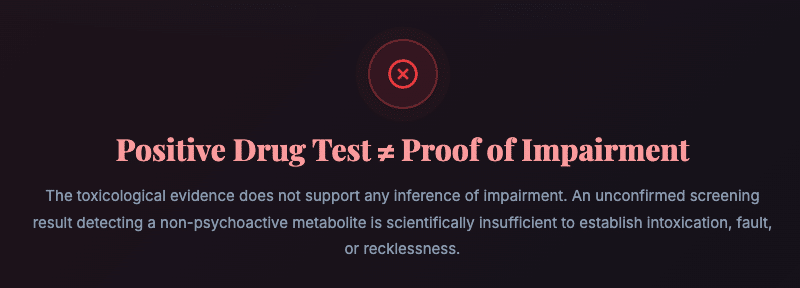
In objectively quantifying drug-induced impairment, there is critical distinction between mere presence of a substance and its psychoactive effect on an individual’s functional capacity (Compton et al., 2009).
Specifically, while drug concentrations in biological samples can confirm exposure, they frequently do not correlate with the degree of psychomotor, behavioral, or executive function impairment due to variables such as individual sensitivity, tolerance, metabolism, and the chronicity of drug administration (Berning et al., 2015).
This discrepancy is particularly pronounced with urine analysis, which primarily indicates past exposure and cannot reliably reflect current drug concentrations in the brain or the immediate effects on cognitive and motor functions (Busardò et al., 2017). Consequently, establishing a direct causal link between drug presence in urine and impairment is scientifically untenable, given that urine drug levels do not correlate with blood concentrations, nor do blood concentrations consistently predict impairment (Reisfield et al., 2012).
The notion of a direct correlation between blood drug concentrations and driving performance has even been described as a “mirage” by some researchers, underscoring the complexities involved in establishing such a link for illicit substances (Ferrari et al., 2025; Liebenberg et al., 2019).
Indeed, prior investigations have consistently failed to establish a clear relationship between specific blood concentrations of Δ9-tetrahydrocannabinol and impairment, thereby precluding a robust scientific justification for the implementation of legal “per se” Δ9-THC blood concentration limits (DeGregorio & Wurz, 2022). This complex pharmacokinetic profile, coupled with inter-individual variability in metabolism and tolerance, further complicates the establishment of universally applicable per se limits for THC in biological fluids (Clément et al., 2024). This challenge is further compounded by the fact that cannabinoids and their metabolites can persist in the body for extended periods, making it difficult to distinguish between recent use and active impairment (McDonald et al., 2021).
Furthermore, studies indicate a poor and inconsistent relationship between the magnitude of impairment and THC concentrations in biological samples, which means that conventional per se limits are ineffective in reliably differentiating impaired from unimpaired drivers (Arkell et al., 2021). For instance, Δ9-THC concentrations exceeding 5 ng/mL have been observed in a significant proportion of subjects after a 12-hour abstinence period without any concurrent impairment (Wurz & DeGregorio, 2022). In frequent cannabis users, metabolites of ∆9-THC, such as 11-nor-9-carboxy-∆9-THC, and even ∆9-THC itself, can be detected in urine for several weeks after the last use, further complicating the assessment of acute impairment (DeGregorio et al., 2021).
The lack of a consistent relationship between THC blood concentrations and driver impairment is primarily attributed to the complex pharmacokinetics and metabolism of THC, alongside significant inter-individual variability in drug response (Busardo et al., 2017). This variability means that similar doses can lead to disparate blood concentrations, and the subjective feeling of confusion may correlate more strongly with driving skills than the objective blood level of THC (Busardò et al., 2017).
This pharmacokinetic complexity underscores why some cannabis-induced effects and impairments can persist even after blood THC concentrations have fallen below the limits of quantification, highlighting the inadequacy of blood levels as a sole indicator of intoxication (Spindle et al., 2018). This issue is exacerbated by the lipophilic nature of cannabinoids, which results in less orderly pharmacokinetics compared to substances like alcohol, making direct correlation between blood concentrations and impairment particularly challenging (Zamarripa et al., 2022).
Literature Review
Given these complexities, establishing definitive impairment thresholds based on cannabinoid concentrations in biological fluids presents significant scientific and practical hurdles (Li & An, 2025). Several studies have indicated that many regular cannabis users can exceed zero tolerance or per se THC cut-point concentrations days after their last use, without exhibiting any evidence of impairment (Fitzgerald et al., 2025). In fact, research has demonstrated that all proposed THC concentration thresholds for per se laws would lead to a substantial number of misclassifications, including both false positives and false negatives, indicating that a quantitative per se threshold for THC lacks scientific support (Pearlson et al., 2021).
This lack of a clear dose-response relationship further complicates the implementation of per se limits, as even low concentrations of Δ9-tetrahydrocannabinol in blood may persist for several days in chronic users after cessation, without necessarily correlating with ongoing neurocognitive deficits (Karschner et al., 2009).. Moreover, some governmental agencies prohibit cannabis use for 24 hours, 28 days, or even indefinitely before safety-sensitive work, yet a scientific consensus on what threshold THC concentration should be enforced remains elusive (Beckson et al., 2019).
The challenges in correlating blood THC levels with impairment are further compounded by the observation that even after a week of abstinence, chronic cannabis users can still exhibit THC concentrations as high as 3 ng/mL (Schlienz et al., 2020). This persistence of THC at concentrations typically associated with impairment, even after prolonged abstinence, further highlights the limitations of using a simple concentration threshold to infer active impairment in forensic contexts (Karschner et al., 2009). The detection of residual THC in the blood of chronic frequent smokers for up to a month of sustained abstinence further complicates the establishment of evidence-based per se laws for driving under the influence of cannabis (Bergamaschi et al., 2013; Hartman et al., 2015).
This extended detection window can lead to legal ramifications for individuals who are not acutely impaired, challenging the foundational premise of per se drugged driving statutes (Bergamaschi et al., 2013; Fitzgerald et al., 2025). These complexities are particularly salient given the increased prevalence of driving under the influence of cannabis post-legalization and the associated rise in motor vehicle collisions, underscoring the urgent need for a consistent, scientifically defensible impairment standard rather than reliance on mere presence of metabolites (Metrik & McCarthy, 2023).
Consequently, current scientific consensus indicates that there is no unequivocal relationship between specific blood or oral fluid concentrations of ∆9-THC and actual impairment, rendering the scientific justification for per se legal limits questionable (Wurz & DeGregorio, 2022). This lack of direct correlation between THC levels and impairment suggests that existing per se laws may not accurately identify impaired individuals, leading to potential miscarriages of justice and undermining public trust in drug-impaired driving enforcement (DeGregorio & Wurz, 2022).
Therefore, developing an objective and universally accepted means of determining recent cannabis use and impairment remains a significant challenge that cannot be adequately addressed by currently available breath- or blood-based testing methods (Clément et al., 2024).
This situation is particularly problematic in states where any detectable amount of THC or its metabolites is deemed sufficient for a drugged driving conviction, given the prolonged detectability of these compounds (Pearlson et al., 2021). This discrepancy often results in legal repercussions for individuals who may have consumed cannabis days or weeks prior but are not actively impaired while operating a vehicle (Fitzgerald et al., 2025). Moreover, the interpretation of toxicological findings is further complicated by the interaction of cannabis with other substances, which can confound impairment assessments and lead to false attributions of causation (DeGregorio et al., 2024).
This intricate interplay necessitates a more comprehensive approach to impairment assessment that extends beyond simple concentration measurements in biological matrices, especially given the complexities introduced by the increasing popularity of hemp-derived cannabidiol products (DeGregorio et al., 2024). The poor correlation between THC levels in blood or oral fluid and actual impairment further precludes their use as reliable indicators for driving impairment (Compton & Research, 2018).
This challenge highlights the need for advanced methods to assess impairment directly, rather than relying on drug concentrations that do not consistently reflect acute psychomotor deficits (Busardo et al., 2017; Compton & Research, 2018). Thus, the validity of driving simulators as proxies for on-road driving impairment remains underexplored, complicating efforts to establish scientifically robust impairment standards (Pearlson et al., 2021). Therefore, there is an urgent need to identify novel biomarkers of cannabis exposure and/or behavioral tests that can reliably and accurately detect cannabis impairment at the roadside and in the workplace (Spindle et al., 2021).
This necessitates a paradigm shift towards developing and validating sensitive biomarkers combined with technologically-advanced behavioral methods to improve the precision and accuracy in determining cannabis-induced driving impairment (Metrik et al., 2026). Such developments are critical given the documented increase in motor vehicle collisions and concerns about public safety following cannabis legalization, necessitating clear messaging regarding risk and robust enforcement strategies (Metrik & McCarthy, 2023).
Specifically, ongoing research aims to develop accurate biomarkers that reflect the complexities of cannabinoid pharmacokinetics and improve the understanding of drug interactions, especially with alcohol, as psychomotor impairments appear more severe when these substances are combined (Costain & Laprairie, 2019; Samet et al., 2025). However, a significant challenge remains in developing objective measures that can detect impairment with robust specificity, as even in controlled settings, cognitive testing has limitations in identifying impaired drivers (Marcotte et al., 2023). Consequently, there is a pressing demand for standardized methodologies to characterize cannabis consumption levels and compound composition, as the varying constituents in cannabis samples pose a challenge to systematic research (Balodis & MacKillop, 2019).
Furthermore, the variability in individual responses to THC, significantly influenced by cannabis use history, further complicates the development of universal impairment metrics (Arkell et al., 2019). This variability underscores the critical need for comprehensive pharmacokinetic and pharmacodynamic studies to establish a scientifically robust foundation for cannabis driving regulations (Li & An, 2025).
This is particularly critical given that previous research indicates that whole blood tetrahydrocannabinol concentrations do not consistently correlate with psychomotor impairment, especially in heavy, chronic cannabis users who may exhibit tolerance to certain effects (Schwope et al., 2012).
Therefore, reliance on static blood concentrations alone is insufficient for accurately determining impairment, especially when considering the complex interplay of tolerance and individual physiological responses to cannabis. This necessitates focused research on developing sensitive biomarkers and technologically advanced behavioral assessments to enhance the precision and accuracy of cannabis-induced driving impairment determination, as current impairment standards are lacking (Metrik et al., 2026; Spindle et al., 2021).
A direct assessment of neurocognitive function is therefore essential to determine actual impairment, rather than relying on the detection of drug metabolites which merely indicate exposure and do not correlate with real-time psychoactive effects (Costales et al., 2023).
This approach recognizes the limitations of current analytical methods and emphasizes the need for ecologically valid performance-based assessments. Indeed, field sobriety tests, while validated for alcohol, show variable sensitivity for cannabis-induced impairment and often lack the specificity to distinguish cannabis effects from other factors (Bosker et al., 2012; Marcotte et al., 2023).
Discussion
This variability underscores the critical need for comprehensive pharmacokinetic and pharmacodynamic studies to establish a scientifically robust foundation for cannabis driving regulations (Schwope et al., 2012). Such studies are crucial for bridging the current knowledge gaps surrounding THC’s pharmacokinetics and pharmacodynamics, which have historically limited the development of scientifically validated and robust regulations (Li & An, 2025). Furthermore, the highly variable relationship between THC concentration in biological fluids and actual impairment necessitates a shift toward objective behavioral or brain-based metrics rather than per se concentration limits for assessing cannabis-induced impairment (Karunakaran et al., 2024).
The issue is further complicated by the observation that plasma cannabinoid levels may not adequately reflect physical impairment, especially in the context of cannabis concentrate use, thus underscoring the need for alternative measurement strategies (Hitchcock et al., 2021). Future research should therefore focus on developing sensitive biomarkers in conjunction with technologically advanced behavioral assessments to enhance the precision and accuracy of cannabis-induced driving impairment determination (Metrik et al., 2026).
This is particularly challenging given the non-linear pharmacokinetics of cannabis, which contrast sharply with the predictable pharmacokinetics of alcohol (Zamarripa et al., 2022). This inherent disparity necessitates the development of novel impairment detection methodologies that account for these pharmacokinetic complexities, rather than simply adapting alcohol-centric paradigms. Indeed, static per se limits for THC concentrations in biological samples have proven to be an unreliable metric for assessing driving impairment due to the drug’s lipophilic nature and its accumulation in adipose tissue, leading to prolonged detectability without concurrent impairment (Preuss et al., 2021).
The complexity of cannabinoid metabolism and distribution further confounds attempts to establish direct correlations between blood THC levels and functional impairment, highlighting the inadequacy of concentration-based legal limits (Brooks‐Russell et al., 2021). This is particularly problematic given the increasing prevalence of driving under the influence of cannabis and the associated increase in motor vehicle collisions post-legalization (Metrik & McCarthy, 2023). This necessitates an urgent call for researchers and policymakers to collaborate on more comprehensive cannabis pharmacokinetic/pharmacodynamic studies to improve and validate existing cannabis driving regulations (Li & An, 2025).
There is a compelling need for novel biomarkers of cannabis exposure and/or behavioral tests that can reliably and accurately detect cannabis impairment both at the roadside and in the workplace (Spindle et al., 2021). These biomarkers should ideally offer real-time assessment of psychomotor and cognitive deficits rather than simply indicating recent cannabis use (Metrik et al., 2026).
The ongoing diversification of cannabis forms and routes of administration, including concentrates, further complicates impairment assessment, as their impact on driving abilities remains understudied (Potvin et al., 2021). This knowledge gap necessitates focused research into the specific dose-response relationships and impairment profiles associated with various cannabis products, including edibles and vaporized forms, beyond the traditional smoked cannabis (Costain & Laprairie, 2019; Spindle et al., 2018). Therefore, developing validated methods to accurately assess impairment across a spectrum of cannabis products and consumption patterns is paramount for ensuring public safety (Li & An, 2025).
Furthermore, the public perception of driving under the influence of cannabis as safe and inconsequential highlights the urgent need for clear messaging about risk, consistent impairment standards, and DUIC-specific statutes and enforcement efforts (Metrik & McCarthy, 2023). Additionally, the co-ingestion of cannabis with alcohol presents an elevated risk for impaired driving, as the combined use of these substances synergistically exacerbates psychomotor and cognitive deficits beyond the effects of either substance alone (Cole & Saitz, 2020; Yurasek et al., 2017).
This heightened risk underscores the importance of public health campaigns that emphasize the dangers of polysubstance use in the context of driving (Cole & Saitz, 2020). Therefore, future research should concentrate on resolving contradictions posed by previous studies by more tightly controlling for methodological problems, focusing on consistent measurement of blood levels or developing more accurate methods of measuring THC levels in the central nervous system, and examining residual effects that persist for more than one hour after smoking (Sewell et al., 2009).
Ultimately, the goal is to develop highly accurate and accessible tools for law enforcement to assess cannabis impairment at the roadside, thereby enhancing road safety and promoting public health (Metrik & McCarthy, 2023).
Conclusion
The development of such tools requires a multidisciplinary approach, integrating advanced analytical chemistry, psychopharmacology, and neurocognitive science to create objective and reliable metrics for cannabis-induced impairment.
References