Nitazenes: Hundreds of times the Potency of Morphine
Nitazenes: An Old Drug Class Driving a New Wave of Synthetic Opioid Deaths
First synthesized in the 1950s and never approved for human use, the 2-benzylbenzimidazole opioids have re-entered the illicit supply, invisible to fentanyl test strips and standard drug screens.
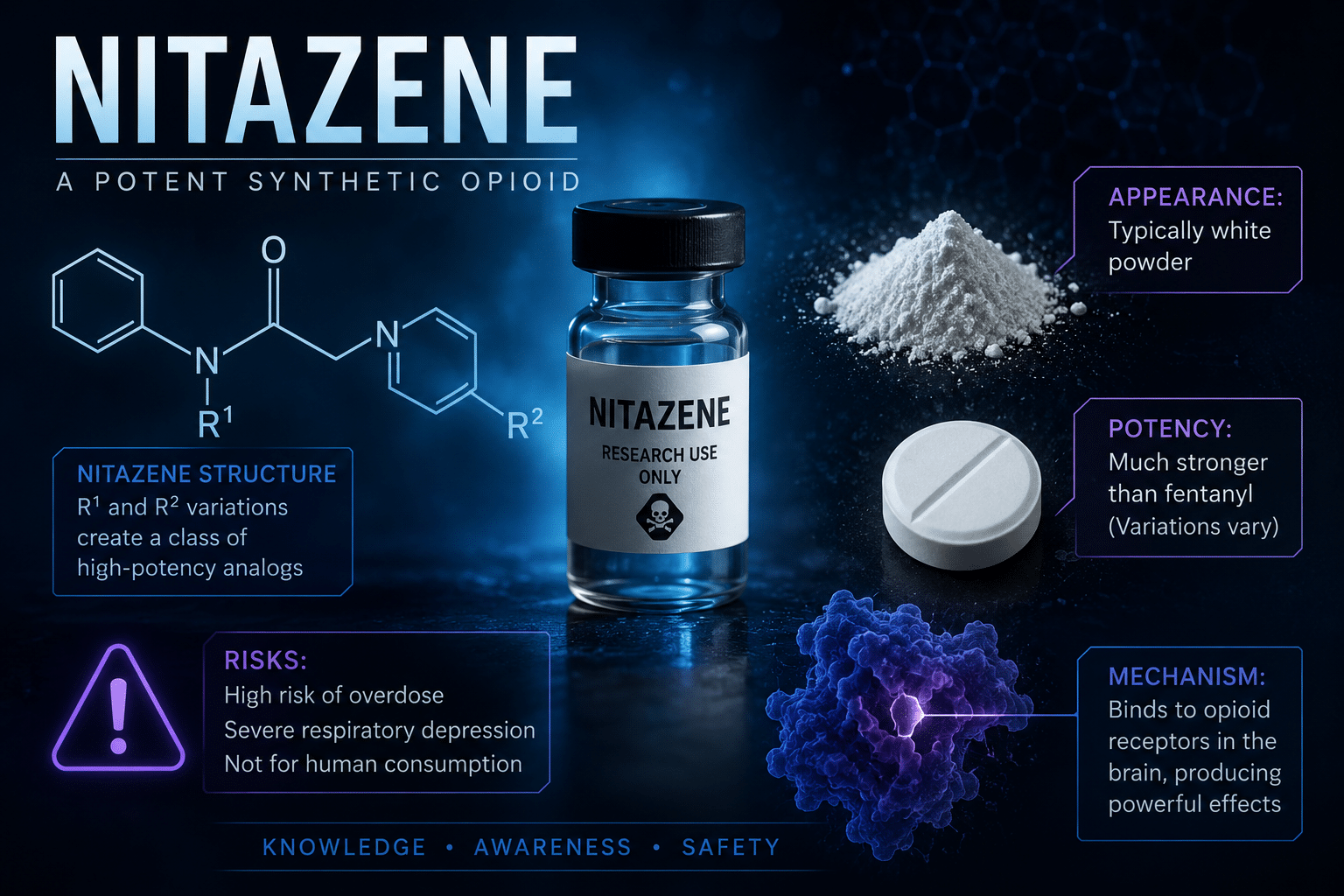
Nitazenes are a class of highly potent synthetic opioids that have emerged as a significant public health threat across North America, Europe, Oceania, South America, and parts of Africa and Southeast Asia. Chemically distinct from both morphine and fentanyl, several nitazene analogs rival or exceed the potency of fentanyl, and some are hundreds of times more potent than morphine.
Although they were first synthesized more than seventy years ago and were never approved for human medical use anywhere in the world, nitazenes have re-entered the illicit drug supply since roughly 2019, increasingly adulterating heroin, counterfeit prescription tablets, and other substances. They are implicated in a rapidly rising number of overdose deaths, and because they are structurally unlike traditional opioids, they evade standard drug screens and fentanyl test strips, complicating detection, surveillance, and clinical response.
01 / OriginsHistory and Discovery
Nitazenes, formally known as 2-benzylbenzimidazole opioid agonists, are not new. They were developed in the 1950s by a Swiss pharmaceutical research laboratory (the work is commonly attributed to CIBA) as part of a search for novel analgesics. Members of the family were shown to have opioid-like effects, but they were determined to be extremely potent with a high risk of addiction and profound respiratory depression. As a result, further development was halted and none were ever released for human use.
In an interesting quirk of the chemistry, some benzimidazole compounds that lack opioid activity are used agriculturally as fungicides (for example, carbendazim, used against nematode and fungal infections).
The illicit history predates the current crisis. Etonitazene and related compounds were detected sporadically in the illicit supply in Italy in the late 1960s, in Germany in the 1980s, in Russia in the 1990s, and in the United States in 2003, before largely disappearing. The modern resurgence began in 2019, when isotonitazene was identified in street drugs in Europe, marking the start of the current wave.
02 / ChemistryStructure and Why It Matters
All nitazenes are built around a benzimidazole ring, a benzene ring fused to an imidazole ring, with a benzyl substituent at the 2-position, giving the class its 2-benzylbenzimidazole designation. Different chemical substitutions on this core scaffold produce the many distinct analogs, each with its own potency and pharmacological profile.
Crucially, this structure is entirely different from morphine and its derivatives, and also different from fentanyl and its analogs. This has two important practical consequences: nitazenes are not identified by standard immunoassay drug screens, and they cannot be detected by fentanyl test strips. A negative fentanyl test does not mean a drug is nitazene-free.
Because the class is defined by a common scaffold, chemists can generate new analogs quickly. This has driven regulators in several countries to adopt “generic” legal definitions that ban the entire structural class rather than chasing individual molecules.
03 / AnalogsThe Common Nitazenes
Since 2019, at least 20 unique nitazenes have appeared in US forensic and toxicology reports, and the European early-warning system now monitors 22 different nitazenes. The most frequently encountered include:
- Isotonitazene: the compound that launched the modern wave, identified in European street drugs in 2019 and, since its detection, the most frequently reported nitazene in overdose deaths. It has been implicated in more than 200 deaths in Europe and North America.
- Metonitazene: first detected in early 2020 during the COVID-19 period, becoming a dominant analog in several US and European jurisdictions.
- Protonitazene: increasingly prominent in later years and in European clusters.
- Etonitazene and clonitazene: the oldest and among the most potent, both scheduled internationally in the 1960s.
- Etodesnitazene, etonitazepyne, N-pyrrolidino etonitazene, N-pyrrolidino protonitazene, and N-desethyl isotonitazene: newer analogs found in seized tablets and counterfeit pills.
A closely related non-nitazene compound, brorphine (a piperidine benzimidazolone), is structurally adjacent and frequently discussed alongside nitazenes because it is also a potent mu-opioid agonist found in the same drug markets.
04 / PharmacologyPotency and Mechanism
Nitazenes act as agonists at the mu-opioid receptor, the same target responsible for the analgesia, euphoria, sedation, and, critically, the respiratory depression of all opioids. Some of their metabolites also retain activity at the mu receptor, which may prolong or intensify respiratory depression. Nitazenes are metabolized in the liver by the cytochrome P450 system, and genetic polymorphisms in these enzymes may cause unpredictable variation in effect between individuals.
Potency varies widely across the class. One commonly cited clinical reference table gives the following approximate potencies relative to heroin:
Overall, nitazenes have been described as reaching up to roughly 500 times the potency of morphine, with several analogs matching or exceeding fentanyl.
To make the danger concrete: forensic analysts identified counterfeit “oxycodone” tablets containing an average of about 35 mg of metonitazene, which would be roughly equivalent in potency to approximately 350 mg of fentanyl in a single tablet, an amount described as highly lethal.
An important pharmacological subtlety: potency (the dose needed for an effect) is independent of binding affinity, receptor dissociation rate, and duration of action. This distinction matters for overdose reversal. Laboratory work shows that some nitazenes bind the mu-opioid receptor tightly and dissociate slowly. In one study, protonitazene dissociated more slowly than even carfentanil, and its displacement required roughly fourfold higher antagonist concentrations. Slow dissociation kinetics can make antagonism by naloxone “pseudo-competitive,” meaning higher or repeated doses may be needed and the risk of re-narcotization (relapse into overdose) is elevated.
05 / MarketWhy Nitazenes Are Spreading
Nitazenes are attractive to illicit manufacturers for several structural reasons:
- They can be manufactured rapidly and are inexpensive to produce.
- They do not require crops, unlike heroin, which depends on poppy cultivation. This is significant given restrictions on poppy cultivation in some producing regions, which have squeezed heroin supply and created a market gap.
- Their high potency means very small quantities can be shipped and dosed, easing smuggling.
They typically enter the supply as adulterants, often without the end user’s knowledge. Nitazenes have been found mixed into heroin and fentanyl, and pressed into counterfeit tablets sold as oxycodone, hydromorphone, alprazolam (Xanax), and diazepam. In Ireland, nitazenes were mis-sold as heroin in 2023 and as benzodiazepines in 2024, causing clusters of inadvertent overdoses. Because there are no visible warning signs, nitazenes cannot be detected by sight, smell, or taste, and users generally cannot know their drugs are contaminated.
06 / EpidemiologyThe United States
Nitazene detections and deaths have risen sharply. The DEA’s National Forensic Laboratory Information System (NFLIS) recorded nitazene reports climbing from 43 in 2019 to about 1,905 in 2024, with more than 7,100 nitazene analog reports over that period. The dominant analog shifted over time: isotonitazene made up 97.7% of NFLIS nitazene reports in 2019, but by 2024 the mix had shifted toward metonitazene and protonitazene (about 29.5% and 30.1%, respectively).
On mortality, CDC data drawn from the State Unintentional Drug Overdose Reporting System (SUDORS) show confirmed nitazene-involved overdose deaths rising from 27 in 2020 to 409 in 2024, an increase of roughly 1,415%. The CDC reported 320 nitazene-involved deaths across 38 jurisdictions in 2023, most concentrated in Ohio, Pennsylvania, and Illinois. More than 1,100 US fatalities have been confirmed through SUDORS since 2019, though experts believe the true toll could approach 2,000 because of testing gaps and reporting lags.
These figures come with an important caveat: US overdose surveillance runs on a 12-to-18-month lag, so published counts consistently trail the evolving drug supply, and many jurisdictions did not test for nitazenes early on. Notably, the nitazene trend has been rising even as overall US overdose deaths fell about 27% in 2024 (to roughly 80,391) and fentanyl-related deaths declined, prompting concern that nitazenes are “waiting in the wings” to fill any gap left by fentanyl.
An early and well-documented US cluster came from Tennessee, which identified 52 nitazene-involved fatal overdoses from 2019 to 2021, a fourfold jump from 10 in 2020 to 42 in 2021. In 2020, isotonitazene was involved in about 90% of these deaths, but by 2021 metonitazene accounted for roughly 86%.
07 / EpidemiologyEurope and the Rest of the World
In Europe, nitazenes have driven localized but severe poisoning outbreaks. Since 2019, at least 21 countries have reported nitazenes to the EU Early Warning System. The Baltic states have been hit hardest. In Estonia, drug-induced deaths rose from 82 in 2022 to 119 in 2023 (a mortality rate of 135 per million, roughly six times the EU average), with nitazenes, mostly metonitazene and protonitazene, implicated in about 52% of cases. In Latvia, deaths rose from 63 to 154 over the same period, with nitazenes present in about 66% of cases.
Elsewhere in Europe, Sweden reported over 30 metonitazene-associated deaths from January 2023 to September 2024; Norway registered 34 nitazene-related deaths (mainly metonitazene) between June 2023 and August 2024; and clusters were reported in France (2023) and Germany (2024) before some incidences declined.
In the United Kingdom, the National Crime Agency confirmed over 179 deaths involving nitazenes between June 2023 and May 2024, and other reporting cited at least 176 deaths in a similar window, figures widely believed to be underestimates. Nitazene-linked deaths and toxicity have also been reported in Australia, New Zealand, Brazil, and West Africa.
08 / ClinicalPresentation and Overdose
Nitazene overdose looks like any other opioid overdose. The hallmark effects are sedation and respiratory depression, and the primary mechanism of death is hypoxia following hypoventilation and apnea. Typical signs include pinpoint pupils (miosis), depressed or absent breathing, unconsciousness, and bluish skin. There is no way to distinguish a nitazene overdose from a fentanyl or heroin overdose at the scene without advanced laboratory testing.
A recurring theme in the toxicology literature is polysubstance involvement. Nitazene cases almost always involve other drugs: additional opioids, benzodiazepines, and increasingly the veterinary sedative xylazine, an alpha-2 adrenergic agonist that is not an opioid and therefore is not reversed by naloxone. This makes clinical presentations more complex and can create the false impression that naloxone is “failing.”
09 / TreatmentOverdose Reversal
Naloxone reverses nitazene overdoses. As of writing, there is no opioid that naloxone has failed to reverse. The nuance is dose and duration, not whether the antidote works.
Reviews of case reports and clinical series confirm that naloxone remains an effective antidote, with a median parenteral reversal dose of about 1.2 mg in hospital and about 0.8 mg in the pre-hospital setting, doses within the usual therapeutic range. A series of nine single-nitazene exposures found standard doses of 400 to 800 micrograms IV/IM effective, and an Australian series of 32 nitazene poisonings likewise found standard naloxone doses sufficient.
That said, there are important nuances:
- Multiple or repeated doses may be required. Because some nitazenes are highly potent and dissociate slowly from the receptor, a proportion of patients need more than one dose or a continuous naloxone infusion. In one review, 6 of 30 patients required prolonged naloxone infusions, a higher proportion than for typical opioids.
- Re-narcotization is a real risk. Naloxone begins to wear off after 20 to 30 minutes, and because some nitazenes act longer than naloxone, a person can slip back into overdose. Guidance recommends monitoring for an extended period, in some cases up to 24 hours, with repeat dosing as needed.
- Recommended approach. Start resuscitation with standard naloxone doses (for example, 0.4 mg IV or a 2 to 4 mg intranasal device), prioritize restoring breathing and oxygenation (rescue breathing and airway support), and titrate upward to adequate respiratory response rather than full arousal.
- Failure to respond to large naloxone doses should prompt suspicion of a co-ingested non-opioid depressant (such as xylazine or a benzodiazepine) or another cause, rather than an assumption that naloxone does not work on nitazenes.
Longer-acting antagonists such as nalmefene have been proposed for ultra-potent opioids, but its long half-life and risk of precipitating severe, prolonged withdrawal limit its utility, especially given that naloxone appears effective.
For dependence and withdrawal, clinical consensus guidance (for example from NSW Health in Australia) recommends managing withdrawal much as with other opioids: assessment via the Clinical Opiate Withdrawal Scale (COWS), symptomatic stabilization with morphine, and transition to buprenorphine or methadone maintenance. Notably, the effectiveness of standard opioid-use-disorder medications (buprenorphine, methadone, naltrexone) specifically in nitazene users has not yet been formally studied, an acknowledged research gap.
10 / DetectionSurveillance Challenges
Detecting nitazenes is a persistent challenge. Because their structure is unlike morphine and fentanyl, they are missed by routine immunoassay drug screens and by fentanyl test strips. Confirmatory identification requires advanced laboratory methods such as liquid chromatography-mass spectrometry. Several complementary surveillance strategies have emerged:
- Drug-checking services such as the UK’s WEDINOS program, which first detected nitazenes in April 2021 and found that samples were often misidentified. Some assumed to contain only benzodiazepines actually contained nitazenes.
- Forensic and post-mortem toxicology feeding databases like NFLIS and the CDC’s SUDORS.
- Wastewater-based epidemiology, which can detect trace levels of nitazenes (and xylazine) across a community, providing early warning ahead of clinical case reports. Validated methods can now separate and detect roughly a dozen nitazene analogs, and wastewater monitoring has been deployed across multiple countries and US states.
11 / RegulationLegal and Regulatory Status
Regulation has moved unevenly and reactively. The oldest analogs, etonitazene and clonitazene, were placed under international control decades ago. They are listed under the 1961 UN Single Convention on Narcotic Drugs and were scheduled in the 1960s.
- United States: Isotonitazene was made a Schedule I substance in 2020, and other nitazenes have followed. However, because scheduling has historically targeted individual molecules, some newer analogs may fall outside the Controlled Substances Act at any given time, and none are approved for medical use in the US.
- United Kingdom: In January 2025, the UK adopted a generic definition of nitazenes and controlled the entire class as Class A drugs under the Misuse of Drugs Act 1971, following advice from the Advisory Council on the Misuse of Drugs (ACMD). This class-based approach is designed to capture future analogs automatically rather than scheduling them one by one.
- China: China implemented class scheduling of nitazene analogues, applying control measures to the structural class rather than to individual compounds.
The trend among regulators is clearly toward generic, class-wide scheduling, precisely because the ease of producing new analogs makes molecule-by-molecule prohibition ineffective.
12 / ResponsePublic Health and Harm Reduction
Because nitazenes present clinically as opioid overdoses and respond to naloxone, the central public health messages emphasize expanding proven tools rather than inventing new ones:
- Widen naloxone access and distribution, including take-home and intranasal naloxone, and educate responders that multiple doses and extended monitoring may be needed. In one Tennessee analysis, naloxone was administered to only about 23% of people who died from nitazene-involved overdoses, underscoring how underused it remains at the point of overdose.
- Never rely on fentanyl test strips alone, and expand access to drug-checking services that can identify nitazenes.
- Strengthen surveillance through forensic toxicology, wastewater monitoring, and rapid drug alerts.
- Warn people who use drugs that potency and contamination are unpredictable, that a small amount can be lethal, and that using with others and carrying naloxone can be lifesaving.
13 / ConclusionAn Old Class, a New Era
Nitazenes represent an old chemical class repurposed for a dangerous new era. Cheap to make, crop-independent, extraordinarily potent, and easy to modify into fresh analogs that evade both drug tests and the law, they have spread quietly through the illicit supply as adulterants, killing people who often never knew they had taken an opioid at all.
The reassuring counterpoint is that naloxone works, standard opioid-overdose management applies, and the tools to respond (naloxone distribution, drug checking, wastewater surveillance, and class-wide scheduling) already exist. The central challenge is closing the gap between a fast-evolving drug supply and slower-moving detection, surveillance, and treatment systems, a gap that, as fentanyl deaths begin to decline, nitazenes appear poised to exploit.