Cannabis DUI Evidence: Four Questions That Must Remain Separate
By Okorie Okorocha, J.D., M.S., M.S.
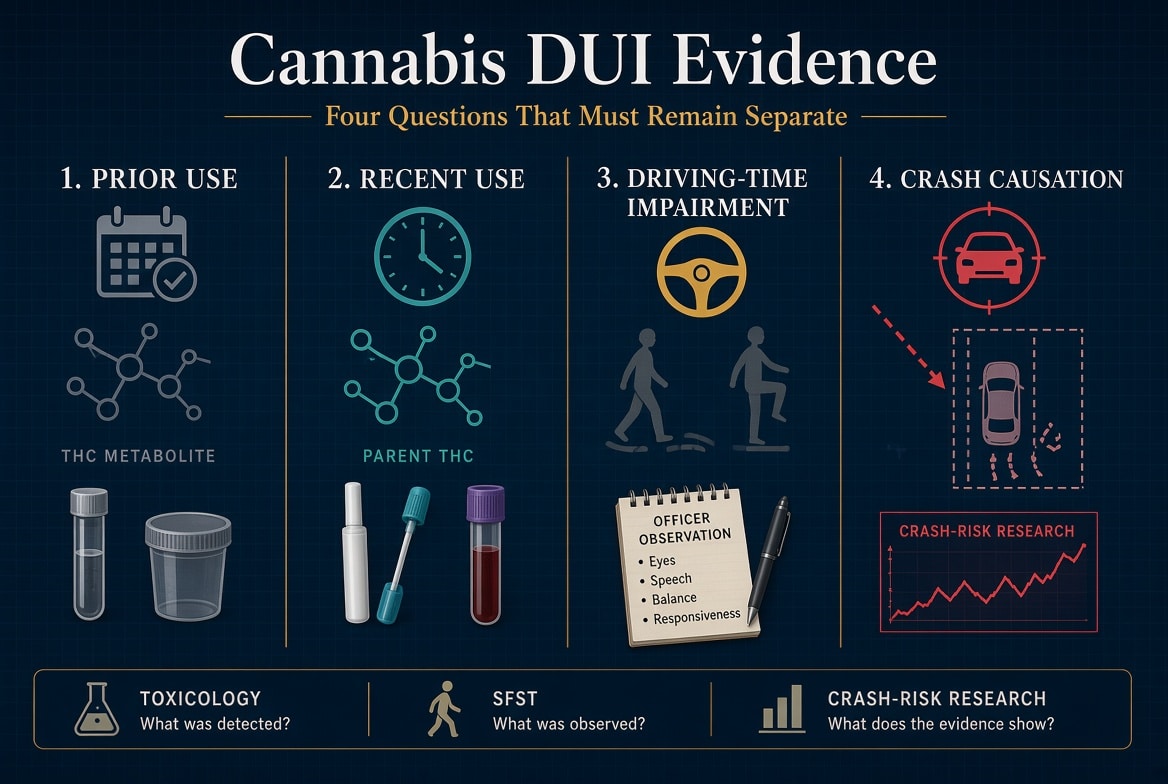
For attorneys: Cannabis driving evidence often combines four different propositions as if they were interchangeable: prior use, recent use, impairment at the time of driving, and causation of a crash. Each requires different evidence. A positive THC test, field observation, or crash association does not automatically prove the other three.
Question one: Was cannabis used?
First establish the chemical identity: The HHC drug-test evidence guide examines a published example in which a plausible library match required further testing. Its records checklist separates a screening response, a candidate match, and a supported identification. This AI-assisted reading-path addition was prepared September 28, 2026.
A confirmed cannabinoid result may support prior exposure, but the analyte and matrix control the scope of that conclusion. Urine THC-COOH generally has a longer detection window than blood parent THC. Oral fluid can be influenced by recent oral-cavity deposition. Whole blood, plasma, and serum are not numerically interchangeable.
The report should identify THC, 11-OH-THC, THC-COOH, the specimen, units, method, cutoff, uncertainty, and confirmation procedure. The word “cannabinoids” is not sufficiently specific for a driving-time opinion.
Question two: Was the use recent?
In occasional users, parent THC in blood usually points to a more recent exposure than urine metabolite. In frequent, long-term users, low blood THC can persist after days of monitored abstinence.
Karschner and colleagues housed 25 frequent users on a secure unit for seven days. Six still had detectable whole-blood THC on day seven, and five remained positive throughout the study. Odell and colleagues studied 21 dependent users and found detectable blood THC in some participants for at least seven days, oral-fluid THC up to 78 hours, and high urine THC-COOH concentrations many hours after last use.
Those studies do not prove that every low result is residual. They show why recent use cannot always be dated from one number without the use history, matrix, collection time, metabolite pattern, and analytical limit.
Question three: Was the person impaired while driving?
Research reading path: Compare the residual-driving study after reported abstinence with the acute THC-potency and driving study. They examine different timeframes, populations, and outcomes. Read each study’s methods and limitations before applying it to an individual. This AI-assisted reading-path update was added September 27, 2026.
THC concentration and effect do not follow a simple alcohol-like curve. Blood THC can fall rapidly after inhalation while subjective or performance effects continue. Frequent users may also begin with a residual baseline and exhibit tolerance to some measured effects.
Standardized Field Sobriety Tests were developed and validated for alcohol-related applications. Cannabis studies have produced population- and timing-dependent sensitivity. In a 40-participant study, the percentage classified as impaired after the higher cannabis dose declined from 46.2% five minutes after smoking to 28.2% at 105 minutes. In a study of 20 heavy users, the overall SFST score failed to distinguish cannabis from baseline, while the one-leg stand showed more sensitivity.
A test can miss an affected participant, and a poor performance can have causes unrelated to cannabis. Age, injury, footwear, surface, instructions, anxiety, fatigue, medical conditions, and officer scoring belong in the analysis.
Question four: Did cannabis cause the crash?
Laboratory experiments can show that cannabis affects particular tasks under controlled conditions. Epidemiological crash-risk studies answer a different question and must address age, sex, alcohol, driving exposure, risk-taking, and other confounders.
NHTSA’s 2015 Virginia Beach case-control study reported an unadjusted odds ratio of 1.25 for THC-positive drivers. After adjustment for age, gender, and race/ethnicity, the odds ratio was 1.05 with a 95% confidence interval of 0.86–1.27. After additional adjustment for alcohol, it was 1.00 with a 95% confidence interval of 0.83–1.22. The adjusted associations were not statistically significant in that study.
That result does not establish that cannabis can never increase crash risk. The exposure classification was THC-positive versus negative, not a validated measure of each driver’s impairment. It does show why an unadjusted association should not be presented without the adjusted analysis and study limitations.
A practical evidence matrix
| Proposition | Potential evidence | What it does not automatically prove |
|---|---|---|
| Prior use | Confirmed THC or metabolite | Recent use, impairment, or crash causation |
| Recent use | Parent THC, oral-fluid result, history, serial specimens | Driving-time impairment |
| Impairment | Driving pattern, observations, validated tasks, toxicology context | That cannabis caused every observed error |
| Crash causation | Reconstruction, roadway evidence, witnesses, vehicle data, medical and toxicological evidence | That a positive result was the substantial cause |
Records counsel should request
- Dispatch, body-worn video, dashcam, roadway, collision, and reconstruction records.
- Complete event, stop, examination, arrest, warrant, collection, and analysis timeline.
- Field-test instructions, scoring sheets, officer notes, training, and environmental conditions.
- Reported product, route, potency, quantity, time of use, and frequency of use.
- Whole-blood, plasma, serum, oral-fluid, and urine identification.
- Separate THC, 11-OH-THC, and THC-COOH results with units and uncertainty.
- Screening, confirmation, and chiral or other specialized methods when relevant.
- Validation, calibration, controls, blanks, chromatograms, audit trail, and repeat analysis.
- Storage, preservative, stability, chain of custody, and collection documentation.
- Alcohol, medications, other drugs, fatigue, injury, illness, and alternative explanations.
Questions for an expert or officer
- Which of the four propositions are you offering an opinion about?
- What evidence distinguishes recent use from residual THC?
- Is the reported concentration whole blood, plasma, or serum?
- What is the validated relationship between this concentration and this individual’s driving performance?
- What was the sensitivity of the SFST procedure for cannabis in a comparable population and at a comparable time?
- Which non-drug causes of the observed signs were evaluated?
- Does the crash-risk citation report adjusted or unadjusted results?
- What evidence links cannabis—not merely its detection—to the specific driving error or crash?
Frequently asked questions
Does a positive THC result prove recent use?
Not in every frequent user. Residual whole-blood THC has been documented for days during monitored abstinence.
Does failing an SFST prove cannabis impairment?
No. Cannabis-specific sensitivity is incomplete and varies by task, timing, dose, and user history. Alternative causes must also be considered.
Did NHTSA find no cannabis crash risk?
NHTSA’s 2015 study found no statistically significant association after its adjustments. That is not the same as proving zero risk under every exposure or circumstance.
Can a THC concentration be converted into a BAC-equivalent impairment level?
No scientifically universal conversion exists. THC kinetics, route, timing, tolerance, and concentration-effect hysteresis differ materially from alcohol.
Bottom line
Good cannabis DUI analysis states exactly which proposition the evidence supports and which it does not. Prior use, recency, impairment, and crash causation should be proved separately rather than inferred from one positive result.
For the residual-detection science, see Residual THC in Frequent Users. Related pages include THC Blood Levels in California Driving Cases and What the Largest U.S. Government Drugged-Driving Study Found.
Selected sources
- Compton R, Berning A. Drug and Alcohol Crash Risk. National Highway Traffic Safety Administration. 2015;DOT HS 812 117.
- Compton R. Marijuana-Impaired Driving: A Report to Congress. National Highway Traffic Safety Administration. 2017;DOT HS 812 440.
- Papafotiou K, Carter JD, Stough C. An evaluation of the sensitivity of the Standardised Field Sobriety Tests to detect impairment due to marijuana intoxication. Psychopharmacology. 2005;180:107–114. doi:10.1007/s00213-004-2119-9.
- Bosker WM, Theunissen EL, Conen S, et al. A placebo-controlled study to assess SFST performance during alcohol and cannabis intoxication. Psychopharmacology. 2012;223:439–446.
- Karschner EL, Schwilke EW, Lowe RH, et al. Do THC concentrations indicate recent use in chronic cannabis users? Addiction. 2009.
- Odell MS, Frei MY, Gerostamoulos D, et al. Residual cannabis levels in blood, urine and oral fluid following heavy cannabis use. Forensic Science International. 2015. doi:10.1016/j.forsciint.2015.01.026.
Educational material only. It is not legal advice or a case-specific expert opinion.