Vitreous Alcohol Evidence in Court: Ratios, Prediction Intervals, and Laboratory Records
By Okorie Okorocha, J.D., M.S., M.S.
Core point: Vitreous alcohol evidence may corroborate or substitute for postmortem blood in appropriate circumstances, but an average ratio is not an exact blood-alcohol calculator. The legal and scientific review should focus on what was measured, what was estimated, and how uncertainty was communicated.
Measured result versus converted estimate
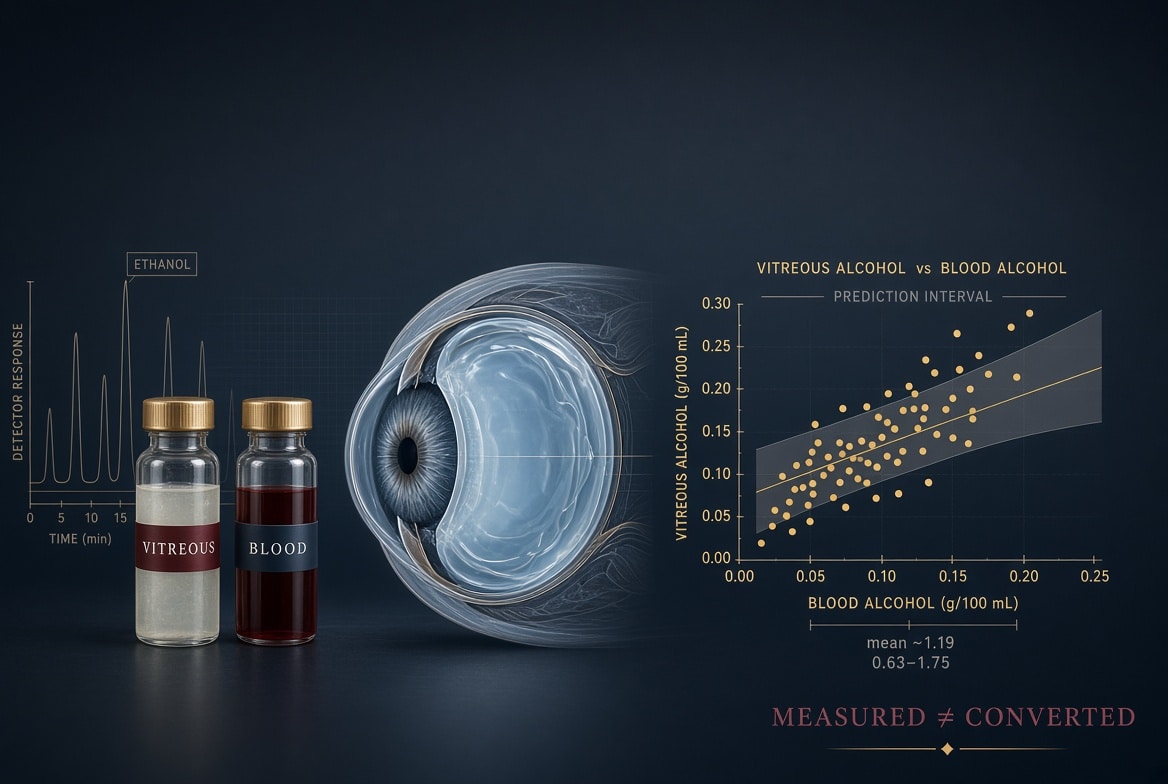
A laboratory may directly measure ethanol in vitreous humor. If a witness then applies a formula or ratio to estimate blood alcohol concentration, the converted figure is not a second measurement. It is a model-based estimate whose validity depends on the source population, case conditions, and individual prediction error.
The report and testimony should clearly label the measured vitreous result, the equation used, the estimated blood result, and the uncertainty. Presenting the estimate with the same apparent precision as a measured value can mislead.
Why correlation is not enough
Correlation answers whether vitreous and blood values tend to rise together across a group. It does not answer whether the values agree closely enough to substitute one for the other in a specific case.
In a 345-case study, Pounder and Kuroda found that individual prediction intervals were too wide for practical BAC prediction. In a 706-necropsy series, Jones and Holmgren reported an arithmetic mean vitreous-to-femoral-blood ratio of 1.19, with a 95% range from 0.63 to 1.75. The group average cannot erase that spread.
Questions about the source study
- How many paired cases supported the equation?
- Were values measured in femoral, central, or unspecified blood?
- Were decomposed, traumatized, aspirated, transfused, or absorption-phase cases excluded?
- What analytical methods, detection limits, preservatives, and storage conditions were used?
- Was the model independently validated?
- What were the residual standard deviation, limits of agreement, and individual prediction interval?
- Does the current case fall within the study’s concentration range and factual conditions?
Collection evidence that can change the interpretation
- which eye was sampled and whether both eyes were pooled;
- needle route, volume, visible blood or retinal contamination, and collection order;
- tube type, preservative, seal, labeling, and chain of custody;
- death, refrigeration, autopsy, collection, shipment, and analysis timeline;
- actual storage temperatures and freeze-thaw history;
- blood collection site, trauma, decomposition, gastric contents, aspiration, resuscitation, and transfusion.
These are not clerical details. Local diffusion can affect central blood. An experimental cadaver study simulating aspiration found the highest ethanol concentrations in pulmonary vessels and low femoral concentrations after 48 hours. The experiment demonstrates a mechanism; it does not automatically prove that the mechanism occurred in a particular death.
EtG and EtS address source, not every disputed issue
Ethyl glucuronide and ethyl sulfate are direct ethanol metabolites. Their presence in vitreous or other matrices may support antemortem consumption when low ethanol could have formed after death.
They do not independently establish the amount consumed, the precise time, impairment, ability to act, or cause of death. The absence of a marker is also not automatically proof of no drinking because detection depends on timing, elimination, postmortem interval, degradation, cutoff, and method.
Records to request from the laboratory
- complete toxicology report and every measured value without converted substitutions;
- specimen inventory, collection forms, photographs, chain of custody, and storage logs;
- headspace GC method and validation for blood and vitreous matrices;
- calibration, internal standard, blanks, controls, chromatograms, calculations, repeats, and uncertainty;
- EtG/EtS method, confirmation data, cutoffs, ion ratios, retention times, and stability studies;
- laboratory policy for blood-vitreous comparison and conversion;
- the publication or dataset supporting any equation;
- all companion matrices, decomposition indicators, and amended reports.
Questions for the interpreting witness
- Which number was directly measured and which number was calculated?
- What is the individual prediction interval for your calculated BAC?
- Why is the source population applicable to this death?
- Did you evaluate absorption phase, elimination phase, decomposition, and sampling-site artifacts?
- What result would follow from the lower and upper plausible prediction limits?
- Would your opinion change if no conversion were performed?
- What do EtG and EtS establish, and what do they not establish?
- Can the toxicology result alone prove impairment, ability to act, or causation?
Common overstatements to avoid
- “Vitreous alcohol equals blood alcohol.”
- “A correlation near 1.0 means the matrices are interchangeable.”
- “The average ratio applies to every person.”
- “EtG proves intoxication.”
- “A negative blood result invalidates a positive vitreous result.”
- “Vitreous is immune to storage and postmortem change.”
For the technical analysis, see Vitreous Ethanol and BAC Conversion Uncertainty.
Frequently asked questions
Can an expert testify to an estimated BAC from vitreous?
An estimate may be scientifically discussed if the model is applicable and uncertainty is disclosed. It should not be presented as an exact measured BAC.
Is a ratio of 1.19 universally accepted?
No. It was a group average in a particular study with wide individual variation.
Can vitreous evidence help when blood is decomposed?
Yes. It may provide important corroboration, especially with direct metabolites and other matrices, but the complete postmortem context remains necessary.
Does EtG prove the person was impaired?
No. EtG supports prior ethanol exposure; impairment requires different evidence.
Selected sources
- Pounder DJ, Kuroda N. Forensic Science International. 1994;65:73-80.
- Jones AW, Holmgren P. Journal of Clinical Pathology. 2001;54:699-702.
- De Martinis BS, et al. Human & Experimental Toxicology. 2006;25:93-97.
- Thierauf A, et al. Forensic Science International. 2011;210:63-68.
- Rainio J, et al. Forensic Science International. 2013;226:261-265.
This article is general educational material, not legal advice or an opinion about any individual matter.