Speak with an expert today (424) 363-3347(For attorneys only)

GLP-1’s Extremely Rare Side-Effects

One Drug, Three Injuries: GLP-1 Agonists, the Stomach, the Pregnancy, and the Optic Nerve
Forensic Notebook The Okorocha Firm

One Drug, Three Injuries: GLP-1 Agonists and the Causation Question

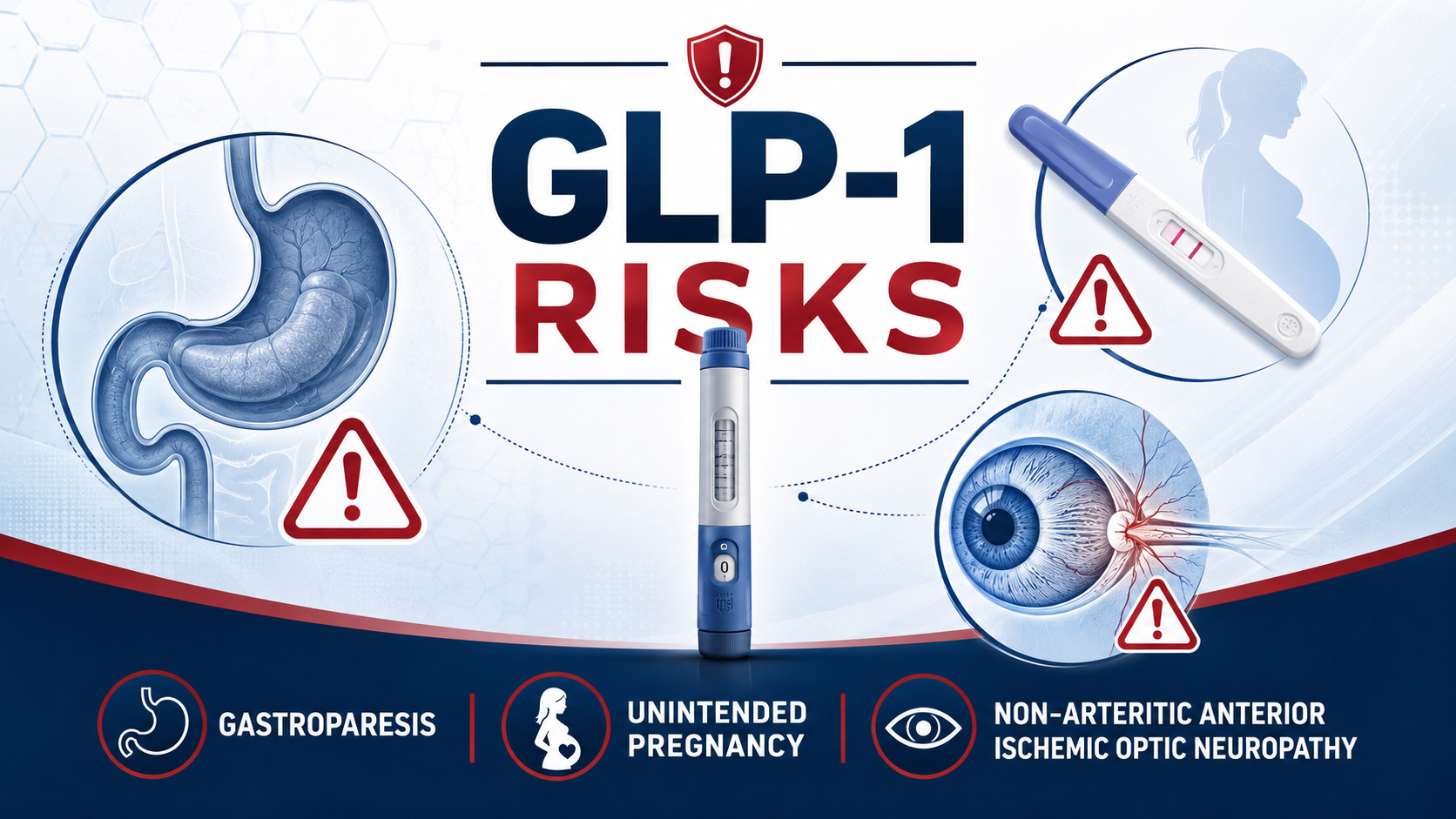
The same slowed-stomach pharmacology that makes semaglutide and tirzepatide work is now at the center of three separate injury theories: stomach paralysis, unintended pregnancy, and sudden vision loss. Here is what the science actually supports, and where it does not.

GLP-1 RECEPTOR AGONIST I. Gastroparesis DELAYED GASTRIC EMPTYING II. Unintended Pregnancy ABSORPTION AND FERTILITY III. NAION Vision Loss OPTIC NERVE INFARCTION
One mechanism, three downstream claims

A class of medicines built to treat type 2 diabetes has become the most prescribed weight-loss tool in a generation, and with that scale has come a litigation wave. Semaglutide, sold as Ozempic, Wegovy, and Rybelsus, and tirzepatide, sold as Mounjaro and Zepbound, share a single defining property: they slow how fast the stomach empties. That one effect is responsible for the appetite suppression patients want. It is also the thread that runs through three very different injury theories now moving through the courts. Sorting the real signal from the noise is a causation problem, and causation is where these cases are won and lost.

GLP-1 receptor agonists imitate a gut hormone released after eating. They prompt insulin release, blunt glucagon, and act on vagal nerve pathways to delay gastric emptying and signal fullness. The drugs in this class differ in important ways. Semaglutide and liraglutide are pure GLP-1 agonists. Tirzepatide is a dual agonist that also activates the GIP receptor, which produces a more pronounced delay in gastric emptying. Those pharmacologic differences matter, because the injury theories do not apply equally to every product. A forensic analysis that treats the class as one undifferentiated drug is already off the rails.

I.

The Stomach: Delayed Emptying and Gastroparesis

Gastroparesis means delayed gastric emptying in the absence of mechanical obstruction. In its severe form the stomach essentially stops moving food forward, producing nausea, vomiting, early satiety, bloating, and in extreme cases dehydration and malnutrition. The diagnostic gold standard is a gastric emptying scintigraphy study, which measures the percentage of a labeled meal retained at set intervals. This matters for litigation: a chart note that simply says gastroparesis is not the same as an objective, quantified emptying delay, and the difference often decides whether a claim survives.

The pharmacology here is not in serious dispute. GLP-1 agonists slow gastric emptying by design. The contested questions are whether the drugs cause a durable gastroparesis that persists after discontinuation, whether the effect represents true paralysis or expected pharmacology, and how to separate the drug from powerful confounders. Long-standing diabetes is itself a leading cause of gastroparesis. Opioids, anticholinergics, and several other common medications delay emptying as well. There is also evidence that the gastric-emptying effect attenuates over time through tachyphylaxis, which complicates any claim of permanent injury. A credible causation opinion has to address each of these, not wave them away.

The forensic flashpoint: anesthesia and aspiration

The most concrete real-world harm tied to delayed emptying is perioperative. A patient who has fasted by the clock can still arrive in the operating room with a full stomach of retained solid food, raising the risk of regurgitation and pulmonary aspiration under sedation. In 2023 the American Society of Anesthesiologists issued consensus guidance advising clinicians to hold daily-dosed GLP-1 agonists on the day of a procedure and weekly-dosed agents about a week before, and to treat symptomatic or unprepared patients as full-stomach cases. Endoscopy data have since shown materially higher rates of retained gastric contents in patients on these drugs. That is a clean, documentable mechanism of injury, and it is where toxicology, pharmacokinetics, and the medical record meet.

The pharmacology that suppresses appetite is the same pharmacology that can leave a fasted patient with a full stomach on the operating table. The dispute is rarely whether the drug slows the gut. It is whether the slowing crossed into injury.

On the litigation side, the gastrointestinal claims are consolidated in MDL No. 3094 in the Eastern District of Pennsylvania before Judge Karen S. Marston. As of mid-2026 the docket holds roughly 3,600 cases, and gastroparesis or stomach paralysis is the single most frequently pleaded injury, named in the large majority of complaints. The core theory is failure to warn. Ozempic’s labeling did not carry an ileus warning until September 2023, and a January 2025 update stated only that the drug is not recommended in patients with severe gastroparesis, language that stops short of conceding the drug can cause the condition. The court has allowed warranty and negligent-undertaking theories to proceed past early dismissal motions. Bellwether trials are being scheduled for late 2026 and into 2027. No global settlement has been announced.

II.

The Pregnancy: Failed Contraception and Restored Fertility

The so-called Ozempic baby is not one phenomenon but two, and conflating them is a frequent error. The first is a drug-interaction theory: delayed gastric emptying, compounded by the vomiting and diarrhea these drugs commonly cause, can interfere with the absorption of an oral contraceptive pill taken at the same time. The second is simpler and arguably more powerful: meaningful weight loss and improved insulin sensitivity can restore ovulation in women whose fertility was suppressed by obesity or polycystic ovary syndrome, leading to spontaneous conception that the patient did not anticipate.

Here the differences between drugs are decisive. The published absorption data indicate that semaglutide does not meaningfully reduce oral contraceptive levels, and its labeling reflects no clinically significant interaction with ethinylestradiol. Tirzepatide is the outlier. Its FDA-approved labeling warns that the drug may reduce the efficacy of oral hormonal contraceptives because of delayed gastric emptying, and advises patients to switch to a non-oral method or add a barrier method for four weeks after starting the drug and after every dose increase. Older agents such as liraglutide and dulaglutide reduce contraceptive plasma levels modestly without clear evidence of failure. In 2025 the United Kingdom’s medicines regulator issued formal guidance to women of reproductive age after receiving dozens of reports of unintended pregnancies on these drugs.

Layered on top is a fetal-safety concern. GLP-1 agonists are not recommended in pregnancy, the human safety data are thin, and regulators advise effective contraception throughout treatment and a washout period before attempting to conceive. A forensic analysis of an unintended-pregnancy claim therefore turns on which specific drug was used, what contraceptive method it was used with, the documented timing and dose escalations, and whether vomiting or diarrhea episodes appear in the record. The strength of a tirzepatide claim and a semaglutide claim are not the same, and the analysis should say so plainly.

III.

The Optic Nerve: NAION and Sudden Vision Loss

Non-arteritic anterior ischemic optic neuropathy, or NAION, is a sudden, usually painless loss of vision in one eye caused by impaired blood flow to the head of the optic nerve. The damage is typically permanent, and there is no established effective treatment. It is the newest and scientifically the most contested of the three theories.

The signal originates with a July 2024 study in JAMA Ophthalmology by Hathaway and colleagues, a retrospective cohort drawn from a single neuro-ophthalmology center, which reported a substantially elevated risk of NAION among patients prescribed semaglutide. The estimated hazard was several-fold higher in both the diabetic and the overweight subgroups. Because it was a single institution with a relatively small number of NAION cases, the finding was provocative rather than definitive. The larger studies that followed have been genuinely mixed. Some multinational, population-based analyses found no significant difference, while a subsequent multi-site analysis reported a real but considerably smaller increase, on the order of a thirty percent relative rise. The honest summary is that an association is plausible and supported by some data, the absolute risk is low, and the magnitude remains unsettled.

That scientific uncertainty is itself the forensic story. The vision-loss claims are consolidated separately in MDL No. 3163, also before Judge Marston in the Eastern District of Pennsylvania, a docket still in its early dozens of cases as of mid-2026 but drawing fast-growing attention precisely because the injury is catastrophic and permanent. Causation in these cases will be a contest of epidemiology: confounding by the vascular risk factors that independently drive NAION, the reliability of diagnostic coding, and whether the published association holds up under more rigorous design. This is expert-versus-expert territory in the truest sense.

IV.

Where These Cases Are Actually Decided

Across all three theories the same analytic discipline applies. Identify the exact product, because the class is not monolithic. Distinguish expected pharmacology from injury. Account for confounders rather than ignoring them, since diabetes, obesity, vascular disease, and co-prescribed medications each carry their own risk. Look for dechallenge and rechallenge in the record, demand objective testing where it exists, and be candid about what the literature does and does not support. A plaintiff’s case is strengthened, not weakened, by an expert who concedes the limits of the science and then explains why causation still holds on these specific facts. An opinion that overreaches invites a Daubert challenge and hands the defense its theme.

GLP-1 agonists are genuinely useful drugs, and most patients tolerate them well. None of that resolves the question in an individual case, which is whether this drug, at this dose, in this patient, more likely than not produced this injury. That is a forensic question before it is a legal one, and answering it well is the whole job.

What It Means

  • Three distinct injury theories, gastroparesis, unintended pregnancy, and NAION vision loss, all trace back to the same slowed-stomach pharmacology, but they do not stand or fall together.
  • The product matters. Tirzepatide carries a specific contraceptive-efficacy warning that semaglutide does not, and the gastric-emptying effect is more pronounced with the dual agonist.
  • Gastrointestinal claims sit in MDL 3094 and vision-loss claims in MDL 3163, both in the Eastern District of Pennsylvania before Judge Karen S. Marston, with bellwether trials approaching and no global settlement yet.
  • Objective evidence wins. A quantified gastric emptying study, documented dose escalations, contraceptive method and timing, and a clean confounder analysis are worth more than a diagnostic label.
  • Causation, not the existence of a side effect, is the battleground. The credible expert concedes what the science cannot support and proves what it can.
The Okorocha Firm
This article is general commentary on forensic and scientific issues in pharmaceutical injury litigation. It is not legal or medical advice, and it does not address the facts of any particular case or create any attorney-client relationship. Drugs are referenced by their established generic and brand names for identification only.
Spread the love


The National Black Lawyers

top 40 lawyers

civil trial law

Lawyers of Distinction

Loading...

Recent Blog Articles

Suboxone Causes Tooth Decay

Suboxone and Tooth Decay: What the FDA Warning and the Science Actually Say Forensic Toxicology Review The Okorocha Firm pH 7.0 5.5 acidic oral surface The Film That Dissolves on Your Teeth Buprenorphine saves lives in opioid use disorder. The way it is delivered, dissolved against the teeth twice a…

Spread the love

Read More

GLP-1’s Extremely Rare Side-Effects

One Drug, Three Injuries: GLP-1 Agonists, the Stomach, the Pregnancy, and the Optic Nerve Forensic Notebook The Okorocha Firm One Drug, Three Injuries: GLP-1 Agonists and the Causation Question The same slowed-stomach pharmacology that makes semaglutide and tirzepatide work is now at the center of three separate injury theories: stomach…

Spread the love

Read More

Depo Provera & Intracranial Meningiomas

The Needle and the Meninges: Depo-Provera and the Rising Science of Intracranial Meningioma The Okorocha Firm Law + Science = Forensics Forensic Toxicology & Pharmacology The Needle and the Meninges A quarterly injection met an ordinary brain tumor, and the collision is now reshaping pharmacovigilance, product labeling, and the science of causation in court….

Spread the love

Read More

Speak with an expert today!

Contact the offices of Okorie Okorocha for professional and reliable advice which you can trust.

Call (424) 283-0029 Contact Us