Does a Positive 7-OH Test Identify the Product Someone Took?
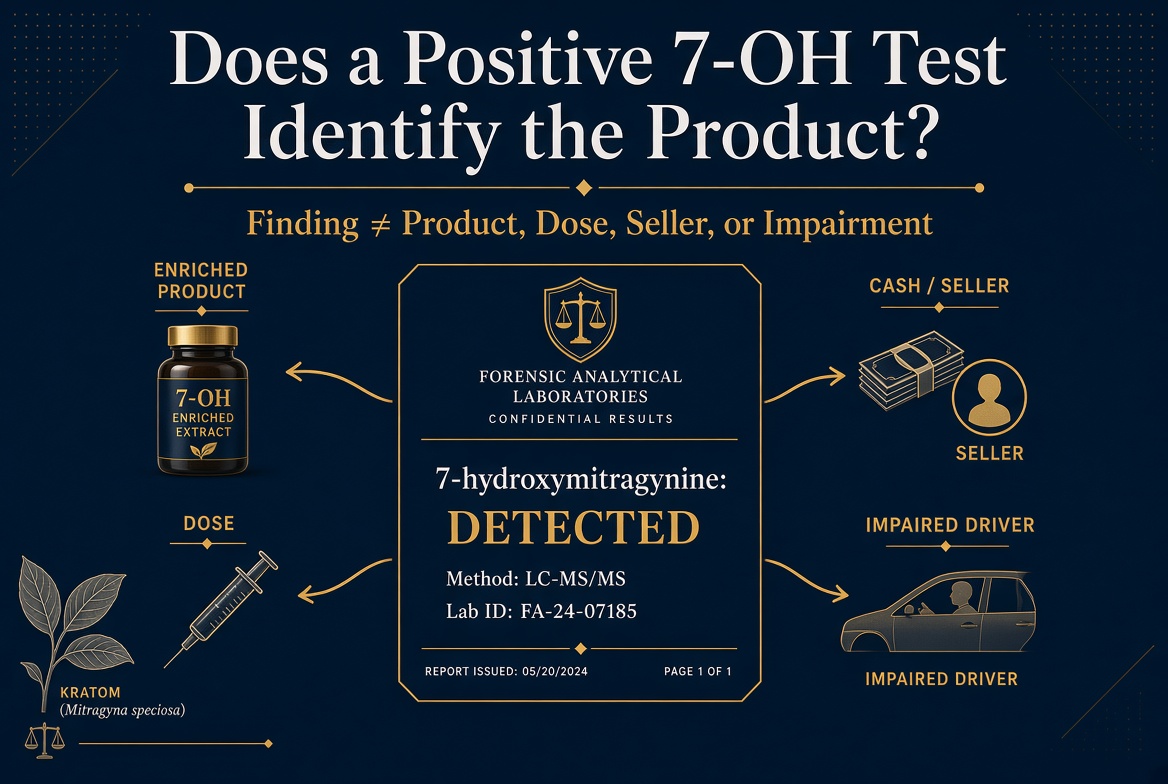
Detection of 7-hydroxymitragynine, often abbreviated 7-OH, is not by itself a product identification. The toxicologist must consider direct exposure, metabolic formation, analytical specificity, and specimen handling before connecting a biological result to a particular product.
This matters in cases involving allegedly enriched tablets, extracts, or drinks. A product label, a blood result, and a person's account may be mutually informative, but they remain different kinds of evidence. None should silently stand in for the others.
Human metabolism creates an attribution problem
A 2024 healthy-volunteer study used kratom tea containing 23.6 mg of mitragynine in two study periods, with itraconazole pretreatment in the second. Serial blood sampling and LC–MS analysis supported conversion of mitragynine to 7-OH in humans. The design investigated pharmacokinetics; it did not validate a blood-ratio test for identifying commercial products. Peer-reviewed study, February 20, 2024; abstract-only access, DOI: 10.1021/acsptsci.3c00335.
Consequently, a report showing 7-OH requires more explanation than “the person must have taken a 7-OH tablet.” The scientific issue is whether the case evidence distinguishes direct intake from formation after another intake, or supports both.
Examine the product independently
Preserve packaging, lot identifiers, remaining contents, purchase records, and photographs. Establish whether the submitted unit is the one used, another unit from the same package, or a newly purchased example bearing the same brand. These are different sampling relationships.
Ask the product laboratory to identify the measured alkaloids, their quantities, the unit basis, and the sampling plan. Milligrams per tablet, milligrams per gram, and milligrams per serving should not be treated as interchangeable. If a serving contains multiple tablets, document that separately from the analytical concentration.
A certificate of analysis also requires provenance. Does it identify the lot, laboratory, date, method, and tested material? A certificate for a supplier's bulk ingredient does not necessarily characterize the finished unit involved in the event. This is a question to investigate, not a reason to assume fraud.
Review the biological measurement on its own terms
Identify the matrix and whether the result is qualitative or quantitative. Ask whether the procedure specifically distinguishes 7-OH from relevant related compounds and whether specimen stability has been evaluated under comparable conditions. Obtain collection, processing, and storage times when a ratio or low concentration is central to the proposed opinion.
Parent-to-metabolite comparisons require special care. The comparison may be influenced by time, exposure history, interacting drugs, and the analytical limits for each analyte. A large ratio is not automatically a product signature; a small ratio is not automatically proof of metabolism alone.
No numerical product-attribution threshold is established by the human study described above. If an expert proposes one, request the underlying validation population, error rates, product range, and performance on cases not used to derive it.
State separately what is established and what remains inferred
A report can distinguish four conclusions: the specimen contained an identified alkaloid; the retained product contained measured alkaloids; the records connect that product to the individual; and the total evidence supports a particular contribution to the event. The strength of each conclusion may differ.
For cross-examination, ask which step depends on direct measurement and which depends on an assumption. For affirmative testimony, state those assumptions before giving the opinion. A confirmed exposure can be important without supporting an exclusive product source, a precise dose, or impairment at a specified earlier time.
See the broader kratom and 7-OH overview for product context. This article addresses evidentiary attribution rather than current product-specific legal status.



