Why Intelligent People Hold Irrational Political Beliefs
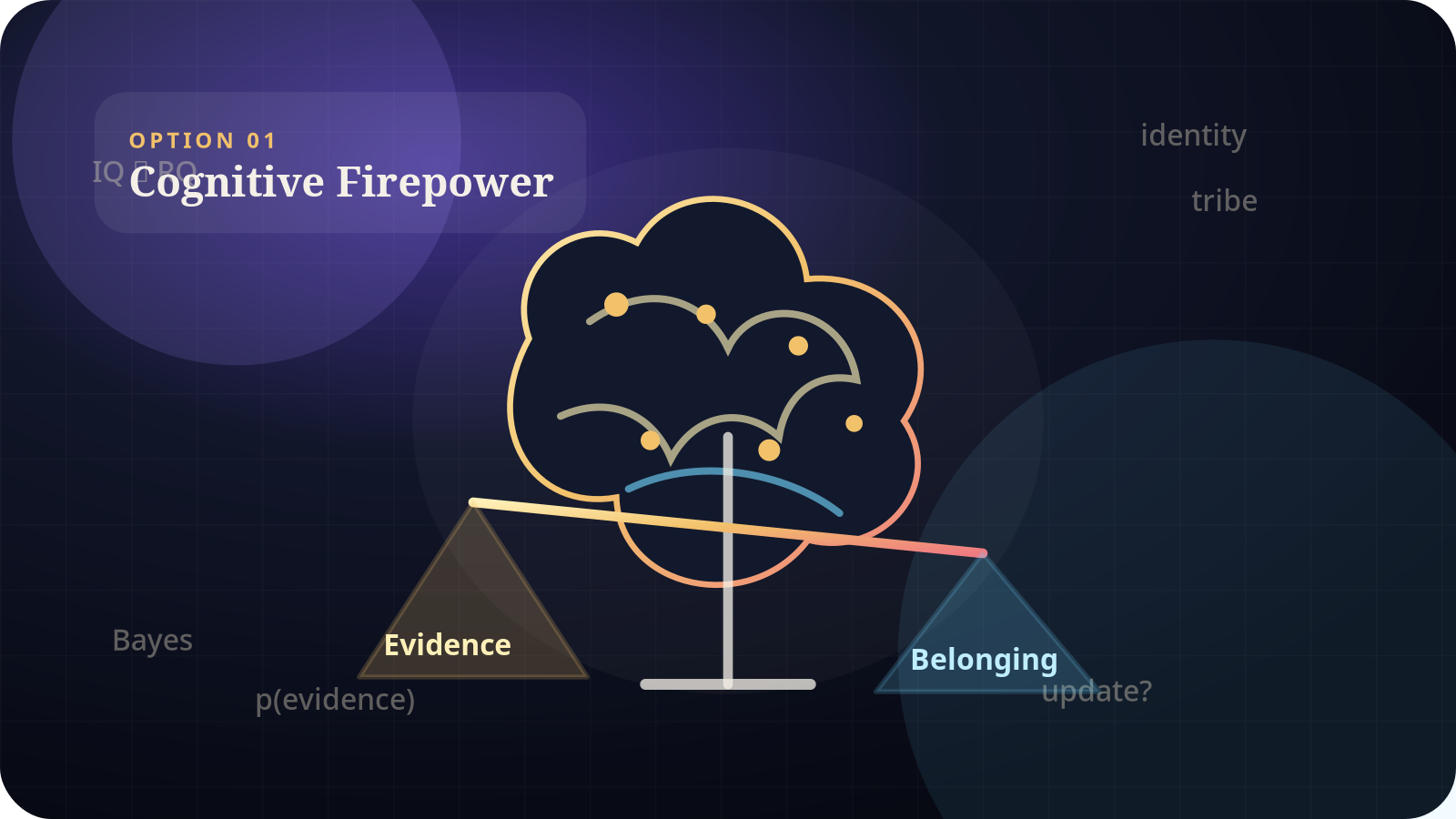
Short answer: Political beliefs are not formed by intelligence alone. Group identity, prior knowledge, trusted messengers, moral values, and selective exposure all shape how evidence is interpreted. Intelligence may improve accuracy in some settings, but it does not make anyone immune to partisan bias.
Reviewed and updated July 24, 2026.
Why politics is a special case
Political claims are often tied to belonging. Accepting a fact can seem to endorse an opposing group, threaten a moral commitment, or damage status within one’s community. Under those conditions, the mind is not solving a neutral puzzle; it is balancing accuracy against social and identity costs.
Partisans on different sides show ingroup favoritism. Reviews find systematic tendencies to seek, believe, and remember information that supports political loyalties. The direction of a bias changes with the issue and group; the underlying vulnerability is not owned by one party.
How partisan bias operates
- Selective exposure: people choose sources and networks that repeat congenial claims.
- Asymmetric scrutiny: friendly evidence receives a lighter audit than hostile evidence.
- Source substitution: trust in the messenger stands in for evaluation of the underlying data.
- Identity-protective interpretation: the same behavior can be described as principled when an ally does it and corrupt when an opponent does it.
- Memory and repetition: familiar claims are easier to retrieve and may feel truer.
Does greater intelligence make motivated reasoning worse?
That popular claim is too broad. Some influential experiments suggested that people with stronger numerical or analytical skills use those skills to defend identity-congenial conclusions. Later preregistered replications and larger studies did not consistently reproduce the effect.
A 2021 set of three studies found a direct effect of political identity on reasoning but no evidence that cognitive sophistication magnified it after accounting for prior factual beliefs. A large U.S. probability-sample study likewise found no association between numerical ability and greater politically motivated reasoning. The defensible conclusion is that partisan bias is robust, while the role of cognitive sophistication depends on the task, prior beliefs, and design.
Prior beliefs are not the same as pure identity defense
If two groups begin with different factual beliefs, they can interpret new evidence differently without consciously protecting a party label. That still creates polarization, but it suggests different remedies. Identity threat may call for trusted cross-group messengers; knowledge gaps may call for clearer evidence and correction of an earlier false premise.
Ways to reason better about political claims
- Use an identity-neutral version. Ask whether you would judge the conduct the same way if the parties were reversed.
- Evaluate the primary record. Read the bill, ruling, dataset, transcript, or study rather than only commentary.
- Separate values from facts. People can share the same evidence and still prioritize outcomes differently.
- Write a forecast. Record what you expect and when; later check the result.
- Explain the mechanism. Step-by-step explanation can expose an illusion of understanding.
- Invite a falsifier. Ask a knowledgeable critic what evidence most threatens your view.
A nonpartisan standard
Apply the same burden of proof, tolerance for uncertainty, and standard of conduct to allies and opponents. The goal is not to become politically neutral; it is to make loyalty less capable of changing what counts as evidence.
For the broader cognitive question outside politics, read why smart people believe irrational things.
Research sources
- Partisan Bias in Political Judgment
- The Partisan Brain: An Identity-Based Model
- Rethinking Cognitive Sophistication and Motivated Reasoning
- Preregistered Replication of Motivated Numeracy
- Numerical Ability in a Large U.S. Probability Sample
This article summarizes research findings and does not characterize the beliefs or intelligence of any individual.
For related political and legal commentary, browse the News archive.
Related reading: For related context, read What is Forensic Toxicology?, What Does a Forensic Toxicologist Do? Role and Daily Work.