Trace Condensate THC Was Not an Exact Quantified Concentration
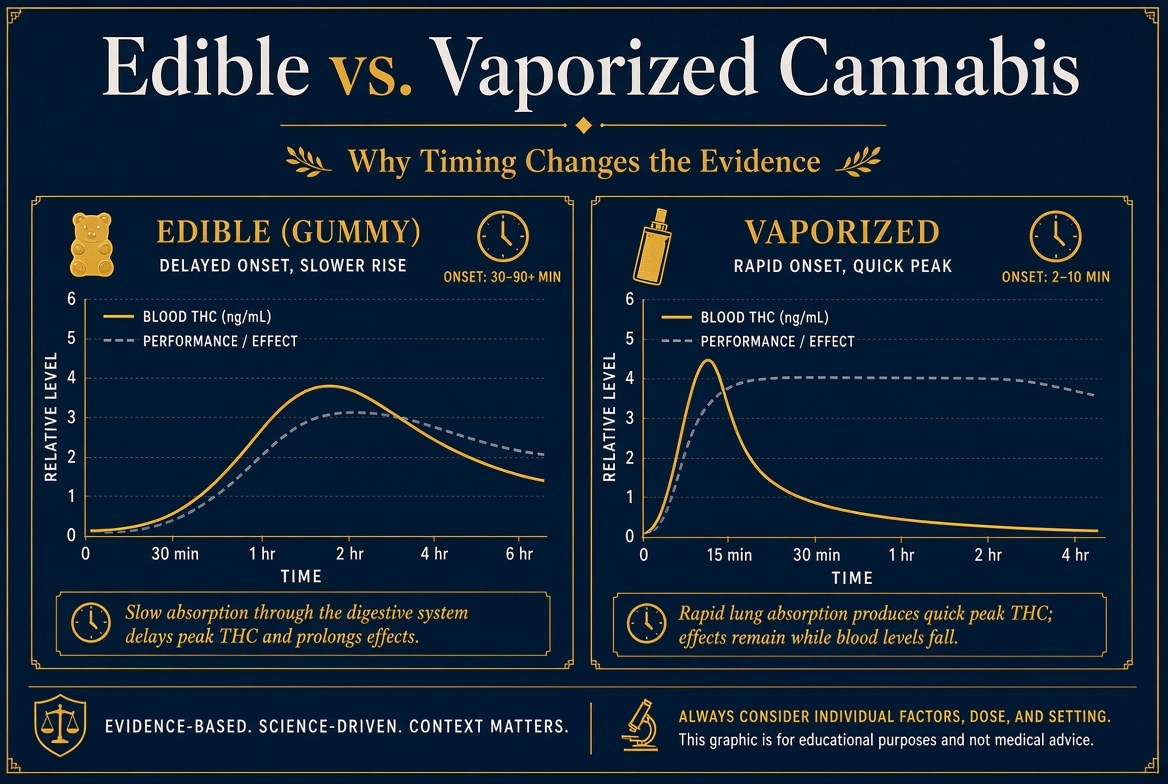
THC Vaporized and THC edibles

The condensate study distinguished trace detection from quantification. One early post-use THC finding was a trace, so detection in every participant did not mean an exact THC concentration was reported for every sample.

Identification criteria could be met below the quantitative range

The researchers designated signals below quantification as trace when other criteria, including qualifier-to-quantifier ratio and retention time, were satisfied. Their approximate lower quantification limit in device units was 0.003 ng per device after the specified preparation. This was distinct from declaring no analyte present.

Preserve three different claims

Nondetection, trace detection and acceptable quantification are not interchangeable. A trace can support identification under the method’s criteria without supporting an exact number below its quantitative boundary. Likewise, absence of a quantified value is not automatically an absence-of-exposure finding.

Do not turn a trace into an impairment value

The study involved twelve participants who inhaled cannabis and two non-users, with limited post-use sampling. It did not validate an individual impairment cutoff. When comparing a trace with another device or specimen, retain collection method, preparation, units and sensitivity. The reported signal cannot be converted directly into a blood concentration, consumed dose or precise time of use.

Related analysis: the condensate proof-of-concept study.

Research cited

Berry and colleagues (2024). Cannabinoids detected in exhaled breath condensate after cannabis use. DOI: 10.1088/1752-7163/ad6347.


Spread the love


The National Black Lawyers

top 40 lawyers

civil trial law

Lawyers of Distinction

Loading...

Recent Blog Articles

What Did Mental Health Professionals Report After a Breathwork Workshop?

Ulrike Lueken and colleagues asked 48 mental health professionals to take part in a high-ventilation breathwork workshop and rate their experience. The participants reported altered states and also gave their judgments about possible therapeutic uses and risks. Those ratings describe the views of the workshop group. They do not measure…

Spread the love

Read Article: What Did Mental Health Professionals Report After a Breathwork Workshop?

What Changed on an Emotional Face Recognition Task After Psilocybin With Support?

In an open-label study, J. B. Stroud and colleagues found that people with treatment-resistant depression recognized facial emotions faster one month after receiving psilocybin with psychological support. Seventeen patients completed the task at baseline and follow-up. Sixteen untreated controls completed it on the same schedule. The researchers reported a group-by-time…

Spread the love

Read Article: What Changed on an Emotional Face Recognition Task After Psilocybin With Support?

What Did a Young-Adult CBD Survey Reveal About How Users Chose a Dose?

A survey of young adults asked how CBD users chose a dose. Their answers show why a product history needs more detail than a report of CBD use.

Spread the love

Read Article: What Did a Young-Adult CBD Survey Reveal About How Users Chose a Dose?

Speak with an expert today!

Contact the offices of Okorie Okorocha for professional and reliable advice which you can trust.

Call (424) 363-3347 Contact Us

