Methamphetamine Driving Cases: Records and Scientific Questions
Prepared by Connectica, LLC marketing staff. This material has not been verified by a trained forensic toxicologist. Read the full Content Disclaimer.
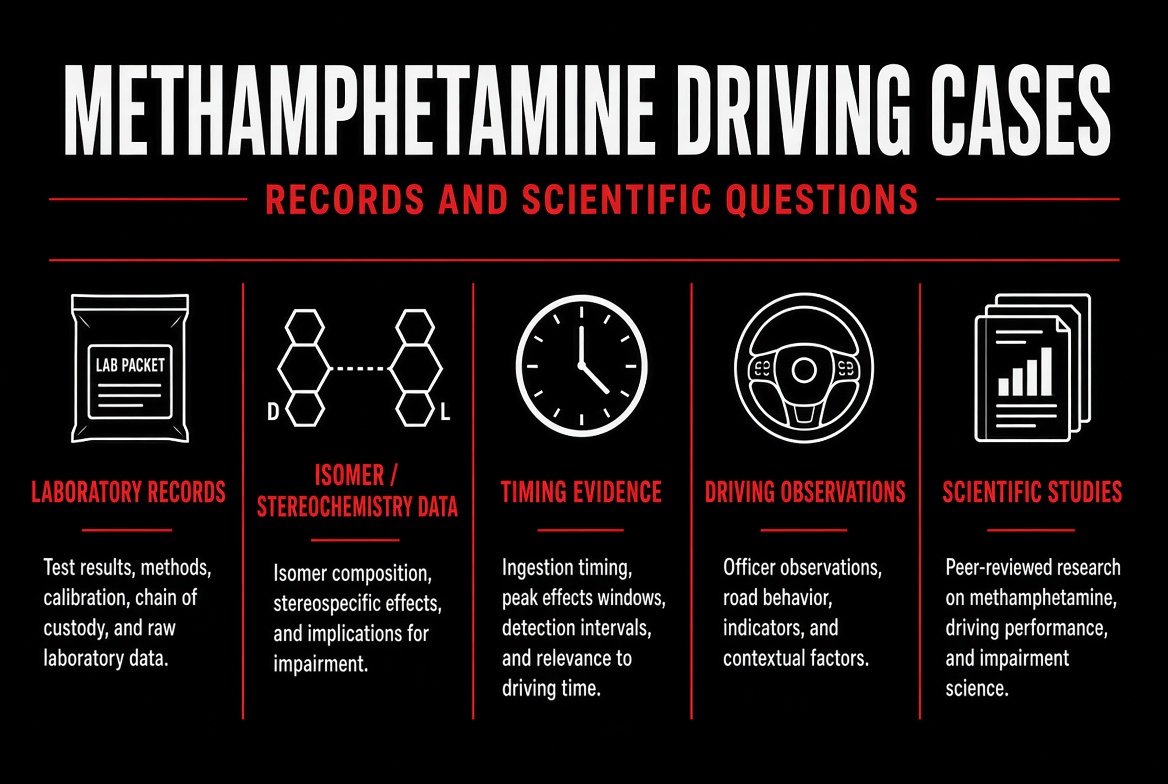
A methamphetamine result can become the center of a driving case even though the laboratory report answers only part of the scientific question. Counsel should separate analytical reliability, source, timing, concentration, observed performance, fatigue, and the limits of the studies relied upon by each expert.
Begin with the complete laboratory packet
The final report is a summary, not the complete analytical record. Request the screening and confirmation methods, quantitative methamphetamine and amphetamine results, calibration, controls, reporting limits, uncertainty, chromatograms, spectra or transitions, integration and calculation records, technical review, and corrective actions.
The file should also identify the specimen matrix, collection time, preservatives, storage, chain of custody, and any deviations. Whole blood, plasma, serum, urine, and oral fluid do not answer the same questions.
Ask whether source or stereoisomer composition matters
Methamphetamine exists in different stereoisomeric forms. A routine non-chiral method may correctly identify methamphetamine without resolving the d- and l-forms. When a medication, inhaler, metabolite, or other legitimate source is factually supported, determine whether an appropriate chiral method was performed and what the complete analyte pattern shows.
Isomer testing is not a generic explanation for every positive result. The proposed source, product history, dose, timing, metabolites, and measured proportions must fit the evidence.
Do not treat the concentration as a stimulant BAC
Published research does not establish a universal blood methamphetamine concentration that proves a particular degree of driving impairment. A result collected after the stop describes the specimen at collection. The relevant legal and factual question concerns function at the driving time.
The review should examine the delay between driving and collection, reported use, dose pattern, tolerance, last sleep, acute stimulation, prolonged wakefulness, withdrawal, other substances, health conditions, and the behavior actually observed.
Use controlled studies within their limits
Silber and colleagues reported no significant overall simulator impairment or improvement in 20 selected participants at one defined d,l-methamphetamine dose and interval. Hjalmdahl and colleagues found that d-amphetamine did not compensate for fatigue-related driving impairment in a different experiment. Downey and colleagues found that standardized field sobriety tests did not significantly identify low-level d-methamphetamine under their controlled conditions.
None of these studies decides an individual case. The drug, isomer, dose, route, population, timing, task, and outcome must match before a publication can be applied. A prosecution or defense expert should explain both the study’s result and its boundary conditions.
Records to request
- the original report and every amended report;
- specimen labels, seals, collection records, preservatives, storage, and chain of custody;
- screening, confirmation, and quantitative method records;
- calibrators, controls, blanks, chromatograms, spectra or transitions, and calculations;
- measurement uncertainty, reporting limits, validation, proficiency testing, and corrective actions;
- methamphetamine, amphetamine, and other reported analytes and concentrations;
- chiral or stereoisomer data when source is genuinely disputed;
- medication, over-the-counter product, supplement, and exposure history;
- driving video, body-camera video, dispatch, collision data, and witness statements;
- field sobriety instructions, scoring, environmental conditions, and medical limitations;
- sleep history, work schedule, health conditions, injury, and other substances; and
- every publication, guideline, or database relied upon by each expert.
Questions for expert review
- Does the analytical record support the reported identification and concentration?
- What does the specimen establish about exposure and collection-time concentration?
- Can the available testing resolve the source or stereoisomer question?
- What can and cannot be inferred about the driving-time concentration?
- Do the observations fit acute stimulation, fatigue, withdrawal, another drug, illness, or multiple causes?
- Does each relied-upon study match the actual facts?
- Has the expert separated analytical findings from a functional impairment opinion?
When the case depends on the science, your lawyer should understand the science. The Okorocha Firm evaluates matters in which drugs, alcohol, laboratory testing, pharmacology, or complex scientific evidence may determine the outcome. A case-specific assessment requires the actual reports, raw data, timeline, observations, and governing legal standard.
Selected scientific references
- Jones AW. Age- and gender-related differences in blood amphetamine concentrations in apprehended drivers: lack of association with clinical evidence of impairment. Addiction. 2007;102(7):1085-1091. doi:10.1111/j.1360-0443.2007.01802.x.
- Silber BY, Croft RJ, Downey LA, et al. The effect of d,l-methamphetamine on simulated driving performance. Psychopharmacology. 2012;219(4):1081-1087. doi:10.1007/s00213-011-2437-7.
- Hjalmdahl M, Vadeby A, Forsman A, et al. Effects of d-amphetamine on simulated driving performance before and after sleep deprivation. Psychopharmacology. 2012;222:401-411. doi:10.1007/s00213-012-2744-7.
- Downey LA, King R, Papafotiou K, Swann P, Ogden E, Stough C. Examining the effect of MDMA and methamphetamine on the standardized field sobriety tests. Forensic Science International. 2012;220:e33-e36. doi:10.1016/j.forsciint.2012.02.025.
Related scientific reading
For the evidence-focused scientific discussion, read Can a Blood Methamphetamine Level Prove Driving Impairment?. For source and stereoisomer questions, see Amphetamine Enantiomers in Forensic Toxicology.
SCIENCE. STRATEGY. TRIAL EXPERIENCE.
General informational and marketing material only. It is not legal advice, expert opinion, or a statement of scientific fact. No attorney-client or expert-client relationship is created. Full Content Disclaimer.