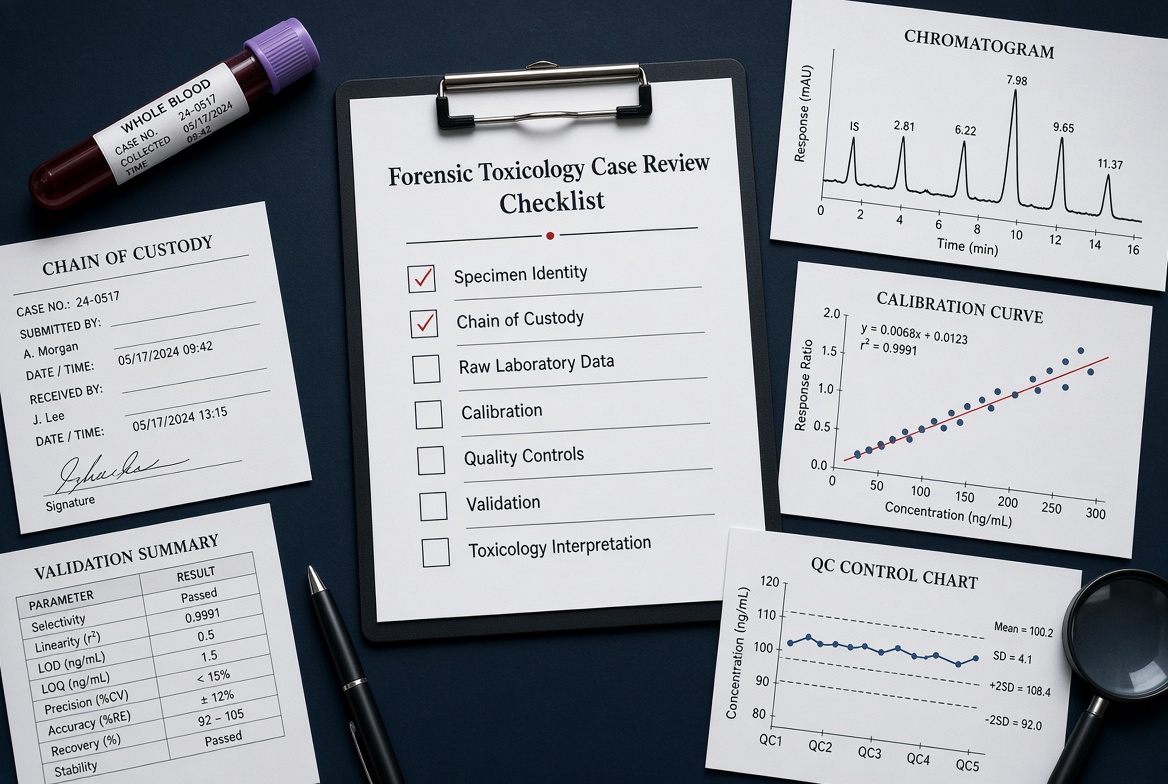
Forensic Toxicology Case Review Checklist
THE OKOROCHA FIRM*
Content notice: Scientific and toxicology content on this site was written by non-toxicologist marketing staff at Connectica, LLC. It has not been verified for accuracy by a trained forensic toxicologist. Read the full Content Disclaimer.
A useful forensic toxicology review starts with the complete laboratory record, not only the final report. The report may identify a drug, metabolite, alcohol concentration, or interpretive conclusion, but it usually does not show every step needed to evaluate how the specimen was collected, preserved, tested, reviewed, and reported. Attorneys should request the materials that connect the specimen to the stated result and the stated result to the opinion offered in the case.
This checklist is designed for civil and criminal matters involving drugs, alcohol, medication, poisoning, impairment, causation, or disputed laboratory evidence. The precise request should be tailored to the specimen type, laboratory, governing rules, and issues in the case.
Quick checklist: records to request
- Final toxicology report and every amended or supplemental version
- Collection records, labels, seals, and chain-of-custody documentation
- Specimen type, source, collection time, receipt time, and storage history
- Accession records and the laboratory case worksheet
- Screening data and confirmatory testing data
- Instrument sequence, calibrators, controls, blanks, and internal standards
- Chromatograms, spectra, integration records, and quantitative calculations
- Calibration model, calibration verification, and acceptance criteria
- Quality-control results, corrective actions, and nonconformance records
- Method validation or verification materials applicable to the reported test
- Standard operating procedures in effect on the date of testing
- Analyst notes, technical review, administrative review, and audit trail
- Measurement uncertainty, reporting cutoff, detection limit, and quantitation limit
- Laboratory accreditation scope and relevant proficiency-testing records
- Communications about the test, interpretation, retesting, or amended report
Why the final report is not the entire laboratory record
A final report is a conclusion document. It may accurately summarize the laboratory’s result, but it generally cannot answer every reliability question. A complete review may need to determine whether the correct specimen was tested, whether the method was suitable for the analyte and matrix, whether controls met the laboratory’s criteria, whether an analytical interference was considered, and whether the interpretation extends beyond what the measurement can support.
The distinction matters because identification, quantitation, exposure, timing, impairment, and causation are different propositions. A result can be analytically valid while an opinion about what that result means remains disputed.
1. Specimen collection and identity records
Begin with the evidence trail. Request documents showing who collected the specimen, when and where it was collected, how it was labeled, what container and preservative were used, who handled it, when the laboratory received it, and whether seals were intact. For postmortem testing, request the anatomical source of each specimen. Peripheral blood, central blood, vitreous fluid, urine, tissue, and other matrices do not necessarily answer the same questions.
Time information should be assembled into one chronology. Collection time, incident time, treatment time, death time, receipt time, preparation time, analysis time, and report time may each affect the issues that can reasonably be addressed.
2. Analytical method and raw-data records
Request the method used for the initial screen and the method used for confirmation. Screening tests may be designed to identify a class of compounds or possible presence. Confirmatory methods are generally more specific and may identify and quantify individual analytes. Ask for the complete instrument sequence and the data for the case specimen, calibrators, controls, blanks, and internal standards.
Depending on the method, useful records may include chromatograms, mass spectra, ion ratios, retention times, integration events, calibration curves, dilution records, calculations, batch worksheets, and electronic audit trails. The purpose is not to collect paper for its own sake. It is to determine whether the reported result is traceable to acceptable analytical data.
3. Calibration and quality-control records
Calibration connects the instrument response to a concentration. Quality controls help show whether the analytical batch performed within predefined limits. Request the laboratory’s acceptance criteria along with the actual results. A control value without the applicable range is difficult to evaluate.
Also request records of failed controls, reinjections, repeat preparations, carryover checks, blank responses, maintenance, troubleshooting, and corrective action. A repeated test is not automatically unreliable, but the reason for the repeat and the laboratory’s response should be documented.
4. Validation, procedures, and laboratory standards
The relevant standard operating procedure is the version in effect when the testing occurred. Request the method’s validation or verification summary and any matrix-specific limitations. Useful topics include selectivity, sensitivity, calibration model, precision, bias, carryover, interference, stability, dilution integrity, detection limit, quantitation limit, and reportable range.
The NIST Forensic Science Standards Library provides a current landscape of forensic-science standards, including standards that may be relevant to toxicology work. The existence of a standard does not by itself decide a case. The question is which standards applied, what the laboratory represented it followed, and whether the case record documents compliance.
5. Reporting thresholds and measurement limits
Ask the laboratory to identify the reporting cutoff, analytical detection limit, quantitation limit, and reportable range. These terms are not interchangeable. A reporting cutoff may reflect a program rule or administrative decision, while a detection or quantitation limit describes analytical performance under defined conditions.
For federal workplace testing, SAMHSA publishes current drug-testing resources, including mandatory guidelines, custody and control materials, and laboratory resources. Those federal program requirements do not automatically govern every clinical, criminal, civil, or private workplace test, but they illustrate why the governing program and its rules must be identified before interpreting a result.
6. Interpretation and opinion materials
If an expert offers an opinion about use, timing, impairment, tolerance, behavior, cause of death, or causation, request the materials relied upon. These may include medical records, dose history, scene facts, witness observations, pharmacokinetic assumptions, published literature, reference databases, and calculations.
An opinion should identify both what the evidence supports and what it does not establish. For example, a positive urine result can support prior exposure to a drug or metabolite under the conditions of the test. Standing alone, it may not establish the concentration in blood at an earlier time, a specific dose, the time of use, or impairment at the time of an event.
Organize the production into a review map
A practical review map connects each conclusion to its supporting records:
| Question | Primary records | Common follow-up |
|---|---|---|
| Was the correct specimen tested? | Labels, seals, accession, chain of custody | Resolve gaps, duplicate identifiers, or timing conflicts |
| Was the analyte reliably identified? | Method, raw data, confirmation, controls | Review selectivity, interference, and identification criteria |
| Was the concentration reliably measured? | Calibration, controls, calculations, reportable range | Review dilution, uncertainty, and repeat analysis |
| What does the result mean? | Matrix, timing, medical facts, literature, assumptions | Separate exposure from timing, impairment, and causation |
When to involve a forensic toxicology reviewer
Early review is especially useful when the result is central to liability or guilt, the report has been amended, the specimen history is unclear, the testing includes multiple matrices, the opinion depends on back-extrapolation or pharmacokinetics, the laboratory used a screening result without adequate confirmation, or the disclosed production omits raw data and quality-control records.
For plain-language scientific background, see the independent educational material at ForensicToxicology.com on toxicology data review. For a litigation-oriented evidence reference, see the ForensicToxicology.net evidence library.
Focused review for the legal question
The strongest request is not the longest request. It is the request tied to the disputed scientific proposition. A toxicology case review should identify the proposition being offered, the records needed to test it, the assumptions connecting the data to the opinion, and the limitations that must accompany the conclusion.
Related workflow: See Urine and Blood Drug Testing: Collection to Interpretation and Forensic Toxicology Testing: Specimens, Methods and Interpretation.
When the case depends on the science, your lawyer should understand the science. To discuss legal representation, toxicology co-counsel, or expert-witness review, use the site’s consultation form.
This article provides general educational information and is not legal advice or a case-specific scientific opinion.