Federal Immigration Enforcement and the Supremacy Clause
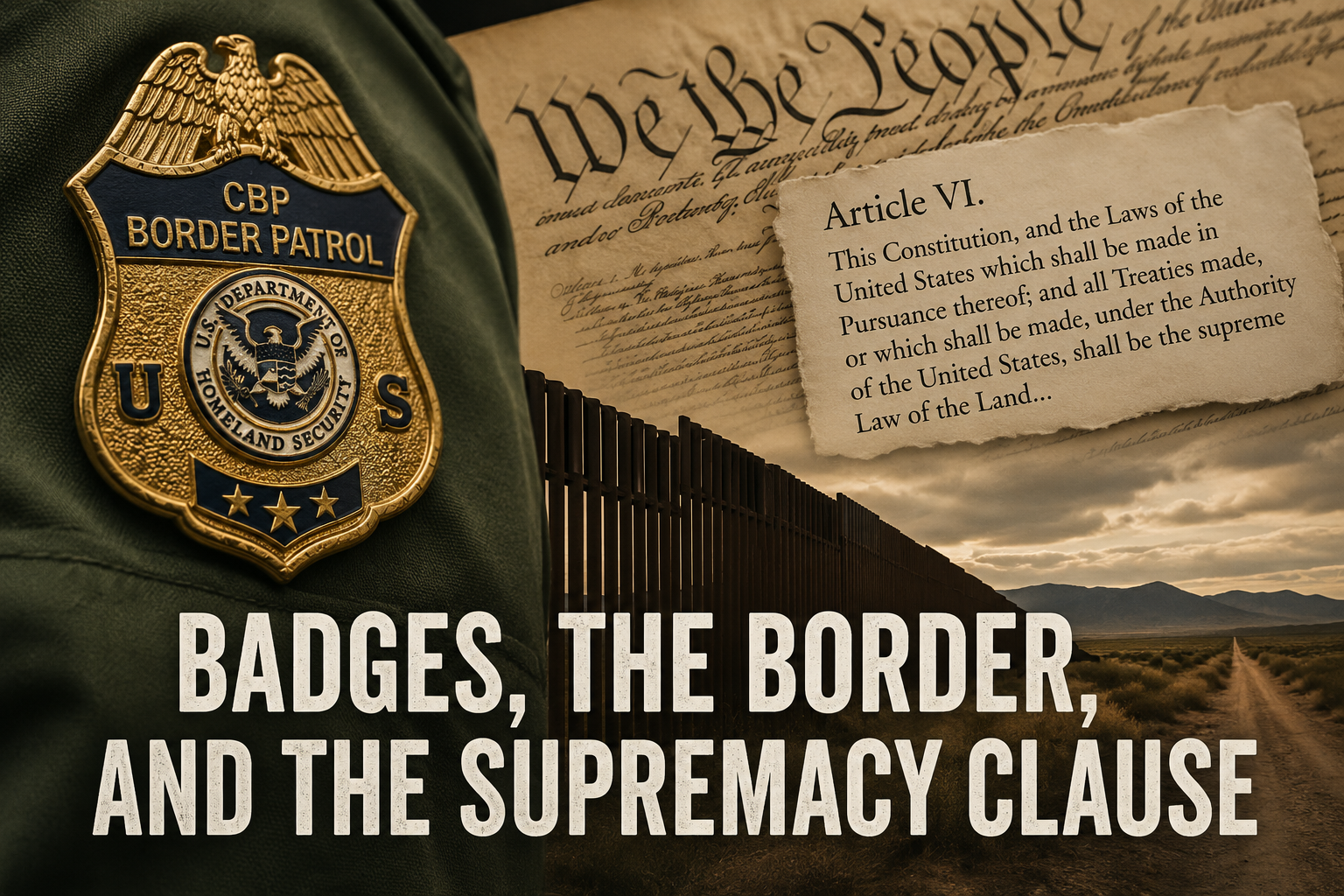
Article overview: The Ninth Circuit paused California’s “No Vigilantes Act,” ruling the state likely cannot force non-uniformed federal agents to display identification. Here is what the order does, and what it leaves undecided.
California passed the No Vigilantes Act in 2025 to answer a public worry that had grown loud during a wave of federal immigration enforcement: agents in plain clothes, sometimes masked, detaining people without any visible sign of who they were or what agency they served. The Ninth Circuit has now blocked the state from enforcing the heart of that law against federal officers while the case is on appeal, holding that the United States is likely to win on a Supremacy Clause theory. The order is a significant marker in the running conflict between Sacramento and Washington, and it is worth understanding precisely.
The provision at issue, codified at Penal Code section 13654 and known as Section 10 of the Act, required a law-enforcement officer working in California who is not in uniform to visibly display identification showing the officer’s agency and either a name or a badge number while carrying out enforcement duties. Violations were treated as misdemeanors. A companion measure, the No Secret Police Act, separately addressed face coverings by officers. The Legislature framed both as transparency and accountability laws.
How the case reached the Ninth Circuit
The federal government sued to stop enforcement against its agents. In February, a district judge in the Central District of California declined to enjoin Section 10, finding the United States had not shown that the requirement would interfere with or seize control of federal operations. The government asked the Ninth Circuit for an injunction pending appeal, and a unanimous three-judge panel granted it. The opinion explained that the doctrine of intergovernmental immunity, which flows from the Supremacy Clause, forbids a state from regulating the federal government in the performance of its functions.
The panel’s central move was to characterize what the statute actually does. The law does not regulate conduct that any ordinary person might engage in. It applies exclusively to law-enforcement agencies and their officers, including federal ones, and it dictates how a federal agent may carry out federal duties. Because the measure reaches directly into the manner and conditions under which federal agents enforce federal law, the court concluded it likely runs afoul of the rule that states may not control federal governmental functions. California urged the court to weigh the public-safety concerns that motivated the law, but the panel declined to balance the equities, reasoning that enforcing a likely unconstitutional statute is itself an irreparable harm and that the supremacy of federal law lies in the public interest.
What the order decides, and what it does not
Two cautions are essential. First, this is an injunction pending appeal, not a final judgment on the merits. The panel ruled only that the United States is likely to succeed; the appeal itself, and any deeper analysis of the doctrine, still lies ahead. Second, the order addresses the law as applied to federal agencies and officers. It does not erase the statute as to other actors, and the related face-covering and policy provisions involve their own procedural wrinkles, including questions about who has standing to challenge them.
The doctrine the panel applied has deep roots. Ever since the early nineteenth century, courts have held that the states cannot tax, regulate, or otherwise control the operations of the national government, because a power to interfere is a power to impede or even to defeat. Modern cases refine that principle into intergovernmental immunity, which asks whether a state law discriminates against the federal government or regulates it directly. The panel found that Section 10 did the latter, since it singled out the manner in which federal officers, among others, must perform their enforcement duties.
California countered that the law is a neutral transparency measure, not a hostile one, and that accountability for armed agents serves an obvious public interest. The panel did not dispute the importance of those goals. It held instead that the constitutional allocation of authority does not bend to them. If the United States consents to such a requirement it may adopt one, but a state may not impose it unilaterally on federal operations. That distinction, between a policy a sovereign chooses for itself and one another sovereign forces upon it, is the heart of the ruling.
What recourse, then, remains for someone confronted by an unidentified agent? Other avenues survive untouched by this order. Federal agencies set their own identification and body-camera policies, and individuals retain ordinary remedies for unlawful conduct during an encounter. State transparency rules that do not regulate federal officers directly are unaffected as well. The ruling closes one specific door, the criminal enforcement of Section 10 against federal agents, without disturbing the broader landscape of accountability tools.
For Californians, the most immediate effect arrives in immigration-enforcement encounters. For now, the state cannot use Section 10 to compel a plain-clothes federal officer to show agency identification during an arrest, detention, or crowd-control action. The decision does not speak to whether such transparency is wise policy, a question on which Californians plainly disagree. It speaks only to which sovereign gets to set the rules for federal agents, and on that narrow question the court sided with the federal government. The merits appeal, and the doctrinal debate over how far intergovernmental immunity reaches, will be the next chapter, and it is the kind of question that can draw the Supreme Court’s attention.
What it means
- California is temporarily barred from enforcing the ID requirement in Penal Code section 13654 against federal officers.
- The court relied on intergovernmental immunity: a state generally cannot dictate how federal agents perform federal functions.
- This is an injunction pending appeal, not a final ruling, and it targets the law as applied to federal officers specifically.
- The most concrete impact is in immigration-enforcement encounters while the appeal proceeds.
For related federalism and constitutional analysis, browse the Law Updates archive.
Primary authorities on the No Vigilantes Act ruling
- Ninth Circuit opinion in United States v. California
- California Penal Code provisions including section 13654
- California Government Code chapter containing section 7288
- California Legislature bill record for SB 805
Primary authorities on the No Vigilantes Act and Supremacy Clause ruling
- Ninth Circuit opinion in United States v. State of California
- California Legislature’s enacted text of SB 805
- California Penal Code section 13654
- United States complaint challenging the California identification requirements
Related reading: For related context, read California Bail Conditions: What Courts Require, People v. Houston: When a Phone Call Is Not Enough, Research-Funding Litigation and the Trump Administration.