Research-Funding Litigation and the Trump Administration
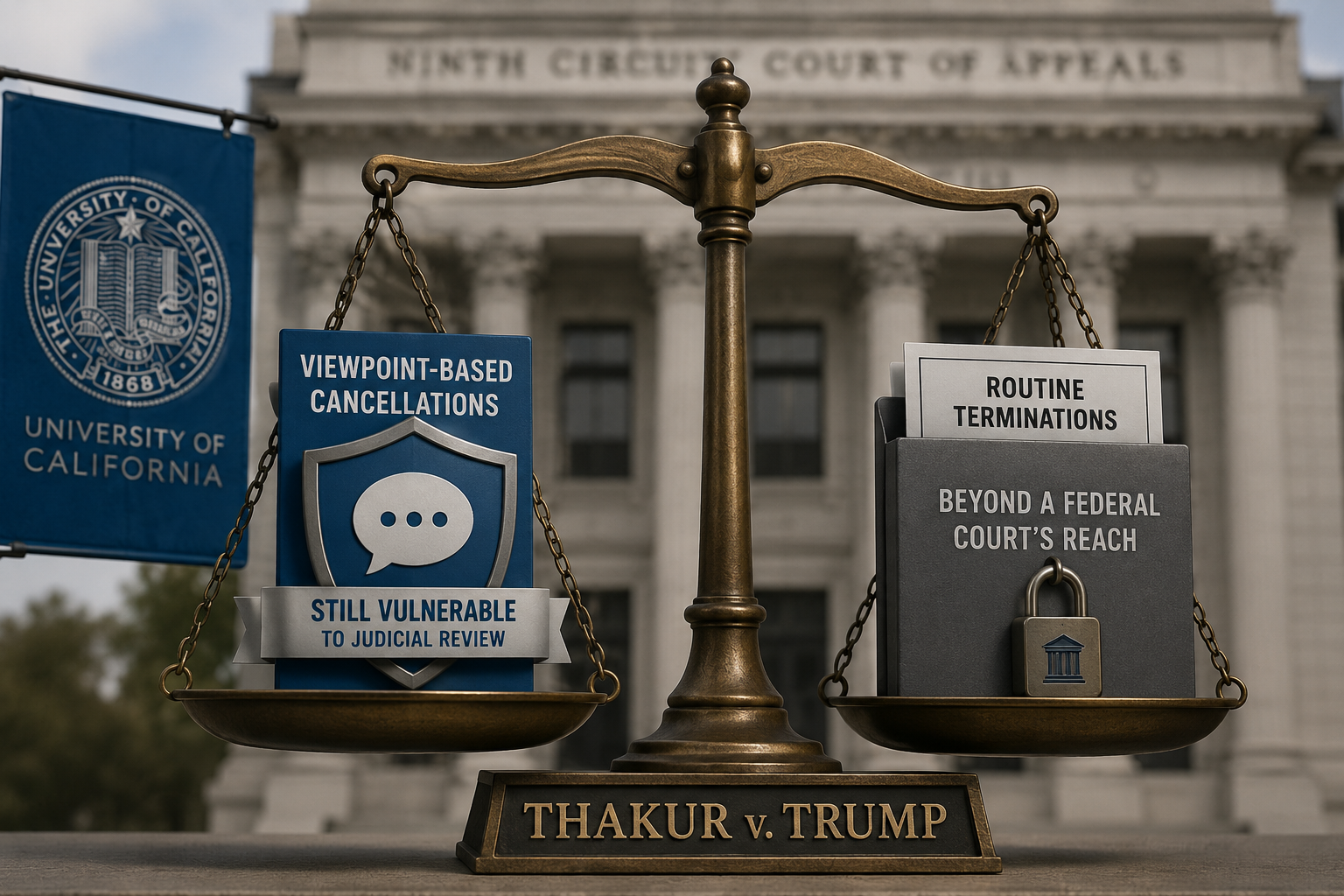
Article overview: In Thakur v. Trump , the Ninth Circuit split the difference for University of California researchers: viewpoint-based cancellations stay vulnerable, while routine terminations may sit beyond a federal court’s reach.
For University of California labs that lost federal funding overnight, the Ninth Circuit’s decision in Thakur v. Trump is both a relief and a warning. The court kept alive an order reinstating grants that were cut because of the recipients’ perceived viewpoints, yet it pulled back relief for a much larger group whose grants were canceled with little explanation. The result is a roadmap that tells researchers which doors remain open in federal court and which ones do not.
The dispute began in the spring of 2025, when several federal agencies, including the Environmental Protection Agency, the National Science Foundation, and the National Endowment for the Humanities, terminated multiyear research grants awarded to UC faculty. The terminations arrived as form letters that cited shifting agency priorities and a series of executive orders, some of which were aimed squarely at eliminating diversity, equity, inclusion, and environmental-justice initiatives from federally funded work. Researchers said they were left with disrupted projects, damaged reputations, and no ready source of replacement money.
Two classes, two very different outcomes
Six UC researchers filed a class action in the Northern District of California, raising constitutional and statutory claims. The district court provisionally certified two groups. One, the Form Termination Class, captured researchers whose grants were ended by form letter with no grant-specific reason. The other, the DEI Termination Class, captured those whose grants were cut specifically because of the diversity-related executive orders. The trial court issued a preliminary injunction ordering roughly three hundred twenty-four million dollars in grants reinstated for both classes, and the government appealed.
On appeal, the Ninth Circuit first confirmed that the researchers had standing to sue. It then divided the case. As to the DEI Termination Class, the court affirmed the injunction, concluding the researchers were likely to succeed on a First Amendment theory. The panel reasoned that canceling grants because of the recipients’ perceived support for disfavored views looks like viewpoint discrimination, the kind of government action the First Amendment treats with deep suspicion. The government is generally free to decide which programs to fund, but it may not wield that spending power to punish ideas it dislikes.
The Form Termination Class fared differently. The court reversed the injunction for that group, holding the district court likely lacked jurisdiction over their core claim that the cancellations were arbitrary and capricious under the Administrative Procedure Act. The problem is one of forum, not merit. When a dispute is essentially about money the government promised under something resembling a contract, the Tucker Act often channels the claim to the Court of Federal Claims rather than a federal district court. The panel’s analysis drew on the Supreme Court’s recent guidance in the NIH grant litigation, which sharpened the line between viewpoint claims that belong in district court and contract-flavored funding claims that may not.
Why this matters beyond Berkeley and Davis
The practical stakes are large for the UC system and for any institution that depends on federal research dollars. The decision signals that grant terminations driven by hostility to a viewpoint remain legally exposed, which gives researchers a meaningful tool when an agency’s own letters or the surrounding executive orders reveal an ideological motive. At the same time, the ruling cautions that a generic termination, dressed up as a change in priorities, may be far harder to fight in district court. A researcher in that position may need to pursue the money in the Court of Federal Claims, a different venue with different remedies and timelines.
Consider what a termination means on the ground. A multiyear grant is rarely just a number. It funds graduate-student stipends, postdoctoral salaries, equipment leases, and the day-to-day continuity of experiments that cannot simply be paused and resumed. When the money stops mid-project, the damage compounds quickly, and the affected researchers described exactly that kind of cascading harm. The reinstatement that survived appeal therefore matters not only as a precedent but as a lifeline for ongoing work.
The First Amendment theory the court endorsed rests on a settled idea. Government may choose what to subsidize, but it may not condition a benefit on the surrender of protected expression, nor revoke one to retaliate against views it disfavors. The agencies’ own form letters and the executive orders they invoked supplied the evidence of motive that made the viewpoint claim plausible. That is the lesson for future disputes. Documentation cuts both ways, and an agency that announces an ideological purpose hands the other side its strongest argument.
It is worth being precise about what remains unresolved. The appellate ruling addressed a preliminary injunction, which turns on likelihood of success rather than a final verdict. The case returns to the district court, where the parties will litigate the merits, the proper scope of any class, and the line between a viewpoint-based cut and an ordinary funding decision. Institutions watching from the sidelines, including hospitals, universities, and research nonprofits across the circuit, will read the eventual merits rulings carefully, because the same federal agencies fund work far beyond California.
There is a broader principle here too. Thakur sits within the unconstitutional-conditions tradition, which holds that the government cannot use funding as leverage to suppress speech it could not ban outright. As the case returns to the district court for further proceedings, expect both sides to fight over how to characterize each termination, because the label that attaches, viewpoint-based versus run-of-the-mill, may decide whether the courthouse doors stay open.
What it means
- Grant cancellations that punish a disfavored viewpoint remain vulnerable under the First Amendment, and that relief survived appeal.
- Generic, form-letter terminations face a jurisdictional wall: the contract-like money claim may belong in the Court of Federal Claims, not district court.
- For grant-dependent UC labs and faculty, the agency’s stated reason for a cut now carries real legal weight.
- The case continues on remand, where the characterization of each termination will drive the outcome.
For related litigation developments, browse the Law Updates archive.
Primary authorities for Thakur v. Trump
- Ninth Circuit published opinion in Thakur v. Trump (May 26, 2026)
- U.S. Supreme Court order in NIH v. American Public Health Association
- Ninth Circuit emergency-motion order in Thakur (August 21, 2025)
- U.S. Supreme Court docket for NIH v. American Public Health Association
Primary authorities on Thakur v. Trump and research-grant litigation
- Ninth Circuit’s 2026 opinion in Thakur v. Trump
- Ninth Circuit’s 2025 order in Thakur v. Trump
- Supreme Court order in NIH v. American Public Health Association
- Executive Order 14173 in the Federal Register
Related reading: For related context, read California Bail Conditions: What Courts Require, People v. Houston: When a Phone Call Is Not Enough, Stop-and-Identify Laws: When Must You Identify Yourself?.