Higher Blood THC Did Not Mean Greater Task Impairment Across User Groups
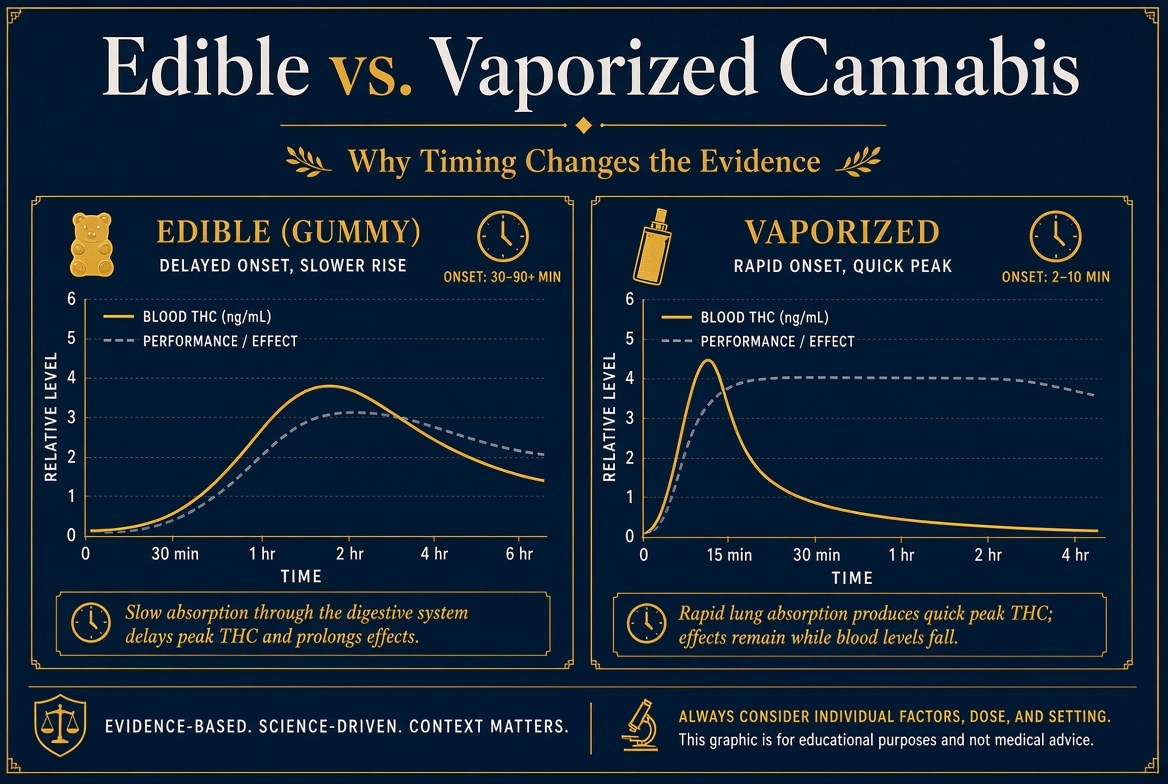
Frequent cannabis smokers had higher blood THC concentrations but weaker effects on some tasks than occasional smokers in a controlled-smoking study. The finding supports a limited, domain-specific role for tolerance; it does not show that frequent users were universally unimpaired.
One smoking session, different histories
Desrosiers and colleagues studied 14 frequent and 11 occasional smokers. Participants stayed on a secure research unit before smoking a cannabis cigarette containing approximately 54 mg THC, with smoking allowed to the participant’s desired comfort level within ten minutes.
The experiment measured blood cannabinoids, subjective effects and several performance domains. The groups were not randomized to develop different cannabis-use histories. They also differed in age and other history characteristics, and two participants were reclassified using their biological profiles.
Blood exposure and task responses diverged
At 30 minutes, mean blood THC was 32.3 ng/mL in frequent smokers and 17.4 ng/mL in occasional smokers. Nevertheless, occasional smokers generally showed stronger subjective effects and greater disruption of selected psychomotor and divided-attention measures.
The outcome was not uniform across the test battery. Working-memory and risk-taking tasks did not show the same session-by-group effects. The overall critical-tracking analysis was also not significant, although a specific contrast favored frequent smokers at 1.5 hours relative to their baselines. A broad claim that every cognitive function was impaired equally would misrepresent those results.
Tolerance is not a personal clearance certificate
There was no placebo smoking session. Consequently, changes over time may include fatigue, practice and boredom as well as drug effects. Some task data were excluded for poor baseline performance, and the small sample limited statistical power.
The study did not measure actual crash risk or identify an individual blood concentration at which driving became safe. Less impairment in one group is a relative comparison, not proof of normal performance in every frequent smoker.
In testimony or a report, name the affected task, comparison and user population instead of relying on the word “tolerant” alone. Our discussion of THC blood levels and impairment explains why concentration and functional evidence must be evaluated together.
Primary research
Nathalie A. Desrosiers and colleagues. Journal of Analytical Toxicology (2015). Smoked Cannabis’ Psychomotor and Neurocognitive Effects in Occasional and Frequent Smokers.



