Do Three Delta-8 THC Cases Validate HGN or a Three-Hour Driving Rule?
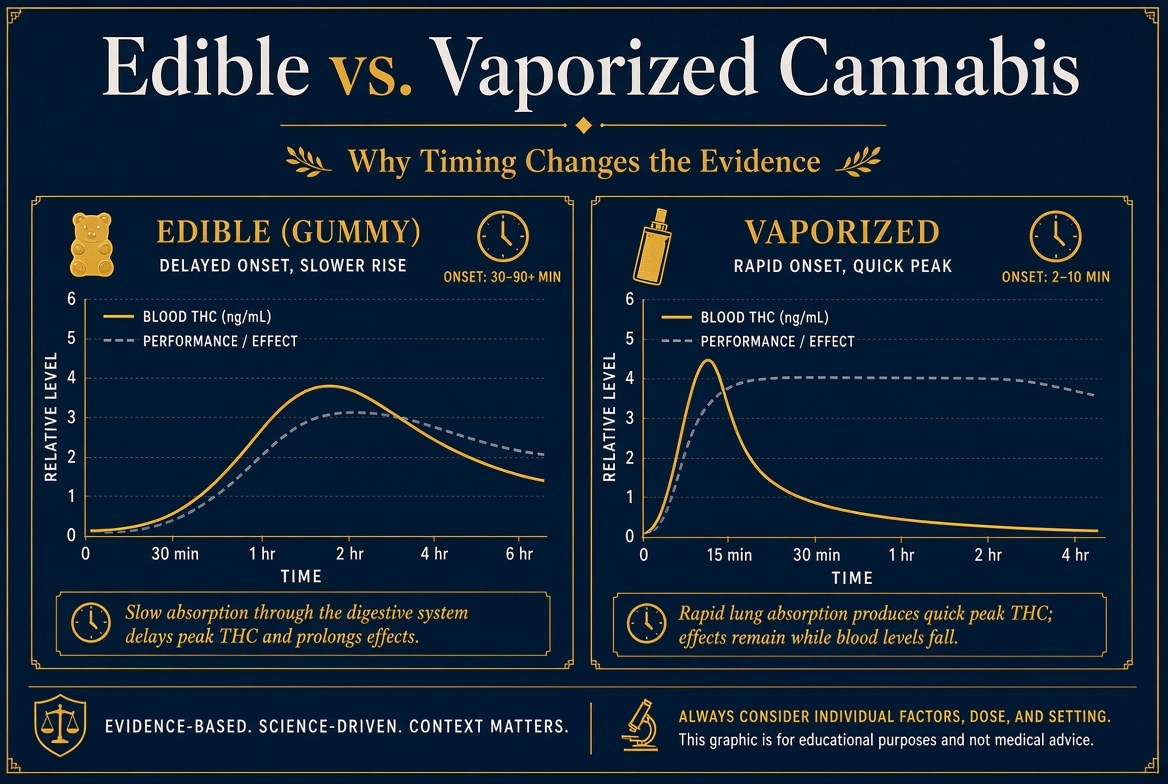
Three delta-8 THC case studies documented subjective effects and eye findings, but they did not validate HGN as a diagnostic test or establish a universal safe-driving interval. The small design supports a narrower conclusion about observed responses.
What the researchers measured
Wurz and colleagues studied three young male frequent cannabis users after ad-libitum vaporization of a delta-8 concentrate. They collected capillary blood and breath, obtained self-ratings, and assessed horizontal gaze nystagmus. Results were compared with earlier delta-9 sessions in the same participants.
The earlier and later sessions used different routes and assessment schedules. This was not a large randomized comparison with matched absorbed doses and a blinded diagnostic examiner.
Observed disappearance is not proven recovery
Subjective effects peaked early and declined; the reported HGN findings also resolved during observation. By three hours the measured signs had dissipated. No on-road test established that every driving-related function had recovered.
Blood concentrations and fitted early decline rates described the sampled pharmacokinetics. A short early half-life is not the time until all drug is eliminated, nor a direct measure of how long functional effects persist.
What would test validity require?
HGN sensitivity and specificity cannot be estimated robustly from three exposed participants without an appropriate comparison population. Other causes of eye findings, examiner reliability, and the intended decision threshold would need evaluation.
The cases caution against treating hemp-derived delta-8 as necessarily nonintoxicating. They do not establish identical risk to delta-9 across products, routes, or users. A particular driver requires documented exposure, timing, examination details, and independently assessed behavior rather than a rule derived from these three observations.
The participants were 23–25 years old. The early delta-8 decline estimates, calculated around 20 minutes after vaporization, ranged from 5.2 to 11.2 minutes. Those numbers describe an early concentration phase in these cases. They cannot be substituted for an elimination deadline, a universal detection window, or a safe waiting period.
Related reading: the separate questions in cannabis DUI evidence.
Primary research
Gregory T. Wurz; Edward Montoya; Michael W. DeGregorio. Examining impairment and kinetic patterns associated with recent use of hemp-derived Δ8-tetrahydrocannabinol: case studies. Journal of Cannabis Research (2022). DOI: 10.1186/s42238-022-00146-9.



