Cannabis After Age 65: Why a Three-Hour Simulator Result Is Not a Clearance Rule
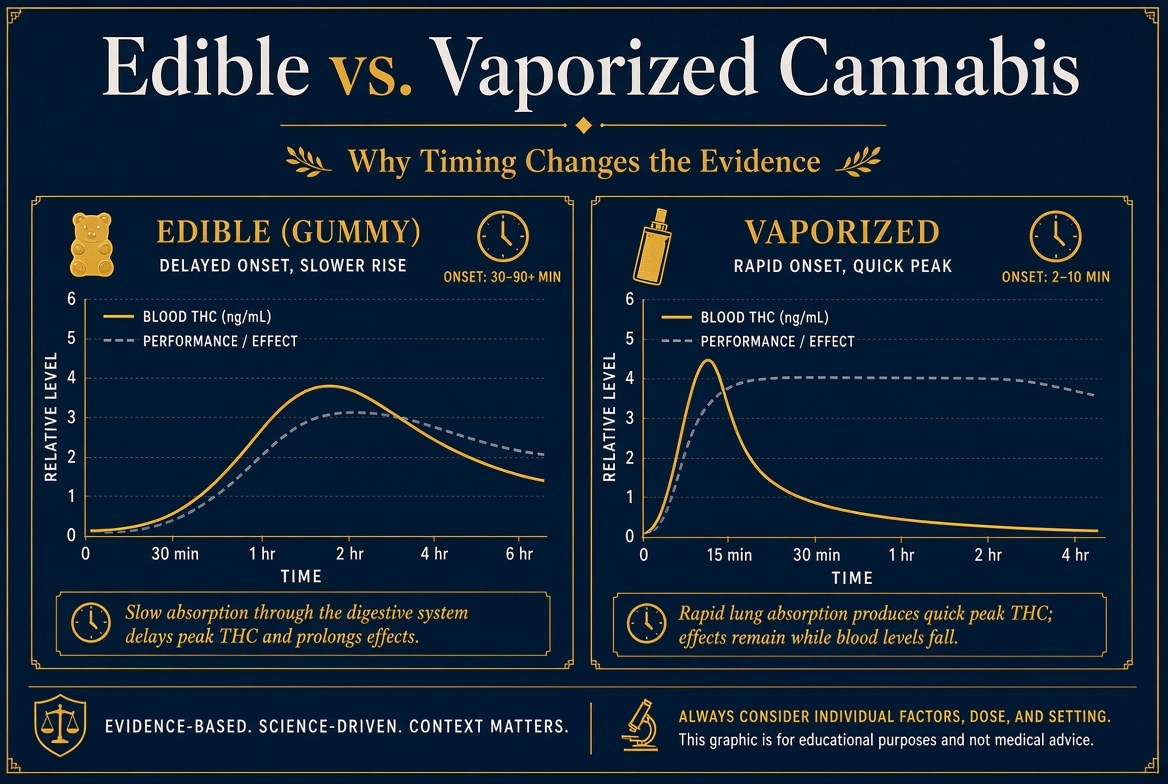
Older regular cannabis users showed increased weaving and slower driving 30 minutes after smoking their usual product. The absence of a significant group effect at three hours did not establish that every driver had recovered.
A study of established users
The cohort included 31 adults aged 65 to 79. In counterbalanced sessions they smoked their preferred legal cannabis or rested, then completed simulator assessments. Blood cannabinoids were measured alongside driving. This compared a person with their own control condition, but did not blind them to smoking versus resting.
Different outcomes followed different clocks
Lane-position variability increased and average speed decreased at 30 minutes under both ordinary and distracted driving conditions. Those treatment effects were not significant at 180 minutes. Blood THC at 30 minutes did not significantly correlate with either driving measure.
Subjective effects lasted longer, and participants remained less willing to drive at three hours. A nonsignificant simulator comparison therefore did not mean every relevant subjective and functional outcome returned to baseline.
The inference the design cannot support
Most participants were White, more than half were male, and they had established cannabis-use histories. Results cannot automatically describe cannabis-naive older adults or a different product. The authors also acknowledged limited simulator sensitivity to subtle later changes.
A recovery deadline requires evidence capable of identifying recovery in the intended individual and setting. Two post-smoking assessment times cannot map every person’s trajectory between them. In reviewing an older driver’s case, document the product, route, timing, medications and observed function rather than substituting this group result for an individualized opinion.
Related analysis
See our analysis of why route changes cannabis timing.
Primary research
Patricia Di Ciano and colleagues. Cannabis and Driving in Older Adults. JAMA Network Open, 2024. DOI: 10.1001/jamanetworkopen.2023.52233.



