Repeated Cannabis Field Tests Improved Even in the Placebo Group
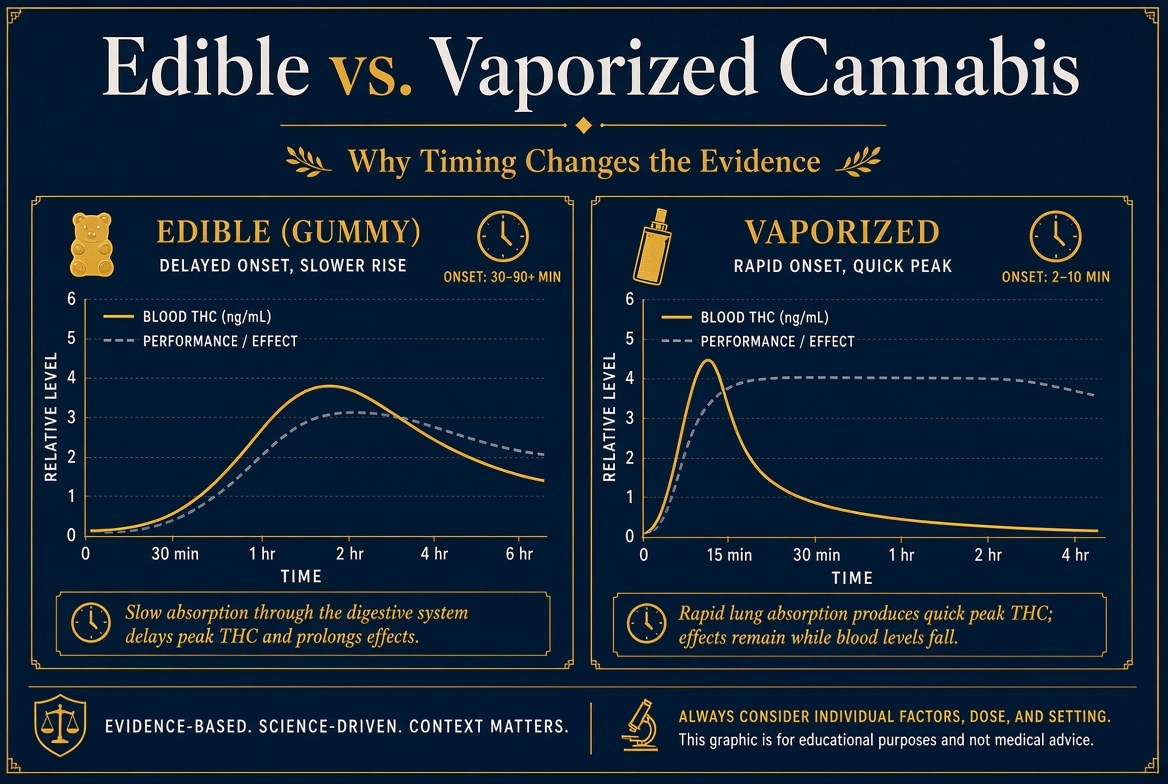
Improvement on repeated field sobriety tests cannot automatically be attributed to recovery from THC. In a randomized cannabis study, officers’ impairment classifications declined over time in both the THC and placebo groups, leaving practice and expectations as plausible contributors.
Repeated testing created two changing groups
The analysis included 184 cannabis users assigned to smoked placebo or active THC. Trained drug recognition expert instructors administered selected field tests about 70, 140, 190 and 250 minutes after smoking. The same officer evaluated a participant across the repeated sessions.
Officers were blinded to treatment assignment and did not observe simulator driving. These were selected field-test assessments and study interactions, rather than a complete drug recognition evaluation incorporating roadside driving observations and interviews.
A binary classification concealed different possibilities
The proportion classified as field-test impaired decreased in both groups. Because the slopes were similar, the authors could not separate practice effects from THC recovery using that binary outcome alone.
Total clue counts provided a more graded measure. On that measure, improvement in the THC group was greater than expected from practice alone, suggesting that the tests captured some recovery. That finding supports a narrower inference than treating every later pass as proof that a drug effect had ended.
Not every test detected the same signal
Some walking, balance and coordination outcomes differentiated THC from placebo, and selected tests were associated with simulator performance. Modified Romberg testing was not sensitive to THC exposure in this study, and pupil diameter did not significantly distinguish the groups.
Consequently, a change in a composite judgment should not be attributed to a specific physiological mechanism without examining the underlying observations. Exposure classification, field-test performance and simulator impairment remain separate outcomes.
How to interpret a repeat examination
Record the exact instructions, prior exposure to the tests, interval between sessions and whether the examiner knew earlier results. Examine component scores alongside the final judgment.
The authors identified possible practice and expectation effects, not a measured correction factor that can be subtracted from an individual’s score. This analysis also shares a parent trial with other cannabis driving publications; repeated reports do not provide independent samples. Its main contribution is showing why an observed improvement needs an explanation, rather than an automatic attribution to THC clearance.
Related: Interpreting THC concentration and impairment.
Primary research
Evaluation of Field Sobriety Tests for Identifying Drivers Under the Influence of Cannabis: A Randomized Clinical Trial. DOI: 10.1001/jamapsychiatry.2023.2345.



