Cannabis Edibles and Slower Driving: Why the Null Results Matter Too
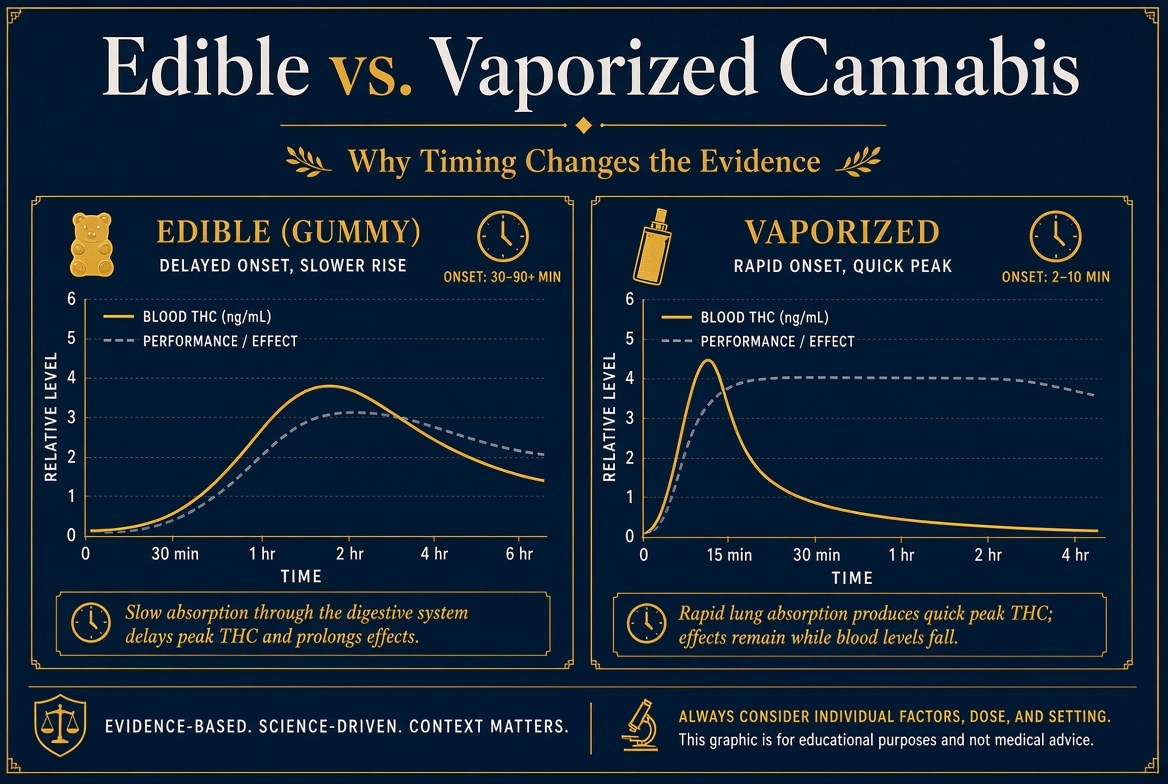
In a small edible-cannabis study, participants drove more slowly two hours after consumption, while lane weaving and several other driving measures did not change significantly. Both parts of that finding matter. It supports neither a claim that every driving skill deteriorated nor a conclusion that the edible had no effect.
What participants consumed
Zhao and colleagues studied 22 adults who brought their preferred legally purchased edible. The average consumed dose was 7.3 mg THC, with variable CBD content. Each participant completed a cannabis session and a control session in counterbalanced order, following simulator practice.
The control involved ordinary candy rather than a blinded active-placebo comparison. Participants knew which condition they received. Driving assessments occurred two, four and six hours after consumption, with blood sampling before consumption and at the two-hour point.
Separate corrected findings from nominal significance
At two hours, average speed was lower in the standard driving task. That comparison remained significant after adjustment for multiple comparisons. The corresponding speed comparison during the additional counting task did not remain significant after that adjustment.
Lane-position variability, speed variability, maximum speed and braking reaction time did not show significant treatment effects. There were too few collisions for a meaningful collision analysis. A sparse collision count therefore cannot establish a demonstrated reduction or increase in crash risk.
Blood THC rose after the edible, but its two-hour value did not significantly correlate with lane weaving or average speed. A null correlation in 22 people does not establish that concentration and performance are unrelated under every dose or testing condition.
Slowing down does not settle overall driving fitness
Reduced speed could reflect altered performance, compensatory behavior or other influences; the measured outcome alone does not prove which explanation applies to an individual. Product variability, the small sample and the absence of blinding constrain the inference.
Subjective effects and willingness to drive also followed their own time courses. The experiment does not define a universal waiting period. For a broader explanation of why administration route and sampling time matter, see edible versus vaporized cannabis evidence.
Primary research
The effect of cannabis edibles on driving and blood THC. DOI: 10.1186/s42238-024-00234-y.



