Automated Cannabis Blood Testing: Sample Preparation Can Change Free THCCOOH
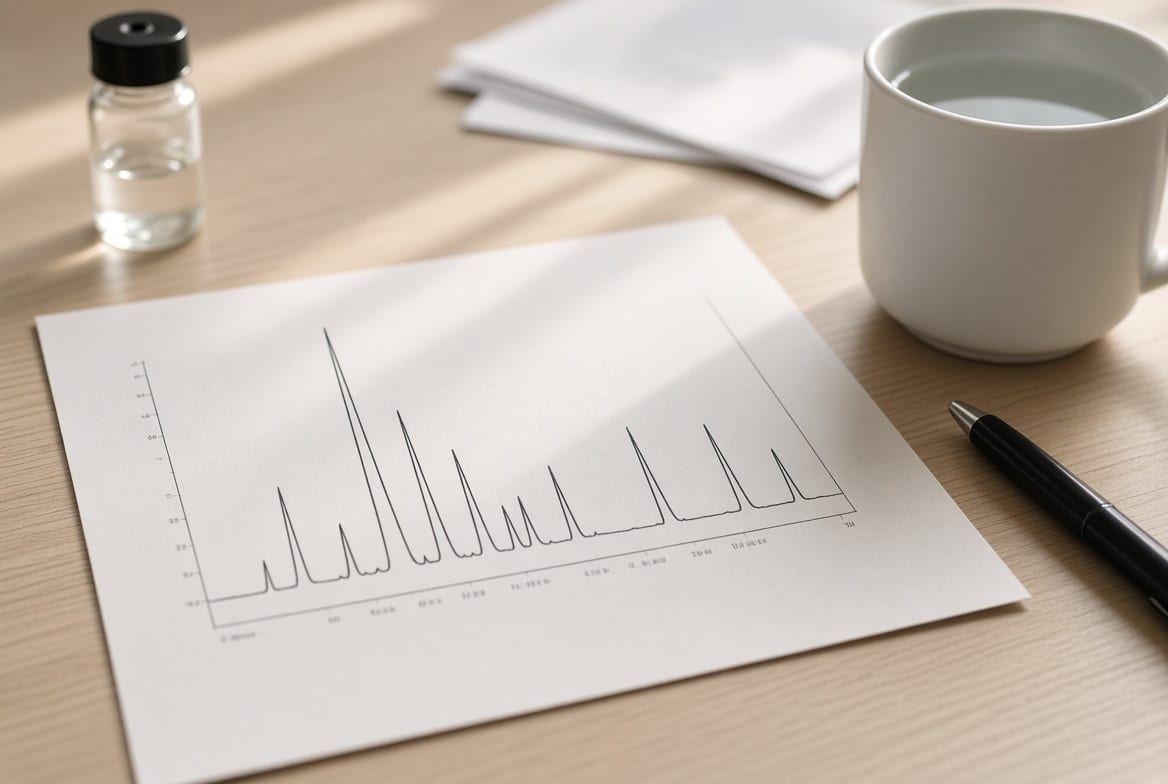
Automating a cannabis assay does not guarantee that sample preparation leaves every cannabinoid unchanged. A 2022 analytical study found that one blood-preparation procedure released substantial free THCCOOH from its glucuronide. Adding water before protein precipitation sharply reduced that effect. The distinction matters when interpreting what a reported concentration actually represents.
The experiment tested the laboratory process
Frei and colleagues developed automated solid-phase extraction coupled to gas chromatography–tandem mass spectrometry for THC, 11-hydroxy-THC, THCCOOH, CBD and CBN in whole blood and urine. This was analytical validation using biological matrices and fortified test samples, rather than a trial linking concentrations to human performance.
During development, precipitation with undiluted acetonitrile produced free THCCOOH corresponding to approximately 25% cleavage of added THCCOOH-glucuronide. Repeating measurements of extracts did not show a progressive increase that would simply explain the result as storage over the next two days.
A small preparation change had a large analytical consequence
Diluting blood with 0.25 mL water before adding 0.75 mL acetonitrile reduced cleavage to below 3%. Using only half that water volume left approximately 12.5–15% cleavage. Changes to other processing conditions had not solved the problem. These findings demonstrate why a validated preparation recipe cannot casually be replaced by a superficially similar one.
The final method provided quantitative measurements in both matrices, but the authors also reported qualifications: some higher-concentration THCCOOH and CBN tolerance intervals exceeded their predefined limits. Successful automation therefore did not erase analyte-specific validation details.
What to examine in a case file
Identify whether the result concerns free or intentionally hydrolyzed metabolite, the specimen type, and the preparation actually used. A method-development artifact does not establish that a particular laboratory result is wrong; it identifies a concrete issue to investigate through validation records and batch documentation.
Neither free THCCOOH nor the efficiency of its extraction supplies a driving-performance measurement. Our discussion of THC concentration and impairment addresses that separate inference. This study supports scrutiny of the measurement process, not a universal correction percentage for another assay.
Primary research
Priska Frei and colleagues. Drug Testing and Analysis (2022). Quantitative determination of five cannabinoids in blood and urine by gas chromatography tandem mass spectrometry applying automated on‐line solid phase extraction.



