Acetaldehyde in Blood-Alcohol Testing: What It Means
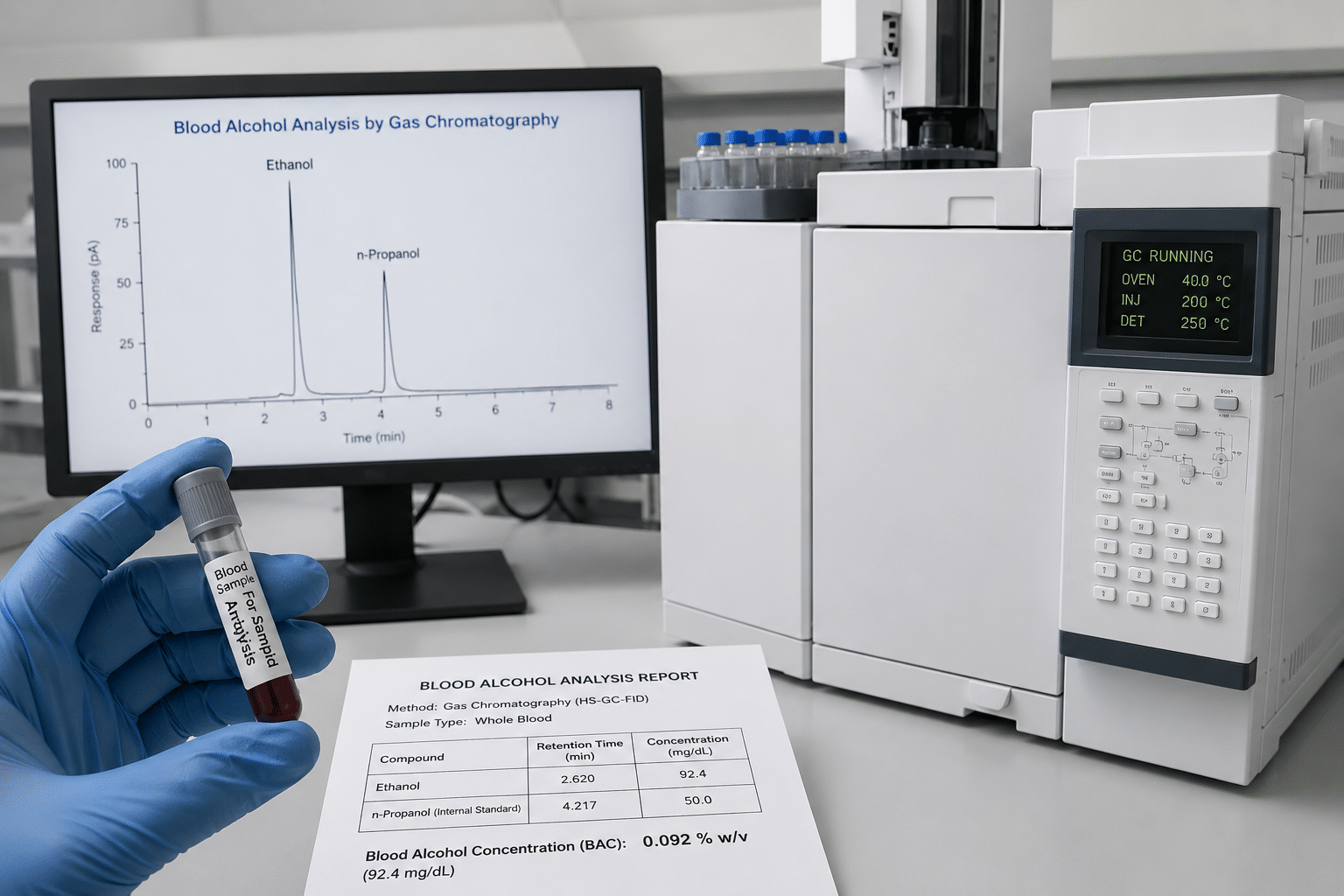
Short answer: Acetaldehyde can be detected in blood specimens, especially when decomposition, storage, or analytical conditions are relevant. Its presence does not by itself prove that ethanol formed after death, that a blood-alcohol result is false, or that fermentation occurred.
Reviewed and updated July 24, 2026.
What is acetaldehyde?
Acetaldehyde is produced when the body metabolizes ethanol, and it can also arise through chemical or microbial processes after a specimen is collected. It is volatile, reactive, and typically present at much lower concentrations than ethanol. Those features make the sampling and analytical method important.
Can a blood-alcohol test be “positive for acetaldehyde”?
A properly validated headspace gas-chromatography method can separate and identify ethanol, acetaldehyde, and other volatile compounds. A chromatographic acetaldehyde peak is not an ethanol result and should not be reported as though the two compounds were interchangeable.
Laboratories identify compounds using validated retention-time criteria, calibrators, controls, and often two columns with different selectivity. The case record should show the method, reporting threshold, specimen type, preservative, storage history, and quality-control results.
Does acetaldehyde prove postmortem ethanol production?
No. Forensic studies have found acetaldehyde in decomposed cases, but the presence or absence of acetaldehyde and other volatiles is not a definitive fingerprint of postmortem ethanol formation. Acetaldehyde may reflect metabolism before death, decomposition, oxidation during storage or analysis, microbial activity, or a combination of processes.
That is why an expert should not infer fermentation from a single compound. The conclusion must integrate the entire pattern of evidence.
Evidence used to evaluate a disputed ethanol result
- Specimen source: peripheral blood is generally preferred over central blood when available.
- Preservation and storage: sodium fluoride, container fill, seal integrity, temperature, and elapsed time can affect stability.
- Decomposition: putrefaction increases the possibility of microbial production and redistribution.
- Other specimens: vitreous humor, urine, or tissue may help test whether findings are consistent across matrices.
- Biomarkers: ethyl sulfate and related markers may add information, although no single marker answers every case.
- Other volatiles: higher alcohols and related compounds can support an interpretation only in context.
- Analytical records: chromatograms, calibrations, controls, carryover checks, and uncertainty matter.
Can microbes make ethanol in a sample?
Yes. Yeasts and bacteria can produce ethanol when suitable organisms, substrate, time, and conditions are present. Published experiments show that Candida can produce ethanol in postmortem blood, while adequate sodium fluoride can inhibit that process. But possibility is not proof that it happened in a specific case.
The related question of why microbes do not normally ferment circulating blood in a living person is explained in this microbiology and toxicology guide.
Could acetaldehyde change the measured ethanol concentration?
Under some storage or headspace conditions, ethanol may oxidize to acetaldehyde, producing a small decline in ethanol concentration. The magnitude depends on temperature, time, specimen composition, and method. An expert must evaluate whether the observed conditions could meaningfully affect the reported value instead of assuming any acetaldehyde invalidates the test.
A defensible interpretation
The strongest conclusion is usually conditional: the result is consistent or inconsistent with the laboratory record, and the evidence does or does not support a material post-collection change. Absolute statements based on acetaldehyde alone are not scientifically justified.
Primary sources
- Postmortem ethanol formation and diagnostic markers
- Acetaldehyde in decomposed cases
- Storage and headspace effects on ethanol and acetaldehyde
- Limits of volatile compounds as proof of postmortem production
- Microbial ethanol production and sodium fluoride
This article provides general forensic science information. Case interpretation requires the complete laboratory and investigative record.
For the broader analytical framework, read alcohol-testing methods and limitations.
Related reading: For related context, read Why Smart People Believe Irrational Things. Browse the Forensic Toxicology topic hub.