Eleven U.S. Top Nuclear Scientists Dead or Vanished in the last Two Years & Zero Explanations
DEAD SCIENTISTS DON’T TALK
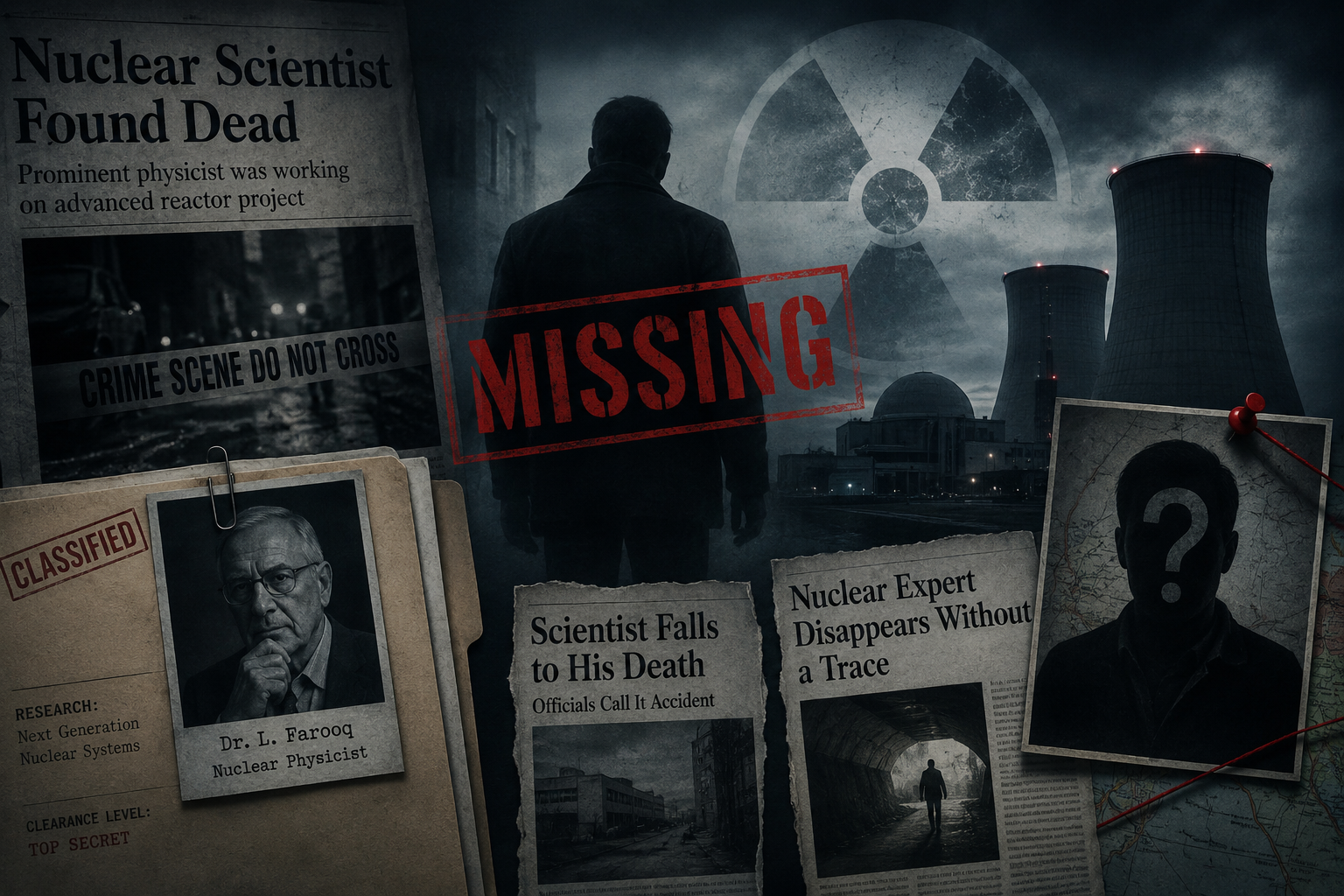
Eleven researchers. America’s most classified institutions. A federal investigation with no answers. Someone should be asking harder questions.
By Okorie Okorocha
The first thing investigators are trained to look for is not motive. It’s not method. It’s not even opportunity.
It’s pattern.
A body turns up on the Fourth of July in Los Angeles — a NASA scientist, 61 years old, a man who spent his career managing the instruments America uses to observe its own planet from space. Tragic, but these things happen. Months later, an Air Force intelligence officer dies before he can take the stand in a federal UFO whistleblower case. Unfortunate timing. Then a nuclear fusion physicist — one of the best in the world — is shot to death outside his home in Boston. An astrophysicist is gunned down at his house outside Los Angeles. A NASA aerospace engineer walks into the Angeles National Forest and never comes back. A retired Air Force general with documented ties to classified UAP research walks out of his Albuquerque home, leaves his phone, his glasses, and every device that could be used to track him on the kitchen counter, takes a revolver, and disappears.
At some point, “these things happen” stops being an answer.
We are now past that point.
The White House knows it. The FBI knows it. The House Oversight Committee knows it — which is why all three have formally opened inquiries into what officials are delicately calling a “holistic review” of eleven individuals: researchers, engineers, intelligence officers, and defense scientists, all connected to the most sensitive programs in the American national security apparatus, all dead or missing within roughly two years.
Eleven people. NASA’s Jet Propulsion Laboratory. Los Alamos National Laboratory — where the atomic bomb was born and nuclear weapons are still designed today. MIT’s fusion program. Caltech. The Kansas City National Security Campus, which manufactures components for America’s nuclear arsenal. The Air Force Research Laboratory.
No confirmed connection between the cases. No arrests in the shootings that can be linked to the victims’ work. No bodies recovered in several of the disappearances. No explanation that satisfies the most basic demand of serious inquiry: why these people, at these institutions, in this window of time?
THE CASES ON RECORD
The following is drawn from public reporting and congressional records.
Frank Maiwald • DECEASED
Principal investigator at NASA JPL overseeing major Earth-observing and space instrumentation projects. Died July 4, 2024, in Los Angeles. Age 61.
Matthew James Sullivan • DECEASED
U.S. Air Force intelligence officer. Died in 2024, weeks before he was scheduled to testify in federal court on UAP matters. Age 39.
Joshua LeBlanc • DECEASED
Died July 2025. Institutional details remain thin in public reporting — which is itself a detail worth noting.
Nuno Loureiro • DECEASED
Director of MIT’s Plasma Science and Fusion Center; professor of nuclear science and engineering. Shot and killed near his Boston home, December 2025. The same shooter killed two Brown University students in the same incident. Age 47.
Carl Grillmair • DECEASED
Caltech astrophysicist and NASA collaborator, recognized for his work in exoplanetary water detection. Shot and killed at his home outside Los Angeles, February 2026. A suspect was arrested. No motive connected to his work has been identified. Age 67.
Jason Thomas • DECEASED
Director at Novartis focused on cancer treatment research. Vanished from Wakefield, Massachusetts in December 2025. His body was recovered from a lake three months later. No evidence of foul play — a phrase that, in cases like this, should be read carefully, not reassuringly.
Monica Reza • MISSING
Director of NASA JPL’s Materials Processing Group; aerospace engineer. Vanished hiking in the Angeles National Forest, June 2025. An extensive search was conducted. She has not been found. Age 60.
William Neil McCasland • MISSING
Retired Air Force Major General with documented ties to UAP research programs, as reflected in the 2016 Podesta emails. Left his Albuquerque home on February 27, 2026, leaving behind his phone, glasses, and all wearable devices. He took a .38-caliber revolver. The FBI is actively involved.
Anthony Chavez • MISSING
Employee at Los Alamos National Laboratory. Disappeared in New Mexico, May 2025.
Melissa Casias • MISSING
Employee at Los Alamos National Laboratory. Last seen on a highway near Talpa, New Mexico, June 2025. Age 53.
Steven Garcia • MISSING
Employed at the Kansas City National Security Campus, New Mexico division, which produces components for nuclear weapons. Disappeared August 2025, reportedly having left home with a firearm.
WHAT WE KNOW. WHAT WE DON’T.
The investigative standard I apply in every case — whether a DUID prosecution or a federal civil rights matter — is consistent: distinguish sharply between what evidence shows and what it suggests.
What the evidence shows is a cluster of deaths and disappearances concentrated among individuals with classified or highly sensitive institutional affiliations. What it does not yet show is a common cause, a common actor, or deliberate coordination of any kind.
That distinction is not a technicality. It is the difference between responsible analysis and reckless inference. Tragic events do occur in parallel without sinister connection. The three New Mexico disappearances — Chavez, Casias, and Garcia — unfolded within four months of one another, yet officials have noted that none of their roles involved direct scientific research, and at least two reportedly left home with firearms, suggesting the possibility of personal crisis rather than external threat.
The institutional affiliations are real. The clearance levels were real. The deaths and disappearances are real. What remains, for now, is an open investigation.
At the same time, dismissing this cluster as statistical noise would be intellectually dishonest. Several of these individuals held or previously held security clearances at the highest levels. Several were connected — directly or through institutional overlap — to nuclear weapons research, advanced aerospace systems, or UAP-adjacent programs. The death of Nuno Loureiro, one of the world’s leading nuclear fusion physicists, shot outside his own home, is not background data. It is the violent, unexplained loss of irreplaceable scientific expertise.
THE INSTITUTIONAL GEOGRAPHY OF CONCERN
Consider the institutional map. NASA’s Jet Propulsion Laboratory accounts for at least three of the eleven cases. Los Alamos — where American nuclear weapons have been designed since the Manhattan Project — accounts for two more. MIT’s fusion program, Caltech, the Air Force Research Laboratory, and the Kansas City National Security Campus comprise an institutional roster that reads less like coincidence and more like a roster of the places where this country concentrates its most consequential scientific talent.
That same concentration, however, is precisely why credible investigators resist premature conclusions. Thousands of people work at these institutions. Some will suffer tragic ends through entirely unrelated circumstances. The threshold question — the one the FBI and the White House review must ultimately answer — is whether the rate and distribution of these events is statistically anomalous. We do not yet have that answer.
WHY THIS MATTERS BEYOND THE HEADLINES
I have spent my career at the intersection of law and science: testifying on the pharmacokinetics of controlled substances, the reliability of breathalyzer instruments, the biochemistry of impairment. In each setting, the role is the same — translate complex technical reality into a form a court can act on with confidence.
That same discipline is required here. The public is not served by conspiracy theorizing that outruns the facts. Nor is it served by institutional silence that treats transparency as a security liability. The scientists and officials on this list were, in large part, public servants — funded by taxpayer dollars, working on programs that, whatever their classification status, bear directly on national security. Their families deserve answers. The public deserves accountability.
The federal investigation is the right first step. The House Oversight Committee’s inquiry is the right legislative response. What remains to be seen is whether those processes will operate with the rigor this moment demands — or whether, as too often happens in matters touching classified programs, they will conclude with a quiet report that tells the American people nothing.
A NOTE ON INTERNATIONAL CONTEXT
These events do not unfold in a vacuum. In June 2025, Israeli forces killed Iranian nuclear engineering professor Issar Tabatabaei Ghomsheh and his wife in an airstrike — a targeted killing carried out in the acknowledged context of Israel’s sustained campaign against Iran’s nuclear program. Covert operations designed to eliminate scientists with weapons-relevant expertise are not a relic of Cold War fiction. They are documented, ongoing geopolitical reality.
That context does not mean the American cases reflect a foreign intelligence operation. But it would be analytically negligent to exclude the possibility from any serious inquiry. The FBI is institutionally equipped to investigate that question. Whether it will do so with full public transparency is, frankly, another matter.
Eleven people. Two years. The clock is running.
Okorie Okorocha is an attorney and forensic toxicologist based in El Segundo, California.