Misconduct of Judge Robert S. Draper (Part two)-“You better be able to f*** better than you can type.” Yes, he actually said it!
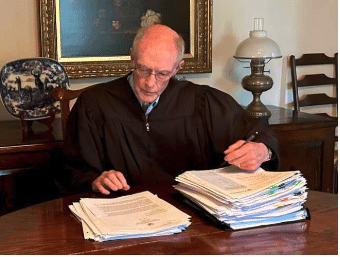
This is a discussion that Judge Draper attempted to force upon a female African-American attorney with 40 years of experience:
Judge Draper: And I use the term that my wife says is not politically acceptable. I think they are politically acceptable because I use terms like “coal black” and “light brown” because I don’t think those are bad terms.
Judge Draper: Have you read the Robert Caro books about Lyndon Johnson?
MS. BROWN: I don’t know if I have.
Judge Draper: This is not part of my decision at all. I’m just telling you. The reason that the South was able to stop civil rights for so long was the Southern senators who were against miscegenation, they called it. You know what “miscegenation” is?
Note: According to Merriam Webster’s dictionary (2026), “Miscegenation” refers to a mixture of races, especially marriage, cohabitation, or sexual intercourse between a white person and a member of another race. The word “miscegenation” is associated especially with historical laws against interracial marriage. In the United States, such laws were declared unconstitutional in 1967.
MS. BROWN: I’m fully aware of that, your Honor.
Judge Draper: Of course you are. That’s my point. Both of the… when I went to Cal… and I’m sorry if I’m boring you, but when I went to Cal, my wife and I, we had seven really good Black players all lined up at split end. And the idea of one of them playing quarterback would have been crazy. Doug Williams – –
MS. BROWN: I remember. I was at that game.
Judge Draper: The Doug Williams game?
MS. BROWN: Uh-huh.
Judge Draper: You’re that old?
MS. BROWN: I’m that old. Just, you know, good skin.
Judge Draper: Both of the quarterbacks, who were spectacular quarterbacks, were the product of miscegenation. And the South would have had a lot better football team if the Southern senators had not…
MS. BROWN: Look, I am here. And you obviously see who I am.
Judge Draper: I know who you are.
Later in the hearing, Ms. Brown inquired as follows:
MS. BROWN: Why did you think Doug Williams was relevant to this case?
Judge Draper: Well, actually, it wasn’t. It was the two quarter – – the super –quarterbacks in the super bowl.
MS. BROWN: Right.
Judge Draper: And it has nothing to do with the case really. It has to do with what I feel society has come to, and it’s a good thing.
MS. BROWN: And what has society come to that—I mean, is there any relation to the case? I mean, you mentioned society has come to—what—having mixed Black men. I mean, the football players were mixed race?
Judge Draper: Yeah.
MS. BROWN: I guess I’m curious why that is—why that has some meaning for this case.
Judge Draper: You know, it doesn’t have meaning for this case except that we’re all a part of the world. We’re all a part of our United States. And I’m very proud of our country. I’m proud of how 75 percent of everybody were in favor of Black Lives Matter right after [George] Floyd was—was done. Okay? Went back to the normal political but it—it doesn’t have anything to do with our case. [¶] We have two plaintiffs [sic] who couldn’t say there was a racial issue in this case because they were both very Black people. Beautiful people, successful people, people I’m proud of. That’s—that’s—so, no. To answer your first question is I can’t do any better than that.
MS. BROWN: Okay. And so…
Judge Draper: It’s not biased me one way or the other in this case.
Ms. Brown then asked Judge Draper about the relevance of the remarks he had made about race and the South.
MS. BROWN: And you also mentioned the South. How did – – does the South, when you mention the South and how people were not accepting of Black people in the South, or mixed race people in the South, Black and White people, how does that – – does that have any impact on this case – –
Judge Draper: Not the case.
MS. BROWN: – – or on your thinking about it?
Judge Draper: No, same thing. He’s—I thought maybe you had read—I think he’s stuck on Freedy [sic], Kairos [sic], Lyndon Johnson, she told you—it’s supposed to be one more. And that was all about who—who was it that got the Civil Rights movement through—the Act through? Lyndon Johnson who had fought it for years. [¶] Kennedy could not have gotten that—that through. The reason Lyndon Johnson could get it through was he knew how to not get it through. He knew how the Southern senators used to talk in all those years, and he—by the way, my son-in-law is from Tennessee. I asked him, why do people in the South hate Lyndon Johnson? He was part—he was one—he was from Texas. That exact reason. He was our–he was our guy, and he got it through. [¶] I’m just sharing a little history with you. When you get older, you like to share history. It had absolutely nothing to do with my decision. There was no racial issue in this case.
MS. BROWN: No. That’s why I was asking the question.
According to the Counsel on Judicial Performance, the entity that is charged with regulating judges stated as follows:
Your comments at the February 15 hearing, when considered individually and when considered as a whole, reflected bias, prejudice, or harassment on the basis of race, national origin, and/or ethnicity, or created an appearance thereof.
Your conduct violated canons 1, 2, 2A, 3, 3B(4), and 3B(5) of the Code of Judicial Ethics. In the alternative, your conduct constitutes evidence of a disability that seriously interferes with the performance of your duties and is, or is likely to become, permanent.
During the February 15, 2023 hearing in Odom, and during the Odom trial, you engaged in a pattern of conduct that reflected sexual harassment or bias, prejudice, or harassment on the basis of gender and/or sex, or created an appearance thereof.
For example, at the February 15 hearing, you used demeaning language when referring to adult women. Seemingly in reference to LACCD’s obligation to its students, you said to Ms. Brown, “You think it might be something that a reasonable employer trying to protect the little girls there that are going to be under somebody’s care . . . .”
You also made several remarks suggesting that LACCD needed to be punished for failing to protect “little girls” like your teenaged granddaughter, who had (according to you) recently been touring colleges, even though the issue in the case was whether LACCD had failed to protect Dr. Odom, a professor. Referring to LACCD student Rachel Gonzalez—an adult who testified at trial about Dr. Irvin and others harassing her and other female students—you said:
So when there was testimony, not from Dr. Irvin, but from other people—about this poor little girl, I saw her there. [¶] . . . [¶] Poor little—Ms. Gonzalez. She looked like—except that she was Hispanic, she could be my granddaughter.
In addition, you made other inappropriate comments that were gender-based, sex-based, or created an appearance thereof. For example, during the afternoon session of the February 15, 2023 hearing, while you were discussing a settlement that you had helped to negotiate between parties in an unrelated case, Ms. Brown looked at her watch. You asked her: “You got a date or something, Ms. Brown?” Ms. Brown responded: “No, no, no. I was just—no.”
At the end of the February 15 hearing, after you stated your ruling denying the two posttrial motions, the following exchange occurred.
Judge Draper: Okay. So I am – – [¶] Ms. Brown, I think I’m done. I think your next step is the Court of Appeal. I have no more jurisdiction in this case. If you want to come and see me tomorrow, I would love to see you.
MS. BROWN: I’m not – – I’m not sure – – like, you denied the motion outright. I don’t know – – what’s the purpose for coming tomorrow?
Judge Draper: I want to talk to you. It’s – – It’s – – for human beings, about this case.
MS. BROWN: Can we do it now?
Judge Draper: In chambers? Sure.
MS. BROWN: Yeah. I’d prefer to do that so I can go home as opposed to…
In chambers, per the counsel on Judicial performance:
His honor engaged in this conduct with the African-American female attorney, amongst others.
You told the parties that you had one more unrelated matter to handle and asked them to return in about an hour to speak with you in chambers. A short time later, Ms. Brown, Ms. Medina, Ms. Gallagher, and Ms. Aceves met with you, in chambers, to discuss the case. During the in-chambers discussion, you relayed a story to them about male attorneys at a law firm sleeping with female secretaries and telling the secretaries, “You better be able to f*** better than you can type.”